![PortStrategy[GreenPort]](https://www.portstrategy.com/wp-content/uploads/2026/09/PortStrategyGreenPort.svg)




GREAT EXPECTATIONS – THE ROBERTS BANK CHRONICLES
Roberts Bank2 remains Vancouver Fraser Port Authority’s preferred option to add capacity.AJ Keyes assesses the latest position and looks at recent developments at the port.
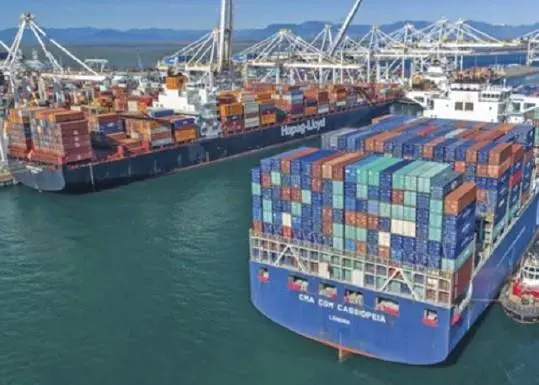
The expansion to Roberts Bank in Vancouver (BC) has long been the preferred option of the Vancouver Fraser Port Authority to meet future container capacity demand.
There is certainly a need for more container space at the port, which has successfully grown its throughput in recent years. At the end of 2014, total container traffic was 2.91 million TEU, which had risen to 3.40 million in 2018, reflecting annual growth of 4.0%.
The trend has continued into 2019, with year-to-date August data confirming that the 2018 total of almost 2.21 million TEU had risen by over 3.8% to reach 2.29 million TEU.
Vancouver also benefits from good volumes of loaded export cargo returning to Asia, volumes other western seaboard ports do not handle. For the year-to-date August 2018 and 2019 position, loaded exports represented 33% of total port handling.
This position reflects that containers are arriving with commodities such as electronics, food, clothing and consumer goods but leaving with agricultural goods, lumber and forest products.
It is a fact not lost on President and CEO of the Vancouver Fraser Port Authority, Robin Silvester. “This year’s record mid-year cargo volumes reflect what continues to be two of the Port of Vancouver’s greatest strengths—its broad global reach and ability to accommodate the most diversified range of cargo of any port in North America,” he confirmed, adding, “ While Canada is certainly not exempt from the challenges impacting global trade, the diverse range of trading partners and cargo handled through the Port of Vancouver ensures the entire port remains resilient, despite variations in any one sector or commodity.”
Moving forward, the port authority remains determined to expand the Roberts Bank facility. Yet this is not a new idea, with planning underway for nearly a decade, and it certainly continues to divide opinion.
In July 2019, President and CEO of the BC Chamber of Commerce, Val Litwin, stated that “ensuring RBT2 moves forward will guarantee local companies have competitive access to key markets around the world that will help grow their businesses and create jobs for Canadians,” while also adding that “the Port of Vancouver generates nearly $12 billion in national GDP every year through its facilitation of trade with more than 170 world markets.
Failure to plan infrastructure accordingly would undermine Canada’s ability to expand trade with Asia and diversify its trading partners.” This view is endorsed by Anita Huberman, CEO of the Surrey Board of Trade who said that without the expansion, by the mid- 2020s, “Shippers would be faced to slow and divert cargo to other ports along the US coast, driving up costs for importers, exporters and, ultimately, Canadian consumers.”
However, there is opposition, especially from within the Port of Vancouver directly. GCT Deltaport, which operates the existing facility at Roberts Bank, put forward its solution involving development of “Deltaport 4.”
The project would increase terminal capacity by 2 million TEU per annum to 4.4 million TEU annually and expand the footprint to 141ha from the current 85ha. If construction commenced in mid-2024, operations could then start in early 2029 – and all at a cost of C$1.0-C41.6 billion.
However, the Vancouver Fraser Port Authority has rejected this proposition, instead preferring to pursue Deltaport 2, much to the likely frustration of GCT President and CEO, Doron Grosman, who was quoted at the time as saying, “You don’t need both projects at the same time. If ours goes forward, then the next logical thing would be for theirs (port authority) to follow in 20 to 25 years, roughly.”
GCT is currently pushing for the federal review panel to halt the Roberts Bank 2 project, while the Port Authority maintains its commitment. The threat here is clear, whatever the outcome. Vancouver needs to resolve its expansion issues and get building. The longer it waits, the longer its utilisation rises and the threat of congestion appears.

Related Articles
 EXPANSION & DEVELOPMENT
 EXPANSION & DEVELOPMENT
 PORT & TERMINAL NEWS