![PortStrategy[GreenPort]](https://www.portstrategy.com/wp-content/uploads/2026/09/PortStrategyGreenPort.svg)

Local Support National Success
US West Coast ports agree that they can only tackle the many pressing issues facing them if they engage with the community, and get their message across beyond the confines of the port, as David Foxwell explains.
Sam Ruda, the Port of Portland’s marine director, tells Port Strategy that, in his view, there are four major challenges each US West Coast port faces, and says he believes ports need to engage with their local and regional communities to work on the most important – environmental issues, developing new infrastructure, and security.
“The first of these challenges is managing the political, environmental, economic, and community tensions that come with competing visions for waterfront development. The second is translating ports’ economic impact into a more tangible local benefit to the broader community.
“This point is really a mandate of the first challenge, but one that has become a substantial challenge in its own right. Reaching local and regional stakeholders with your message about the role a public port plays in creating and sustaining jobs and economic growth has become more important and more difficult.”
The third major issue highlighted by Mr Ruda is infrastructure planning, including mainline rail access. The ports that best manage the complexities involved in leveraging rail and creating capacity at their terminals and supporting infrastructure – roads, waterways, and industrial property – will be in the best position to handle projected trade growth, he believes.
Last, but not least, is delivering and managing environmentally responsible growth. “A number of pressures – from legacy environmental issues to the tremendous growth we’ve seen in the size and scale of port operations – will continue to require West Coast ports to take leadership positions on environmental issues,” says Mr Ruda.
Security issues are, of course, also increasingly important to West Coast ports, and as Mr Ruda explains, like other West Coast ports, Port of Portland has several initiatives under way. “Organisationally, we have centralised security and public safety under one senior manager.Thus, airport and marine security are under the same management structure. The port has hired a recently retired US Coast Guard commander to lead our marine security team,and we are currently implementing a security project associated with the federal Port Security Round 5 grant funding.
“We do not view security and public safety as being in conflict,” he continues. “Our approach is similar to our approach on environmental management – we apply a ‘systematic’approach so as to integrate security into the daily operation and tenant interface.”
At the Port of Long Beach, assistant director of communications Art Wong also highlights some ongoing security initiatives.Working closely with the US Coast Guard and Customs to improve security is key, says Mr Wong, noting that Port of Long Beach has installed surveillance cameras, “and we’ll be adding more”. Radiation monitors have been added at the truck gates, and the port now has a dive team to monitor the water.
In September, the US House of Representatives overwhelmingly passed the bipartisan Security and Accountability for Every (SAFE) Port Act, a bill widely considered to be the most comprehensive port security legislation to come before Congress in years, and one that will create a dedicated multi-year funding stream for port security projects and direct the Homeland Security Secretary to develop a strategy for cargo and maritime security, including a plan for resumption of trade in the event of an attack at a port.
The legislation establishes security standards for all cargo containers entering the US, and authorises the Container Security Initiative and the Customs-Trade Partnership against Terrorism programs. It also authorises the Domestic Nuclear Detection Office and the Directorate for Policy, Planning, and International Affairs within the Homeland Security Department, and requires name checks against terrorist and immigration watch lists of all individuals in secure port areas.
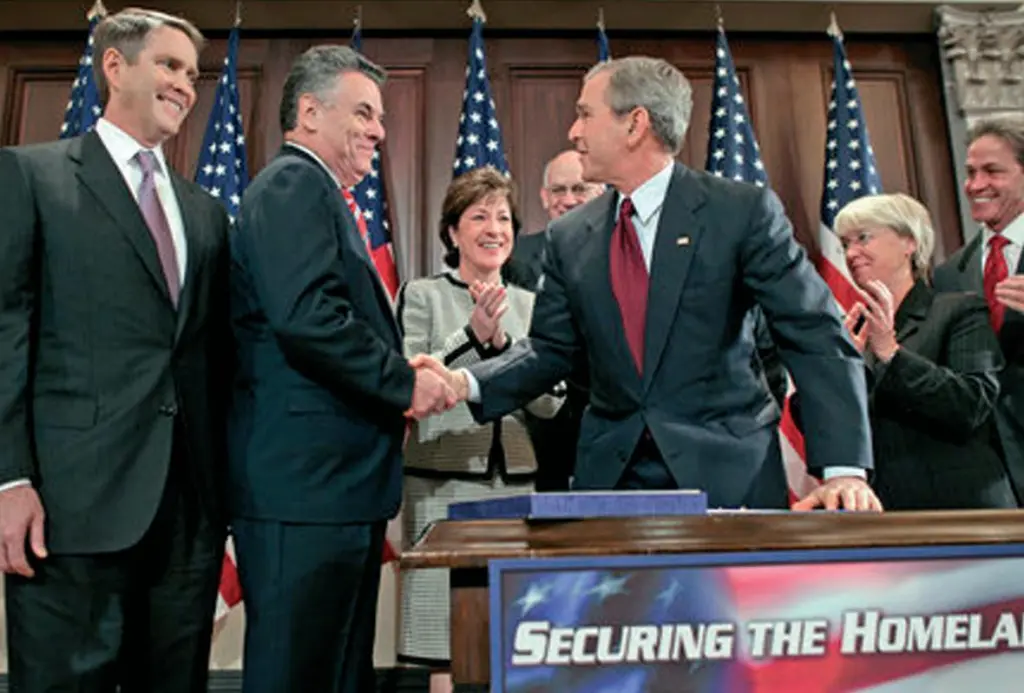
The legislation has been welcomed by West Coast ports, a number of whom have been identified as potential targets for terrorism by the US authorities. John Wolfe, deputy executive director at the Port of Tacoma, notes that the bill, which was signed by President Bush in mid-October, calls for $400m in federal Port Security Grant funding for each of the next five years to help increase security in the maritime transportation system.
“We are pleased that the President signed the SAFE Port Act, and we applaud the leadership of our Congressional delegation, particularly the work of Senator Patty Murray and Senator Maria Cantwell,” said Mr Wolfe, shortly after the Bill was signed by the President, although he noted that “while the SAFE Port Act represents a tangible step toward full cargo visibility and security,more must be done to keep our ports and communities safe”.
Port of Tacoma director of security Ramon Ortiz says the SAFE Port Act “marks a new era” in protecting the US interests and commerce.”It provides real changes in the areas of port security grants, which if properly funded, will more than double authorised resources for each of the fiscal years 2007 through 2011.” Security and environmental issues may be at the top of the list of West Coast ports’ priorities, but even after the passage of the SAFE Port Act and recent ‘green’ initiatives, more needs to be done, say West Coast ports, particularly to find acceptable ways to pay for security measures.
“The SAFE Port Act is a significant leap forward in security investments for ports,” says Mr Wolfe, “however, this funding authorisation alone is still below what ports need annually to meet all mandated security infrastructure and security operations requirements.”
Coincidentally, in September, California Governor Arnold Schwarzenegger vetoed a bill that would have imposed a tax of $30 per teu on containers passing through the ports of Los Angeles and Long Beach. State Senate Bill 927 would have imposed the container tax in order to fund undefined port security, clean air and transportation projects.The bill aimed to extract more than $500m a year from shippers on top of existing, private-sector charges.
“The Governor pointed out that the measure as passed by the state legislature was unfocused, discriminatory, and misguided. Other than that, he found it to be laudable,” said one legal source in the US, noting that a coalition of organisations had fought a concerted campaign against the proposed bill, submitting a formal request to the Governor asking him to veto it, and initiating a grassroots campaign to engage Californians in order to help secure the Governor’s veto and avert what was described as “the bill’s economic burden on industry”.
Among the positions presented to the Governor, many emphasised that legal experts maintain that container taxes constitute an unconstitutional tax on foreign and interstate commerce. In fact, other international cargo and transportation fees have already been struck down as unconstitutional impediments to interstate commerce. “The new container tax, on top of existing infrastructure fees, would substantially increase the cost of moving goods through the ports of Los Angeles and Long Beach.
This added cost would put California’s ports at a competitive disadvantage, and would have forced shippers to seek alternative container ports in other states,” claims one of the organisations lobbying against the bill. Senate Bill 927 may have been described by Governor Schwarzenegger as “flawed in its construction”, and, as he also noted, the tax would have applied to two ports only, and applies only to goods shipped in containers, ignoring all other forms of shipping and ports of entry, but Senator Alan
Lowenthal, who proposed the bill, has already said that he will introduce it again next year. Senator Lowenthal,a former Long Beach City Council member, has been trying for two years to create a Bill that would charge shippers for containers going through the ports. “I’m meeting with interested stakeholders, and we definitely will be coming back with something,” Senator Lowenthal said in the aftermath of Schwarzenegger’s decision, claiming that “we had a lot of support in the Governor’s office, but we knew it wasn’t going to happen this year”.
Related Articles
 EXPANSION & DEVELOPMENT
 PORT & TERMINAL NEWS
 PORT & TERMINAL NEWS