![PortStrategy[GreenPort]](https://www.portstrategy.com/wp-content/uploads/2026/09/PortStrategyGreenPort.svg)

San Antonio megaproject
Port stakeholders want to see more momentum behind the San Antonio new port Megaproject as a path to fending off new competition. Rob Ward reports
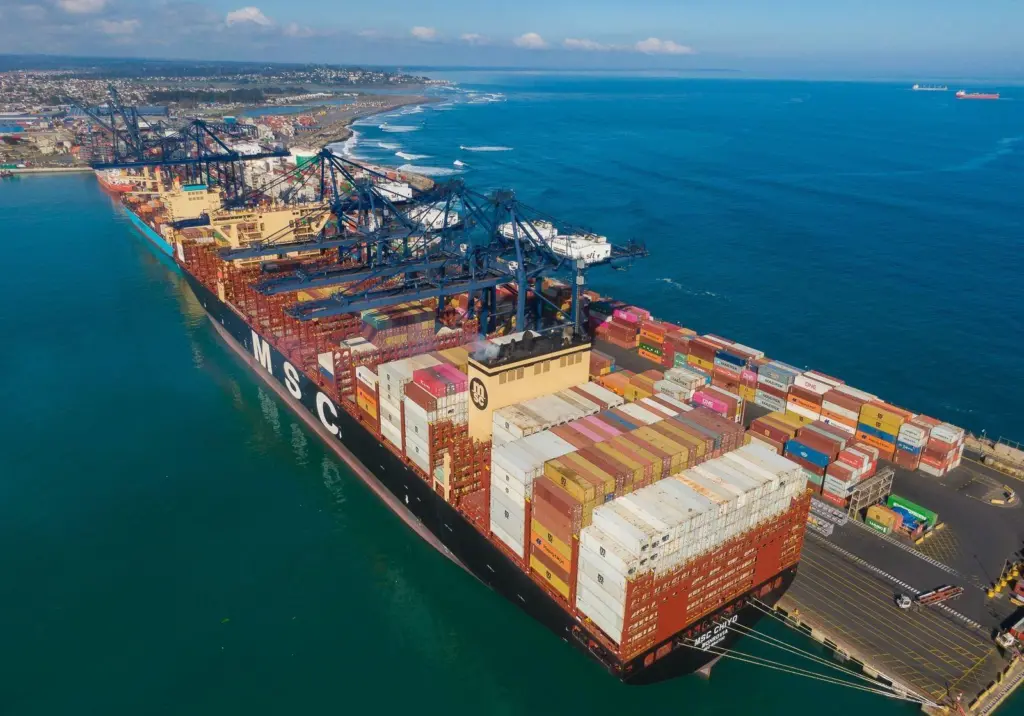
In an unprecedented manoeuvre stake holders in the Chilean port of San Antonio are making a direct appeal to the South American country’s president, Gabriel Boric, to speed up the “Puerto Exterior [Outerport] Megaproject” that will transform the port’s current capacity, of 1.6m TEU per annum, up to 6m TEU, at a cost of around US$4BN, up from the US$3.5 billion that was estimated three years ago.
The “Megaproject”- which will include two new piers, each 1730m long – has been a long time in the making and shippers and port users in San Antonio and its hinterland – which includes the country’s capital Santiago de Chile, some 75 miles and 90 minutes away up the mountain side – are getting fed up with seeing their logistics and business plans emasculated for the lack of infrastructure in San Antonio.
Leading the charge to quicken the process is Juan Armando Vicuña, President of the Cámara Chilena de la Construcción, (or Chilean Chamber for Construction) who button-holed Boric during an industry gathering last month and pushed home the point, backed up by the entire ports sector, that Chile needs to act immediately if it is to preserve the number of direct international liner calls it receives today (predominantly to San Antonio), rather than be relegated to the status of a pure transshipment country.
This is particularly relevant because lurking on the horizon, and forming a serious threat to the Chilean ports scene, is the imminent opening of the Peruvian port of Chancay which, together with impressive expansion plans at the two terminals handling containers in nearby Callao (DP World Callao APMT Callao), will very likely form a Hub Cluster that will serve the entire West Coast of South America (WCSA). Chancay has been the dream, for many years, of Chinese giants Cosco Shipping and the US$3.6BN project is set to begin operations this November. Port Strategy readers are already aware (see last edition) that the commercial departments of both APMT Callao and DP World Callao have been targeting transshipment cargoes from Chile for more than a year now, to the detriment of several Chilean ports, including Valparaiso, Iquique and Antofagasta as well as San Antonio.
FUNDAMENTAL STEP
“Building the extension in San Antonio is a fundamental step to promote international trade and export activity, which is why, with the Regional Chamber of Valparaíso [which includes the ports of Valparaiso and San Antonio], we consider it a priority to accelerate the construction of the Outer Port of San Antonio. The country urgently needs it,” argues the national president of the CCC. He calls for President Boric to declare the “Puerto Exterior Megaproject” a special “Presidential Priority” and to help San Antonio obtain the Environmental Qualification Resolution, necessary to move the project forward.
Simon Mackenzie, President of Asonave, the Chilean Shipagents Association, told Port Strategy that his organisation, has also been lobbying the government for improvements in infrastructure but feels that Boric and his ministers have other priorities.
“The CCC is worried about the slowdown in public works because the government is showing little enthusiasm in transport investment,” states Mackenzie. “Boric’s Socialist government is just not Pro-Investment as it is more focused on Social Matters and this is holding back port expansion projects, in Valparaiso as well as San Antonio.”
He points out that the “Green and Environmental Lobby” was also responsible for the delays in San Antonio, and an ailing Chilean economy did not help either, in that there was less money available for investments. STI and DP World San Antonio, the two operators in the port, have both suffered reductions in container numbers post Covid, although both are sailing very close to terminal capacities.
“These environmental studies have been ongoing for nearly five years now with very little progress and so the ports and shipping community in Chile is very worried about Chancay as we may eventually become just a feeder destination,” adds the veteran executive.
Boric’s “political” response to the lobbying overtures are as follows:
“The Outer Port of San Antonio is moving forward with an advisory council to promote its management,” said Chile’s President. “Also there needs to be an agreement between the community, the port company and the authorities so that some areas in the Ojos de Mar [the planned area for the port expansion] are considered an urban wetland and that this does not prevent the creation or expansion of the Outer Port. The tremendous challenge that we have in Chile is to reconcile development and construction with the protection of the environment.”
Boric, at just 38, one of the youngest leaders of any country in the world, says his government is developing a National Port Policy, and he also suggests that the Chilean, Latin American and international “banks” might want to lend a hand in providing funding for the key project, as well as Santiago.
However, despite all the delays and pessimism Eduardo Abedrapo, President of the Empresa Portuaria San Antonio (EPSA, the port authroity for San Antonio) said that a new timetable has been set for the all-important new breakwater and the initial works will begin during the second half of 2025, along with capital dredging. He notes that 55 technical studies have been carried out and that the tender documents will be released once the Environmental Licenses are granted and the winners of the overall project, which is expected to take 10 years to complete, will be announced.
“We invited Chilean and foreign companies to declare an interest in the project and we had 70 European executives turn up,” the EPSA president told local journalists. Apparently, most of these were from Spain.
It is understood that EPSA can fund the breakwater from its own funds, without recourse to government funding.
One veteran port consultant, based in Santiago, notes that although the Chilean governments, both local and federal, have been guilty of various “political showboating” and delays have occurred since the Presidential days of Michelle Bachelet (2006-10 and 2014-18) the machinations of shipping lines and port operators in the “Callao and Chancay Cluster” are “to a large degree outside the sphere of influence of Chilean players,” and they are free to turn that entrepot into a ‘Hub for the WCSA. “However, having said that, the very fact that Santiago has a sizeable population of more than seven million means that taking out direct calls to San Antonio might not be an ideal logistical solution, especially with National Pride at stake,” he concludes.
Related Articles
 EXPANSION & DEVELOPMENT
 CONTAINER & CARGO HANDLING
 PORT & TERMINAL NEWS