![PortStrategy[GreenPort]](https://www.portstrategy.com/wp-content/uploads/2026/09/PortStrategyGreenPort.svg)





The 5G Revolution
Felicity Landon drills down into the scope of application and rapidly unfolding benefits of 5G in port sector applications
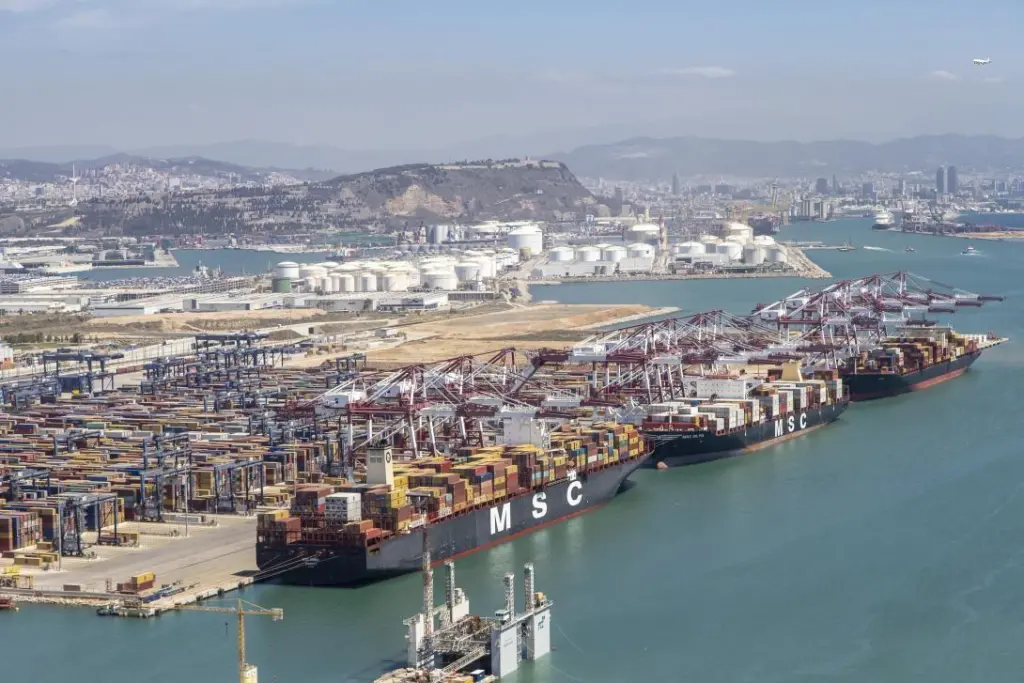
The benefits of a 5G network can be transformational for ports and will be essential for many as port operations become more automated, more connected and, it is to be hoped, more secure.
5G can be delivered as a private, public or hybrid network. While the installation process and maintenance costs of a private 5G network are inevitably more expensive, the pros are clear: a more secure system compared to a public service, lower levels of transmission latency, more control over the network performance and high levels of capacity.
Many ports are working on 5G installation as a starting point for new activities ranging from autonomous vehicles to improvements in diverse container processes, benefiting from speed, capacity and latency improvements compared to 4G, says Barcelona-based Chiara Saragani, a PhD student specialising in digitalisation and logistics in the ports sector.
Three case studies, featured below, signpost the way to what can be achieved.
BARCELONA, ORANGE AND CENIT PILOTS
The Port of Barcelona has launched a 5G network in collaboration with Orange and has been carrying out several pilot projects to test and prove its capabilities; the advanced infrastructure will allow innovative technological solutions in the port ecosystem thanks to its high capacity and reliability, says the port authority.
The network provided by Orange is a private/public hybrid solution, explains Saragani, whose research study is a collaboration between the Center for Innovation in Transport (CENIT) and the Port of Barcelona.
“Orange has provided a public service so that anyone with an Orange contract coming into the port will be directly connected with the 5G connection,” she says. “Then we have a private section of the network that is reserved for the daily operational, security and safety activities in the port. These kinds of activities require a very strong connection – for example, for port services, remote control, information and control tower systems. Also, because ports are critical infrastructure, working 24/7, you need to guarantee this type of connection.
“If you just use the public connection, you are also more vulnerable to cyberattacks. Private 5G is of course more expensive and requires more and newer infrastructure, but it provides a more secure and efficient system.”
Orange is providing the port with ‘Infrastructure as a service’, including all maintenance. The port is responsible for connecting its systems to the service. 5G is being provided in all port areas and extending two nautical miles out to sea – particularly valuable for relaying real-time visibility of ship movements to pilots, while also providing a connection for passengers on cruise ships and ferries calling into the port.
An example of the benefit of 5G has been the Port of Barcelona’s network of 400 CCTV cameras that monitors trucks, people, maritime operations, and so on. “We notice the difference between the 4G connection and the 5G one,” says Saragani. “Every camera streaming requires a lot of capacity and 5G has delivered much more stability.”
A pilot project led by the port and CENIT has tested the use of an interconnected system of cameras to geo-position every vessel moving within port boundaries, using visual recognition and 5G tech. “We interconnected the cameras and computer vision, localising the stern, bow and central point of each vessel, with these coordinates plotted on a platform so that you can see the actual location and direction of each vessel,” she says. “While a combination of AIS and radar is common in ports, this system adds another layer and a greater degree of precision. We have finished this pilot in one part of the port and are discussing extending it to other areas. All of this is based on 5G capability.”
The new private 5G Stand Alone (SA) network has required an investment of €3.6m over five years. The Port of Barcelona says it will meet the needs generated by the increasing level of automation, help port police, security and emergency services with surveillance through the 400 cameras plus drones connected to the network, and improve the efficiency of rail transport. Its resistance to electromagnetic interference will also optimise connectivity management and data transmission in onshore power supply (OPS) systems.
DIGITEST UNLOCKS 5G FOR HHLA
The German Federal Ministry of Digital and Transport set up the DigiTest (Digital Test Fields in Ports) funding programme to accelerate the equipping of German sea and inland ports with digital infrastructure for testing innovations.
One beneficiary is HHLA’s Container Terminal Altenwerder (CTA), which announced in March that it had been granted €2.3m to establish a 5G network as part of the DigiTest initiative. A private 5G network to be set up over the coming months will be used to test various application scenarios.
“With fast response times and high bandwidths [of 5G], data transfer takes place in real time – something that would not have been possible with older generations of the technology,” says HHLA. “As well as optimising digitalised processes at the terminal, the resilience of communication will be strengthened by building a provider-independent network.”

CENTREPORT, NZ & Tū ĀTEA
CentrePort is believed to be the first private business – port or otherwise – to trial an enterprise-grade private 5G network in New Zealand. The port operator announced in February that it was to incorporate 5G coverage across its Wellington port facilities by deploying a new network with Maori-run communications provider Tū Ātea Ltd.
The system aims to give port workers dedicated connectivity across port operations, explains CentrePort – initially providing high-speed connections to dozens of tablets used in vehicles and cranes. “The network will also underpin innovative converged solutions that will boost productivity and security at the port while bolstering health and safety efforts,” it added.
“Reliable wireless connectivity is a key requirement for most modern facilities, as a way of mitigating safety related risks, managing the environment and enhancing productivity,” says Anthony Delaney, CentrePort’s CEO. “Many ports and larger facilities will struggle with WiFi, as the effective range of this is simply too small, coupled with the fact that this isn’t really designed to support mobility (for example hand-offs).
“Because WiFi operates on free-to-air spectrum, the transmit power is limited and, of course, there is congestion; operators don’t have control over any other users who may wish to use other WiFi services in their area of operations, which could cause interference.”
An alternative to WiFi is the public mobile networks, but these are also subject to congestion, Delaney says. “For example, if a large cruise ship berths, or there’s a large event at the nearby stadium, the public networks might suffer from congestion, meaning that critical portside communications don’t work effectively. By comparison, private 5G networks use dedicated radio spectrum that is reserved specifically for the use cases for which it is designed and is managed securely ensuring no other unauthorised users can access this network.”
CentrePort worked with Tū Ātea to capture a set of specific functional requirements, including target coverage areas, specific network capacity requirements, redundancy levels and use-cases such as in-vehicle mobility connectivity and specific VLANs to be replicated by network slicing features (essentially like specific-function lanes on a multilane motorway).
“Tū Ātea used a sophisticated coverage prediction model that essentially uses a digital twin of the physical radio network to mathematically predict coverage outcomes in a geographical interface system,” Delaney explains. “This creates an initial design layer that the team will then verify and finetune during the deployment process. The network uses carefully selected high-gain antennas and 5G radios with rich feature-sets designed to manage unwanted interference, reflections and multi-path challenges presented by stacked ‘container-canyons’.”
Other challenges include designing the network to continue to operate in a harsh marine environment, as well as the ever-changing, operational 24/7 landscape, said Delaney.
In April, CentrePort announced that the private 5G network was closer to becoming a reality, with the network design having been subjected to a peer review.
“The Tū Ātea team are in the final stages of commissioning and testing of the converged packet core that our radio network will be connecting to. For our 5G radio network, we’re looking at three high-power 5G radio access network sites in our container yard, positioned at the edge of CentrePort’s site. This will give us adequate dedicated capacity and coverage, resolving existing connection issues caused by container stacks blocking radio signals and contention on the public networks.”
The draft design mitigates the impact of the port’s high-density six-high container stacks by mounting high-gain directional radio frequency antenna at an 18 m height to cover areas that containers typically block a signal from reaching.
With the core network in place, CentrePort’s trial 5G system radios and port-side network equipment will be installed soon and it is expected to be commissioned before the end of this year, said Delaney. “This is the first network of its kind for the country, and we’re excited about the future possibilities this could enable once we understand the results of the trial.”
5G is laying the foundations for ever more sophisticated port operations. But it doesn’t stop there. “Companies are now testing 6G,” says Chiara Saragani. “One of the barriers of this connection is that it requires a lot of energy, although there are discussions about 6G having AI algorithms and other systems to reduce energy consumption and emissions.”
Related Articles
 EXPANSION & DEVELOPMENT
 CONTAINER & CARGO HANDLING
 PORT & TERMINAL NEWS