![PortStrategy[GreenPort]](https://www.portstrategy.com/wp-content/uploads/2026/09/PortStrategyGreenPort.svg)
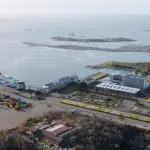

WATCH: Livorno launches vast port expansion
One of Europe’s historic maritime gateways is undergoing a major transformation as Italy moves to expand capacity for the world’s largest cargo vessels.
The Autorità di Sistema Portuale del Mar Tirreno Settentrionale, which oversees the Port of Livorno, has launched the ambitious Piattaforma Europa project, a large-scale reconfiguration of coastal infrastructure designed to strengthen the port’s position within Mediterranean trade networks.
Located on Italy’s north-western coast along the Tyrrhenian Sea at the northern edge of the Mediterranean Sea, Livorno has long played a strategic role in regional shipping. However, port authorities say the existing harbour must evolve to handle larger ships and rising cargo volumes or risk losing competitiveness to other Mediterranean hubs.
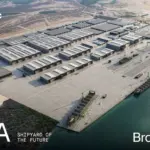
Piattaforma Europa aims to address that challenge by extending the port seaward and constructing infrastructure capable of handling the next generation of deep-draught vessels.
“Conceived and designed to accommodate large ships, it will offer 3km of quays, two large terminals, two million square metres of new areas and a new port entrance with depths up to -20m,” said the port authority.
Dredging and coastal defence works began last year under the leadership of Belgian marine contractor DEME Group. The project involves excavating approximately 14.5 million cubic metres of sediment from the port approaches and internal basins. Once completed, the access channel will reach depths of 17 metres, while interior basins will be deepened to 16 metres, allowing significantly larger container ships and deep-sea vessels to berth.
Material removed during dredging is being reused for land reclamation, forming around two million square metres of new port platform area where future quays and logistics terminals will be built.
The wider civil engineering programme also includes building two new breakwaters and relocating the historic Meloria breakwater to create a modern protective structure for the enlarged harbour basin.
In addition to the breakwaters, engineers will construct a dedicated sediment containment area as part of the environmental management works.
Construction is being carried out by a consortium including Società Italiana Dragaggi, Fincantieri Infrastructure Opere Marittime, Sales and Fincosit.
Financing for the project includes support from the European Investment Bank, which has approved a €90 million loan as part of the broader €473 million investment package.
Development is planned in two stages. The first phase focuses on constructing a new container terminal, while the second will support ‘motorways of the sea’ operations, including RoRo and RoPax ferry traffic.
Construction is expected to continue into the late 2020s, with phased milestones delivering new quays and terminal capacity before the full project is completed.
Related Articles
 EXPANSION & DEVELOPMENT
 CONTAINER & CARGO HANDLING
 PORT & TERMINAL NEWS