![PortStrategy[GreenPort]](https://www.portstrategy.com/wp-content/uploads/2026/09/PortStrategyGreenPort.svg)





Dredging strategies for successful port developments
With commercial pressure to exploit resources in increasingly challenging and remote locations and the drive to accommodate ever increasing vessel sizes, port developers have a wealth of technical challenges to face. Mike Costaras, dredging group manager, HR Wallingford, looks at how advances in the way we plan and execute effective dredging strategies can contribute to a successful project outcome.
Port development around the world seemingly never ends, be it updating existing facilities or developing new ones as international trade types and centres alter and shipping technologies evolve. Commercial pressures have seen us driven to deliver large port and terminal developments in less-developed nations and in remote locations, bringing an immediate requirement for new-build deep draught ports. In response, existing ports have to adapt to accommodate the associated vessels.
This is particularly apparent in the Liquefied Natural Gas (LNG) sector, where in the last decade there has been a boom in terminal and LNG carrier construction. Marine infrastructure owners are seeking to future-proof themselves and remain competitive for increasing vessel draughts, further evidenced and compounded by the simultaneous developments at of the Panama, Suez and the recently conceived Nicaragua Canals.
Port development requirements
Port development requires safe tidal windows for navigation, sufficient berthing space and depth and acceptable conditions for operations on the berth. At the same time, there is much greater global awareness of the effects that altering the existing environment can have. Most ports have a considerable interest in understanding their environment – not just the social and economic environment, but also the natural physical and biological environment. Balancing and understanding the tensions of the natural, social and economic environments are crucial to port development in the modern international port trade.
Design, construction and operation of projects in the maritime environment present significant challenges for all those involved in their development and implementation. HR Wallingford has been providing a wide range of technical consultancy services in the design of maritime projects for over six decades. Our consultancy service has specialists who use their maritime environmental knowledge and expertise to address these challenges on behalf of clients considering a port development.
Impacts to ports during development can include disruption to existing trade, disruption to the normal navigation practices, interaction with surrounding stakeholders, economic costs (cash flow/investments), shareholder views, health and safety issues, waste handling, or political interference/assistance. Understanding the risk of these potential impacts during the planning of any development, as well as understanding the risks to the wider environment, should all be identified early and considered as part of the risk assessment when progressing a development. This integrated decision making leads to a far more efficient and economic process.
Working practice innovation
A variety of innovation and changes to thinking through the years have led to various initiatives or modifications in working practices. These include some of those already mentioned, such as changes to ship size and below we discuss some of the implications of dredger sizes. Changes to the seabed through dredging, whether that is realignment or deepening of channels, berth deepening or providing enhanced turning basins, are often an integral part of any port development to provide safe and efficient navigation. Dredging strategies require understanding of the sediment properties (for example size, type, and sheer strength), the dredging process and the effective, efficient and environmentally sound methods of relocating material. Designing the dredged areas to ensure optimal navigation must also include minimising potential pathways of impact on environmentally sensitive receptors. This is something that HR Wallingford experts work on regularly, as well as appraising the likely maintenance dredging requirement in future.
Within the field of navigation, investigations into required draught have resulted in consideration of whether full navigational depth as indicated by measuring instrumentation is always required. In some areas it can be acceptable to navigate vessels through low density fluid mud layers and in doing so exploit the associated turbulence and prop-wash, thereby minimising dredge quantities. This also leads on to consideration of other types of sediment and flood/coastal management such as:
- maintaining local and regional sediment budgets,
- trickle recharging salt marsh areas with fine grained dredging arisings,
- beach recharge with sand and fine gravel dredging arisings,
- managed realignment for the purpose of habitat compensation with benefits of flood and erosion protection, and
- habitat restoration/creation or ecological enhancement of port structures, eg providing rough surfaces on rock berm harbour arms, which can provide shelter crevices for marine organisms, as well as absorbing wave energies.
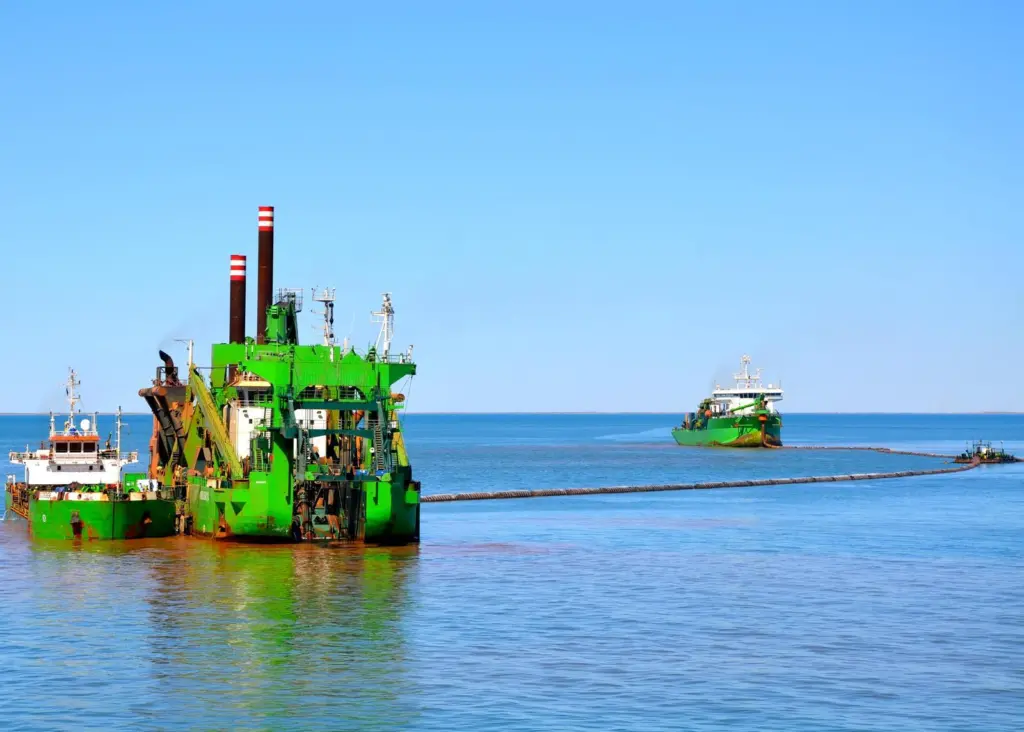
There has also been a considerable increase in the size and number of land reclamations around the world. Not all of these have been for port development, as artificial islands have been favoured to create airports and leisure facilities, whilst in other areas residential or commercial property development has been the driving factor. However, many have been associated with ports, either within their boundaries, or affected by the previously mentioned changing requirements for berths, larger ships with greater draughts or new facilities such as LNG shipment. Even those land reclamations not directly associated may take advantage of the arisings generated by navigation dredging requirements, providing the material is compatible with such a purpose. There is an increasing reliance on reclamations in land creation or berth creation, for which Trailer-Suction Hopper Dredgers (TSHD) or Cutter Suction Dredgers (CSD) are ideally suited for dredging and hydraulically placing the materials required.
Bigger dredgers
The commissioning of the ‘large’ TSHD began in the late nineties, since which time the economy of scale and market requirements have been evident, and hopper sizes have increased up to the current maximum of 46,000m3 (Leiv Eriksson, Cristobal Colon; both 2009 for Jan de Nul). The commercial viability of dredgers of this size has been assured by the nature of modern dredging projects, which often require large amounts of materials to be relocated significant distances, either from borrow areas to land reclamations, or from dredging projects to environmentally appropriate disposal sites.
Pumping from CSD to hopper barges has been a tried and tested solution for offshore disposal of material. The largest hopper barges have a capacity of about 10,000m3 whilst a more typical size is about 3,000m3. Such barges can be filled in tens of minutes by the largest CSDs. The use of larger TSHDs as barges to CSDs has become a viable possibility due to developments in dredging technology. The ‘standardisation’ of modern dredging plant with, for example, interchangeable pumps and pipeline diameters has facilitated this development. This means in areas of particularly high sensitivity to sediment plumes, for example tropical systems where high clarity of water is needed for ecosystem habitats such as sea-grasses or corals, or where mangrove pneumatophores are sensitive to deposition, material can be directly transferred from CSD to TSHD.
This is particularly useful if CSDs have to be used due to the strength of the materials that need to be dredged, where in the past, the material could have been either pre-crushed by the CSD or returned to the bed via the CSD ladder and then retrieved later by TSHDs. Instead of having to use these types of approaches, the material can be removed in-situ by the CSD and then directly transferred to the TSHD for transportation. This can significantly reduce the sediment losses and increase control over the location and rates of sediment losses, particularly if limited overflow is applied, mainly to remove the ballast water in the TSHD hopper.
From the perspective of project cost, a primary overhead expense is fleet mobilisation. Reducing fleet numbers and increasing vessel size means that cost savings are possible. There are often areas that require dredging where a TSHD working in a conventional manner is the optimal piece of plant to use; therefore being able to use a TSHD in a dual role also leads to economic advantages. These factors point towards large capital dredging volumes and good prospects for larger dredging plant. Whilst the pumping of material from CSDs to TSHDs is more expensive than conventional dredging techniques, it does offer significant advantages for those areas where relevant environmental constraints exist.
Global legislation
Understanding global, national and local legislation which exert regulation constraints is also a key factor in successful and efficient port development. The timescale to provide suitable information for any consent or licence application and to adequately inform the decision making process can be a critical part of the programme. It is not unusual for projects to be seriously delayed during engagement with regulators, leading to unforeseen cost implications.
Within environmental legislation, there has been a trend towards increasing international and trans-boundary environmental requirements. Pieces of legislation have been enacted, including European Directives like the Water Framework Directive or Marine Strategy Framework Directive, which have standards that must be observed by all port authorities within the European Union and which some adjacent countries have voluntarily agreed to observe. The IMO has also increased its environmental guidelines, with MARPOL, ballast water management and global greenhouse gas regulations being updated or imposed. Specialist consultants like HR Wallingford consultants understand such marine legislation and pride themselves on being able to provide clear and helpful advice on how best to work with regulators, or, alternatively will engage with regulators on behalf of port clients.
There are a vast range of issues to be considered when planning a modern dredging project; it is reasonable to expect input from contractors, government ministries, legislative bodies, as well as expert consultants, such as HR Wallingford. The industry is under-pinned by pioneering technology and novel operations, and the outlined procedures ensure long-term sustainability and project success.
Related Articles
 EQUIPMENT
 ALTERNATIVE FUELS GREENPORT