



Gaussin introduces Container Terminal Multi-trailer
French port equipment manufacturer Gaussin recently presented the ATT terminal trailer to the market. Now, however, the company has made the next logical step and launched the AMTS – multi-trailer system. Alex Goussiatiner* reports
AMTS is a train which consists of combination of active and passive trailers, connected by drawbars. The active trailer is the same as the ATT trailer. It is equipped with a power pack, located under the trailer frame. The ratio between active and passive trailers depends on the trailer load and power generated by the pack. All trailers are the same length. The total number of trailers is limited only by operational constraints. The maximum speed of the AMTS laden train is 20 km/h (35 km/h empty), which is equivalent with comparable conventional multi-trailer system (MTS). The AMTS dual trailer configuration consists of two 40ft/45ft trailers (65t load each). There is no tractor needed for the system. The lightweight cabin is mounted directly on the trailer front axles.
Environmental protection
AMTS is ‘full’ hydraulic system, with the following features:
1. It does not have a high speed motor. The power is produced by a hydraulic engine which draws power from the diesel engine. The engine gets started and stopped by newly developed hydraulic system, called HERO.
2. It also does not have transmission and transfer case. The hydraulics energy, produced by the power packs is distributed directly to all wheels. It achieves low energy consumption and produces much lower emissions due to the following factors:
• The hydraulic engine shuts down automatically when AMTS is in idle mode and restarts immediately, when power is required. This eliminates fuel consumption during the idle time.
• Elimination of the energy waste in transmission.
• Lower vehicle dead weight. For instance, the weight of the dual trailer AMTS is 25,000 kg. The technology also opens possibility of using different energy sources, as the hydraulics system can have input from electrical engine, alcohol fuel engine, etc.
Operational flexibility and productivity
The main obstacle for implementation of the multi-trailer systems for ship-to-stack transportation is traffic congestion in the container yard and apron area. The AMTS directly addresses this problem as follows:
• Shorter vehicle length, smaller turning radius (13 m outer radius) and individual control of the wheels by on-board computer dramatically improve AMTS manoeuvrability.
• Hydraulic technology im proves AMTS acceleration performance.
• AMTS is truly bi-directional vehicle, which can be moved with precision in forward and backward directions. The feature facilitates fast vehicle alignment for ship to shore and yard crane operations.
• AMTS is the first system which doesn’t have any mechanical parts for the axle steering for trailers. The axles are controlled by onboard computer unit (ECU). This precise steering reduces required ground space for following trailers to a minimum.
The factors will also increase average vehicle speed and reduce working cycle. As a result, terminal operators will be able either to increase ship-to-shore crane productivity or decrease the number of vehicles in the operation. We expect that AMTS will benefit number of terminals, which at the moment using single trailers for the ship to stack transportation.
Equipment maintenance and repair
MTS Components, which are causing most of the downtime: high speed motors, transmissions and transfer cases are not present in AMTS. They are replaced by hydraulics components, which are more reliable and require much less frequent scheduled maintenance and less consumables. In addition, all AMTS components can be stored inside standard ISO container and shipped to client individually. It allows for more dynamic and cost effective spare part management. Also, the machine is design with reparability in the mind: technicians will have direct access to all mechanical and hydraulic components. Also in a matter of minutes the complete power pack can be lifted and replaced by spare one.
Return on investment and payback period
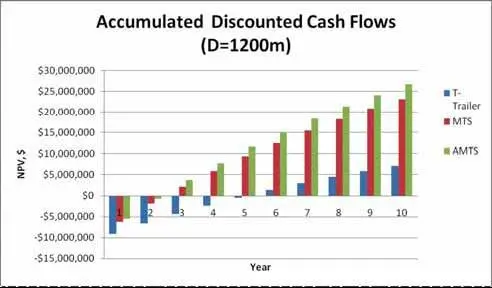
This Examination will compare three competing technologies: tractor-trailers (TT), traditional multi-trailer system (MTS) and AMTS implemented in the terminal with five ship-to-shore gantry cranes. The following base case assumptions were used in the estimations:
• Purchasing cost of MTS and AMTS are identical
• Average ship to stack distance: 1200m
• Number of TT per crane: 11
• Number of MTS or AMTS per crane: 6
• Number of trailers in MTS or AMTS: 3
• The full hydraulic technology is a good match with type of ‘stop and go’ type of operation, which is required for container terminals.
• Due to hydraulic technology and new vehicle configuration, AMTS has a number of very beneficial characteristics such as improved energy efficiency, manoeuvrability and accelerations performance.
• Implementation of AMTS will increase operational flexibility, reduce terminal congestion and increase ship to shore crane productivity as well as productivity of the vehicles fleet.
• Results of financial modelling indicate that if AMTS purchasing price equal to the price of typical MTS, AMTS outperform both TT and MTS options.
Conclusion
AMTS has a number of vital features that makes it attractive: low fuel consumption and environmental protection, high manoeuvrability, operational flexibility, etc. Assuming that the purchasing cost is comparable with conventional multi-trailer systems, we predict, that AMTS will have a wide variety of applications in container terminal operations.
*Alex Goussiatiner, Senior Container Terminal and Transportation Specialist, Modern Port Technologies Inc. Modern Port Technologies, Inc. (www.modernport.com) was founded in 2004 and is based in Vancouver, Canada. It offers consulting and research services in the following main areas: Operations Research in Transportation, Ports and Container Terminal Planning and Simulation, Port Equipment, Terminal Operating System. alexg@modernport.com
Related Articles
 EQUIPMENT
 ALTERNATIVE FUELS GREENPORT