![PortStrategy[GreenPort]](https://www.portstrategy.com/wp-content/uploads/2026/09/PortStrategyGreenPort.svg)





New ‘green’ engines for Liebherr cranes
Liebherr is enhancing its fleet of mobile harbour cranes (LHM) with diesel engines to help the industry meet ever-changing emission and fuel consumption targets.
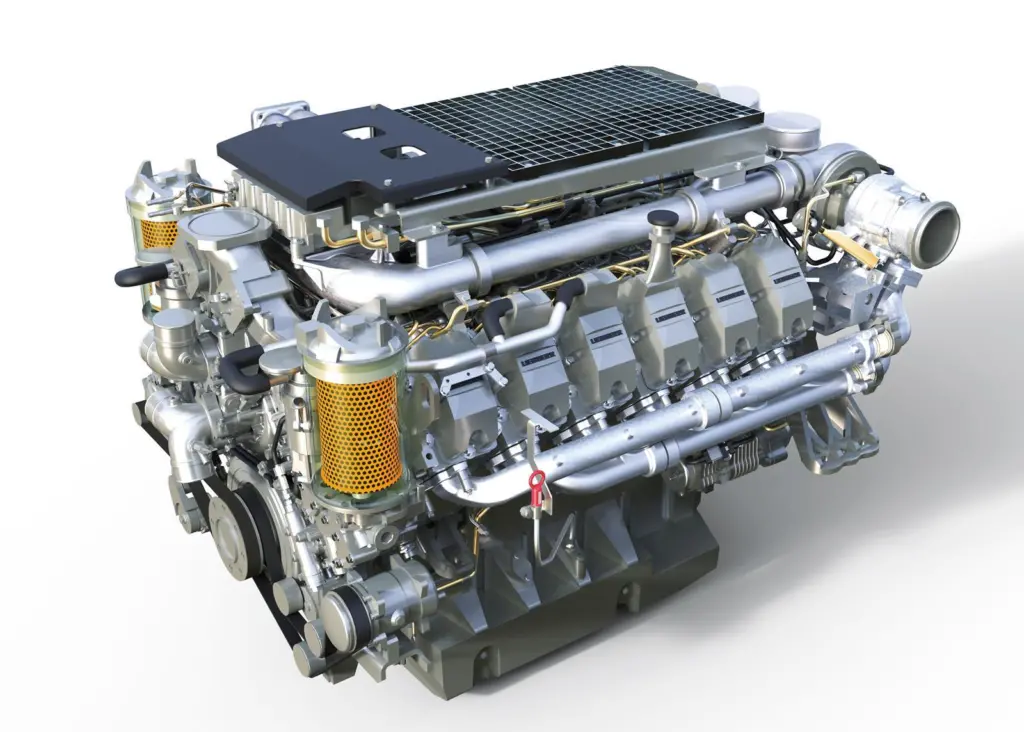
The smaller crane models LHM 120, LHM 180 and LHM 280 will be equipped with a stage IV/Tier 4final 400kW engine. The larger crane models LHM 420, LHM 550, LHM 600 and the new giant LHM 800 are available with a stage IV/Tier 4final 725kW diesel engine. Both diesel engine versions can be boosted with the Pactronic hybrid drive system for up to 100% extra power.
For the latest European Union emission standard stage IV and Tier 4final of the US Environmental Protection Agency (EPA), Liebherr has optimised the whole combustion process. Compared with other solutions, Liebherr says it’s developed a simple solution that reduces the nitrogen oxides (NOx) emissions while cutting operating costs.
A key element of the new engine generation is the gas emission treatment. To simplify the system and to optimise exhaust gas after-treatment, Liebherr engineered the Selective Catalytic Reduction technology (SCR), which reduces particles to a minimum already inside the engine. As the particle emissions are already lower than the emission limits, no more reduction measurements are necessary. Liebherr says this further optimises enhances the motor in terms of power, efficiency and economy. The newly designed SCR catalyst and all other system components such as injector, air- and AdBlue-pump are said to significantly reduce NOx reduction by around 98%.
With the stage IV/Tier 4 final, Liebherr also offers a standardised basic engine that can be adapted to the emission requirements in different markets and regions by minor modifications or by fitting exhaust gas after-treatment systems.
Liebherr says this latest development means customers will benefit from less fuel consumption, less energy for engine cooling and less exhaust backpressure, which preserves the engine components. In addition, maintenance is simple and cost-efficient since no periodical cleaning of the diesel particle filter is needed. The motor oil is also said to be much less contaminated by soot which leads to longer service-intervals.
Related Articles
 EQUIPMENT
 ALTERNATIVE FUELS GREENPORT