



Reducing energy consumption and Co2 discharge
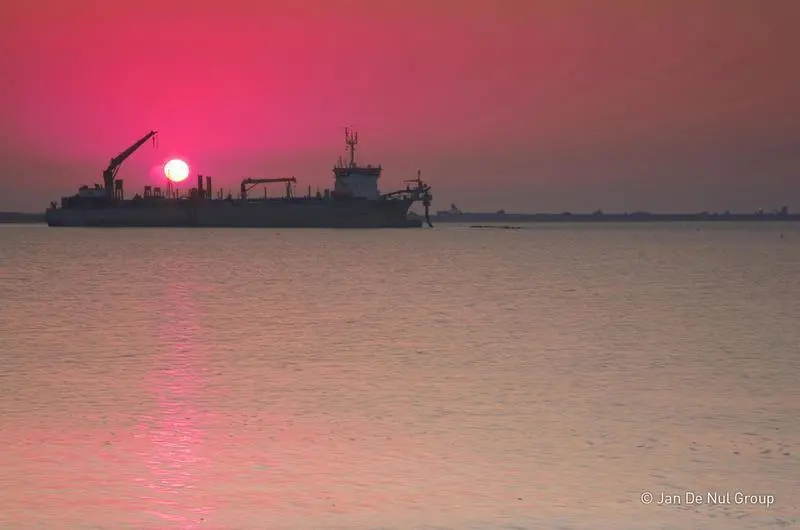
Jan De Nul Group is a leading expert in dredging and marine construction activities, as well as in specialised services for the offshore industry of oil, gas and renewable energy, say Sofie Herman, Project Manager for Environmental Projects and Stijn De Ryck, QHSSE Advisor of Jan De Nul Group.
In 2013, Jan De Nul Group wants to obtain a certificate on the CO2-Preformance Ladder. This is a Dutch energy management instrument by which companies prove their objectives for CO2-reduction and their awareness for saving energy.
Site Tragel
Thanks to several energy audits, Jan De Nul Group got more insight in the use of power, the inventory of emissions and the value chain. The CO2- footprint for the Site Tragel in Aalst in Belgium was determined in March. For 2012 a total footprint of 5,455 tonnes CO2 was estimated and agreed upon. This amount includes the activities of the workshops, the warehouse and the offices in Aalst.
Dredging works Benelux
The ecological footprint of the dredging works in de Benelux is still on-going and near finalisation. The project ‘Kustlijnzorg’ in the Netherlands has been chosen as a reference and pilot project as it was requested at tender stage. On a monthly basis all energy/CO2-data will be mapped and recorded. Jan De Nul Group is on a non-stop basis looking for methods to reduce its energy and CO2 weight. Contractors are granted advantages depending on the efforts and engagements made.
Contaminated sediments incorporated in concrete blocks
Envisan, Jan De Nul Group’s environmental subsidiary has at its disposal a complete range of remediation methods. It has grown into the strong partner for complex redevelopment projects and the rehabilitation of contaminated areas, both on a national and international level. Environmental dredging and processing of waste and alternative raw materials are crucial in order to offer clients the most creative and competitive solutions to their problems.
Facts & Figures
Client: Grand Port Maritime de Dunkerque
Period of execution: August – September 2013, Followed by the placement of additionally ordered concrete blocks in a period of 4 years
Total amount of concrete blocks: 100
By the end of 2012, the client tendered a work for the production of concrete blocks, either by the classic method, or by using contaminated sediments dredged from the harbour of Dunkirk. These blocks will be used to protect the dikes. In March 2013 the client chose the innovative project of incorporating dredged sediments into the concrete. The client ultimately chose Envisan, because of its many years’ of experience in treating contaminated sediments and because of the Jan De Nul Group’s knowhow in civil and maritime works.
The project has taken off in August 2013. In the following two months 100 concrete blocks with incorporated sediments will be constructed on a dedicated platform in the port of Dunkirk. These blocks are cubes of 4.3 m³ and 6.1 m³, of which each 50 copies will be made. To be able to execute reparation works on the cores of the dikes for the coming 4 years, 2 supply locations are foreseen.
Dehydration and preliminary treatment of sediments
The contaminated sediments were dewatered in a few lagoon fields on the harbour site. Since 5 years, these fields are exploited by Envisan. After the dehydration phase, the sediments are preliminary treated with an additive. Due to the mixture of this substance with the sediments, the physical characterizations of the sediments changes into a material that can easily be handled by a concrete plant. This way the sediment is delivered in a user-friendly way and no adjustments need to be made to the plant itself.
Innovative project
The origin of constructing concrete blocks with incorporated contaminated sediments goes way back. A few years ago an extensive laboratory research was started up together with a French laboratory, CTG ( Centre Technique du Groupe Italcementi) to verify the quality and the sustainability of this kind of concrete. It turns out that the quality meets all characterisations and environmental demands. In France, contaminated sediments are considered as waste. Useful applications such as incorporating the sediments are consequently not yet possible yet on a large scale. In order to have an idea of the possible environmental impact in the future, our works are closely monitored during execution of the works and in the following years. With this innovative project Envisan hopes to provide a renewed solution for the environmental issues concerning contaminated dredged sediments in France, but also worldwide. Envisan is convinced that similar projects provide a valuable alternative and will help to create even more environmental awareness.
Environmental objectives
Jan De Nul Group’s target in 2016 is to decrease its CO2- footprint by 2 % compared to the estimated one in 2012 and this for both the dredging works, as well as the site Tragel. The results will be published every 6 months, that way everyone can keep up with the evolution. More information on the CO2– Performance Ladder will appear on our website and the intranet. Jan De Nul Group believes that it is really important to have transparent communication on this matter.
Cooperation
Furthermore, Jan De Nul Group exchanges knowledge of and experience with other companies related to the methods of reducing energy. By sharing this kind of information, we can reach our target faster and more effective. We must however not limit our effort by focussing on texts and procedures only. Jan De Nul Group wants to continuously improve the global environmental impact by implementing a structural system in conformity with ISO 50001 (concerning the energy) and the CO2 Performance Ladder (concerning the greenhouse gasses).
Related Articles
 EQUIPMENT
 ALTERNATIVE FUELS GREENPORT