





Shiploading systems for the grain industry
Dust problems can occur at every transfer point from one conveyor to the other. The height difference is a key factor, writes Tomas Kisslinger at Neuero.
The higher the grain falls, the greater the grain speed will be (valid until approx.10m height, after which the speed is constant). This speed makes the air separate the dust from the grain flow after 1m/s. The dust and the grain have different sink velocities and therefore this is why the separation takes place. At slow velocities (~1m/s) dust and grain remain together.
Loading systems without dust suppression
These systems were very popular in the past because of their low equipment weight with respective low costs. The main objective was to fill the hatch. The problem with the difference of weight between weighed and dispatched product was also neglected. The grain speed reached the maximum at the end of the process and this was used to throw it under the hatch.
In the past, environmental protection was not an issue as it is today. The dust emission depends on the volume, wind, location and loaded products. Examples of these systems are:
– With vertical or inclined falling spout
– With loading rotating spoon
– With jet slinger
Loading systems with dust suppression
Today, not only in developed countries but worldwide, a requirement for dust reduction to improve environmental conditions has brought development in loading skirts and “chokers”. These have worked with limited success worldwide, but not to the complete satisfaction of clients. This technology was accepted at the time, because it was an improvement for product with a constant flow.
The problem with this technology was how to get a low speed at the end of the loading pipe with the product falling from 20m height? To achieve more efficient dust suppression, the product speed must be slowed down at the discharge point. Most of this system design can handle some products, but not all, especially when you consider product flow and product variation. The “chokers” tried to slow the material with a complicated system to control the discharge flow with the result not always positive.
Two systems today are providing the required low dust emission with respective speed reduction – the cascade system and the controlled flow head. Both of these systems reduce the grain speed in order to avoid dust generation. Both also reduce the breakage of the product as a consequence of the low speed. They are the cascade system and the controlled flow dust suppression head.
NEUERO controlled flow head
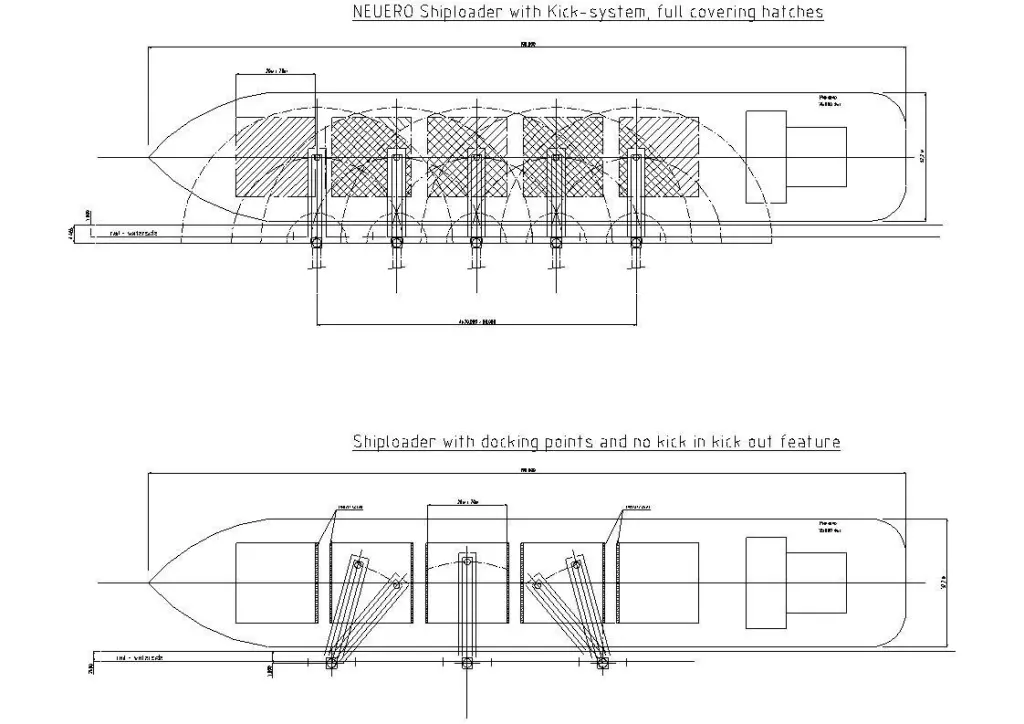
Neuero has perfected the controlled flow head system by teaming it with Kick In Kick Out (KIKO) movements of the vertical loading pipe providing extra advantages. Besides providing excellent dust suppression, low product breakage, and less wear, when combined with the Kick In Kick Out movements it allows a bigger working range to fill the ships hatch more efficiently.
The bigger horizontal movement in addition to the Kick In Kick Out movement is a must for fixed ship loading towers, but also adds advantages to mobile ship loading towers, especially if additional equipment is positioned on the same jetty limiting the movement of the mobile tower. Another advantage is when it comes to the ships hatch shape. The inclined movement of the vertical loading pipe helps to fill the hatch more efficiently.
One example of the Neuero controlled head system featuring KIKO movement expertise is at work in Bunge ETSK in Nikolajev, Ukraine. It is a 800t/h KIKO shiploader with belt conveyor connection from a jetty conveyor.
There is also one at work in ADM Minmetal in Contanta, Romania, which is a 800t/h KIKO shiploader with bucket elevator transfer from a jetty conveyor.
Neuero has high expectations when it comes to equipment sales. One has recently been sold to the Ukraine with 1.500t/h, one to the USA with 1.000t/h at Lake Charles and one to Senalia in Rouen France, which is a 1.200t/h KiKo Shiploader that has just started operation. We believe they are excellent examples in each region to showcase the technology.
Around ten years ago we made the first KIKO system with controlled flow head after realising many control head loading systems. This only had a Kick out movement. The first machine was a success but we did not realise at the time that this would be our solution of choice for the future. Only after several different installations and report of other systems was this confirmed.
The problem with purchasing a dust suppressing system is the initial cost and sometimes an upgrade is not possible because the loads are much higher and existing structure will not support it.
Neuero also highly recommends careful analysis regarding local environmental regulation before proceeding with a new equipment order.
Related Articles
 EQUIPMENT
 ALTERNATIVE FUELS GREENPORT