![PortStrategy[GreenPort]](https://www.portstrategy.com/wp-content/uploads/2026/09/PortStrategyGreenPort.svg)






The business of pollution control
In 2002, the EcoPorts Foundation published a document listing the most significant threats to the environment in the ports industry.
Dredging was listed as the second worst polluter in ports – while third in the list was the question: how to deal with dredged material? One company which has focused on this issue is DEME, the Antwerp hydraulic engineering and environmental group. “When it comes to environmental dredging, we can justifiably claim that DEME has been the pioneer in Europe,” says Hubert Fiers, DEME’s Communications Manager. “Very often dredging companies are attacked as polluting companies, but this is not truth, we deal with pollution.”
Treating the sediment
Storing contaminated soil in an efficient and environmental manner is a major challenge for all ports. Usually, contaminated dredged material is stored in a protected dump area. According to Fiers, this is not sufficient. “This dredged material usually contains large quantities of water,” he says, “which of course means that it takes up a large volume, as well. Consequently, the dump areas are getting full too quickly, so that you then need to find another area – the result being that you generate further pollution by creating more and more dump areas”. To solve this problem, DEME created a system for treating contaminated material. “The system commences with de-watering of the dredged soil,” explains Fiers. “We then clean the water in the water purification plants, treat the soil, separating the contaminated material from the clean soil – which later can be re-used. The contaminated element is substantially reduced in size and can be conveniently stored in an isolated location. So, instead of having a large pool of contaminated dredged material, we now only have a ‘first-size’ quantity.” After developing this technology, continues Fiers, DEME started to treat contaminated earth in the same way. “It’s the same material, just without water,” he says. “So we can clean up industrial areas, the so-called ‘brown-fields’ or ‘black spots’. For example, we are using this system to clean the construction site of London Olympics 2012 village. This place was completely polluted, full of complete junk. All of the 500 hectares now are now being cleaned with mobile soil-washing plants.”
Finding the way to environmental dredging
While storing and cleaning dredged material are significant challenges for dredging companies, they are not the only issues that they have to face. One of their top priorities is to find a way to limit the quantities of dredged sediment that is produced. “While dredging in a contaminated area,” Fiers reports, “it is essential to dredge in such a way that limits the possible storage of this material to an absolute minimum. So we have developed some unique environmental dredging technology.” The two greatest challenges of environmentally- friendly dredging are to avoid spreading pollution and to be as accurate as possible. “Turbidity has to be limited to an absolute minimum,” Fiers explains, “so we have developed dredging techniques that reduces the movement as much as possible. At the same time, it ensures the highest possible concentration of the sediment. The dredged material is always a mixture of soil and water – and clearly the higher the concentration of this mixture, and the lower the content of the water in this mixture, the better it is for the environment.” When the mixture settles down, water has to be removed; so if the material is contaminated, water also contains these contaminated parts.
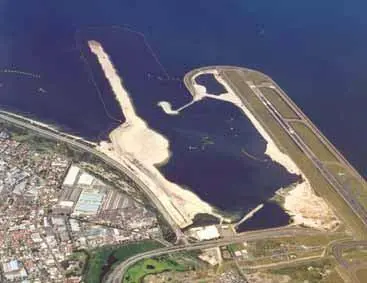
To solve this problem, DEME has developed a special ‘hopper-unit’ that can achieve the highest possible sediment concentration, with almost no water going back into the river. In some situations, there are even simpler ways of avoiding turbidity. “Some years ago,” recalls Fiers, “we were involved in the construction of two new runways for Sydney Airport, in Australia. The runways had to extend out into Botany Bay. So, around the area where we had to reclaim the sand, we build a screen, like a curtain, which was fixed to the sea bottom and helped to prevent the turbidity in the whole bay. After the sand had settled down, we removed the curtain.”
Mitigation
In the application process for the construction of new terminals and docks, compensation – usually in the form of mitigation – has become a significant issue. “To compensate the construction of Deurganck dock in Port of Antwerp,” Fiers notes, “we created many hectares of wetlands and breeding places for birds. Now, after starting the deepening of River Scheldt, we have a compensation programme to implement – to give back land to the river elsewhere. We have been in the dredging business for more than 150 years – and one of the reasons that we have carried on for so long is because when other people saw a problem, we saw a business opportunity”.
More from www.deme.com
Related Articles
 EQUIPMENT
 ALTERNATIVE FUELS GREENPORT