![PortStrategy[GreenPort]](https://www.portstrategy.com/wp-content/uploads/2026/09/PortStrategyGreenPort.svg)


AGVs: Pushing Boundaries
Market analysis: The growing trend to automate is accelerating demand for AGVs in ports.
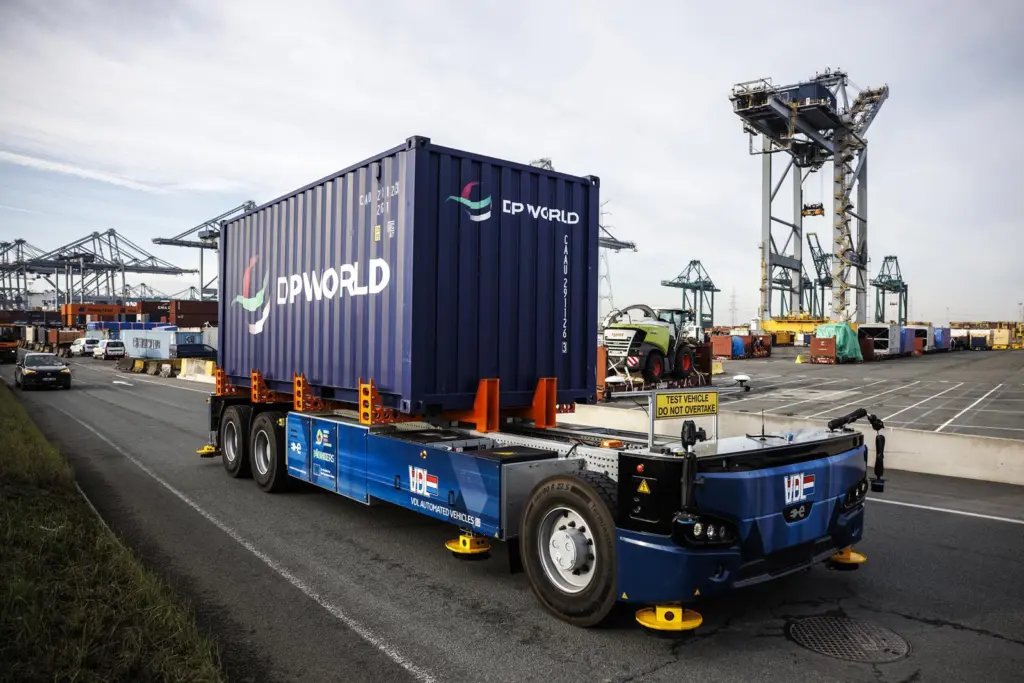
The ongoing trend for automation in ports is driving the growth of Automated Guided Vehicles (AGVs). The rising demand for automation comes on the back of an increase in global trade, leading to growing pressures for ports to boost the efficiency of their cargo handling. Using AGVs is a way for them to increase efficiency, lower operational costs and cut time spent handling cargo. All this means that the global port AGV market is expected to soar from a value of approximately US$1.53 billion in 2023 to a projected US$5.8 billion in 2030, according to Bosson Research’s Global Port AGV Market Research Report 2025 (Status and Outlook). Additionally, the technological advancements seen in the development of AGV solutions is further firing up the market. As the report says: “The development of more advanced navigation and control systems, improved battery life, and better integration with port management systems have made AGVs increasingly viable for a wide range of applications.” This includes AI and the introduction of 5G networks, which helps to improve connectivity between AGVs and terminal management systems. Generally, innovations continue to push boundaries in the AGV sector, as can be seen by the work of the PIONEERS Consortium, at the Port of Antwerp-Bruges (below). Further, stringent environmental legislation and the need to decarbonise operations has also led to a shift towards electric-powered AGVs, as highlighted in the supplier company by company reviews, below:
DATA ANALYSIS: INNOVATION, AUTOMATION, ELECTRIFICATION, OPTIMISATION
BlueBotics: BlueBotics has launched a new ANT locator to manage the interactions between AGVs, AMRs and manual forklifts. The autonomous navigation and fleet management company – whose ANT navigation technology drives over 6,000 AGVs and AMRs around the world – has introduced the ANT locator, a new and flexible vehicle tracking and mixed fleet management system. Dr Nicola Tomatis, CEO, BlueBotics notes: “ANT locator addresses an evolving challenge for internal logistics teams: how to ensure effective interactions between manual forklifts and driverless AGVs and AMRs, by enabling traffic light systems for mixed vehicle types, smart interactions in pre-defined zones, and the integrated monitoring of all vehicles.” The live coordinates of manual trucks are integrated directly into Switzerland-headquartered BlueBotics’ ANT server AGV Fleet Manager. This precise positioning data enables the software to automatically manage interactions between automated vehicles, manual trucks and staff.
Konecranes: Konecranes will supply 42 Li-Ion AGVs to the ECT Euromax terminal as it moves to fully electric operation. The order also includes 42 Li-Ion Automated Charging Stations with fast-charging capabilities. The status of AGV batteries, both in operation and during charging, is handled by a Battery Management System, which collects and stores operational and charging data to secure efficient battery operation and long-term reliability. The AGVs are designed for fully automated container handling and will operate alongside the existing diesel-powered AGV fleet. All of this is controlled by Konecranes’ TEAMS ECS (Equipment Control System) software. A Failure Management & Diagnostic System provides an overview of equipment status down to the component level, including batteries and charging technologies. This order comes on the back of the delivery of Konecranes’ largest-ever single Automated Horizontal Transport System order to Hamburg terminal operator Hamburger Hafen und Logistik AG (HHLA) in October 2024. Key components for this order included 116 Konecranes Gottwald AGVs with Li-Ion batteries, 20 automated charging stations, a battery management system, a safety system and TEAMS equipment control software (ECS). The Konecranes Gottwald AGVs are being used for automated container transport at the Waltershofer Hafen container hub, which spans a total quay length of 3.6 kilometres. The delivery includes a CE TYPE Approved Interchange and Fence Control safety system connected to CTB’s quay cranes and automated stacking cranes, ensuring integrated and safe operations from shipside to landside. The 20-year collaboration with Konecranes includes joint research and development on AGV battery technology with HHLA’s Container Terminal Altenwerder, which claims to be the world’s first certified climate-neutral container terminal. In conjunction with the Eurfomax order Ralf Konnerth, Director Automated Horizontal Transport, Konecranes, emphasises: “This deal underlines two decades of operational success for Konecranes Gottwald AGVs at the ECT Euromax terminal.” And adds: “Konecranes is ready to further support the terminal’s modernisation journey for the next 20 years, with electrification in full focus.”
Hyundai Rotem: South Korea’s Hyundai Rotem has inked a contract to supply Dongwon Global Terminal Busan with 57 AGVs. Announced last year, the deal will also include the supply of associated control systems, chargers, and ancillary equipment to Pusan New Port, Pier 7. Hyundai Rotem is already a key provider of this type of equipment, previously delivering 43 AGVs to Dongwon Global Terminal. In 2024 it also announced a contract for 44 electric AGVs for Yeosu Gwangyang Port Authority to be delivered by 2029. The AGV is 16m long, 3m wide and 2.3m high, capable of transporting containers weighing up to 65 tonnes. The antenna mounted on the AGV and the sensor embedded on the terminal floor, enable sophisticated driving by identifying the location of the vehicle in real time. The design also incorporates the latest unmanned technology to prevent collisions by detecting obstacles with LiDAR sensors, mounted on the front and back.
M1 Limited: A new MoU has been struck to drive the adoption of 5G technology in Vietnam Maritime Corporation’s (VIMC) ports and explore applications such as enhancing AGV operations. The collaboration between Singapore digital network operator M1 Limited (M1), Vietnam Posts and Telecommunications Group (VNPT) and SSI Solutions leverages M1’s expertise in maritime 5G solutions, VNPT’s 5G network infrastructure and SSI Solutions’ integration of the technology into VIMC’s operational landscape. Together, the three parties aim to unlock new efficiencies in Vietnam’s maritime operations. The partnership will introduce advanced 5G-powered use cases to optimise operational efficiency and enhance the digital transformation of VIMC’s ports. “We have spent the last few years co-creating and introducing viable 5G-enabled commercial solutions to digitize Singapore’s maritime operations and make Maritime 5G a reality. By sharing our expertise and experience from successful use cases, we are contributing to the modernisation of one of Southeast Asia’s most critical maritime hubs,” says Andrew Cheng, Chief, Enterprise Services, M1.
VDL Automated Vehicles: DP World has tested an AGV for empty container transport in mixed traffic in its Antwerp Gateway terminal. The automated demonstration, developed by Netherlands-headquartered VDL Automated Vehicles, took place within the framework of the PIONEERS innovation programme in the Port of Antwerp-Bruges. During the demonstration, the AGV transported empty containers across the yard between operational buffer areas and storage blocks. The fully electric vehicle was self-driving using a predefined route interacting with existing terminal traffic, including trucks and internal vehicles. The demonstration followed a preparation phase where the vehicle carried out several test-runs on the terminal to validate the setup and operating conditions ahead of the live event. Edi Cioran, CEO, DP World Antwerp, notes: “Innovation at terminal level starts with understanding how new technologies behave in real operational situations. This demonstration gives us the opportunity to learn, together with our partners, from a live environment.” The PIONEERS consortium, which is led by the Port of Antwerp-Bruges, brings together ports, terminal operators, technology developers and public partners to explore innovative solutions for port operations. Following the trial period, the project team will review the observations and operational findings gathered during the vehicle’s time on the terminal. VDL’s role in the PIONEERS consortium is in the research and development phase, by offering advice to terminal operators on operations with electrical heavy duty AGVs. VDL says that the hardware of the electrical AGV will have a drive-by-wire vehicle control architecture, which can be interfaced with the automated software of partner AKKA, and which will be made available for further software development.
ZPMC: ZPMC’s Narrow and Lightweight AGV, introduced in 2025, is a specialised, compact, and energy-efficient AGV designed to optimise container terminal operations. It features high-density, low-weight construction for better manoeuvrability and reduced power consumption, with key applications including battery-powered transport at PSA Singapore’s Tuas Terminal. The AGVs use high-capacity battery energy storage systems and are designed for integration with modern and automated terminal management systems, such as those implemented at PSA Singapore. This product reflects China-headquartered ZPMC’s focus on “green and intelligent” port technology. Recent uptake: ZPMC is supplying over 100 AGVs to Singapore’s Tuas Port, following a pilot production project in Malaysia. The electric AGVs operate 24/7 with rapid charging (6-8 hours on a 20-minute charge). These AGVs are part of a larger fleet of over 200 AGVs at the terminal, designed to work with automated stacking cranes and a 5G-enabled, AI-driven command centre. The AGVs support the port’s long-term goal of total automation by the 2040s.
Related Articles
 TERMINAL OPERATIONS
 DIGITAL
 DIGITAL