![PortStrategy[GreenPort]](https://www.portstrategy.com/wp-content/uploads/2026/09/PortStrategyGreenPort.svg)



Hydrogen equipment trials
Trials of a hydrogen powered reach stacker and terminal tractor are underway in the Port of Valencia, marking a double first for the operation of this type of equipment. Mike Mundy reports
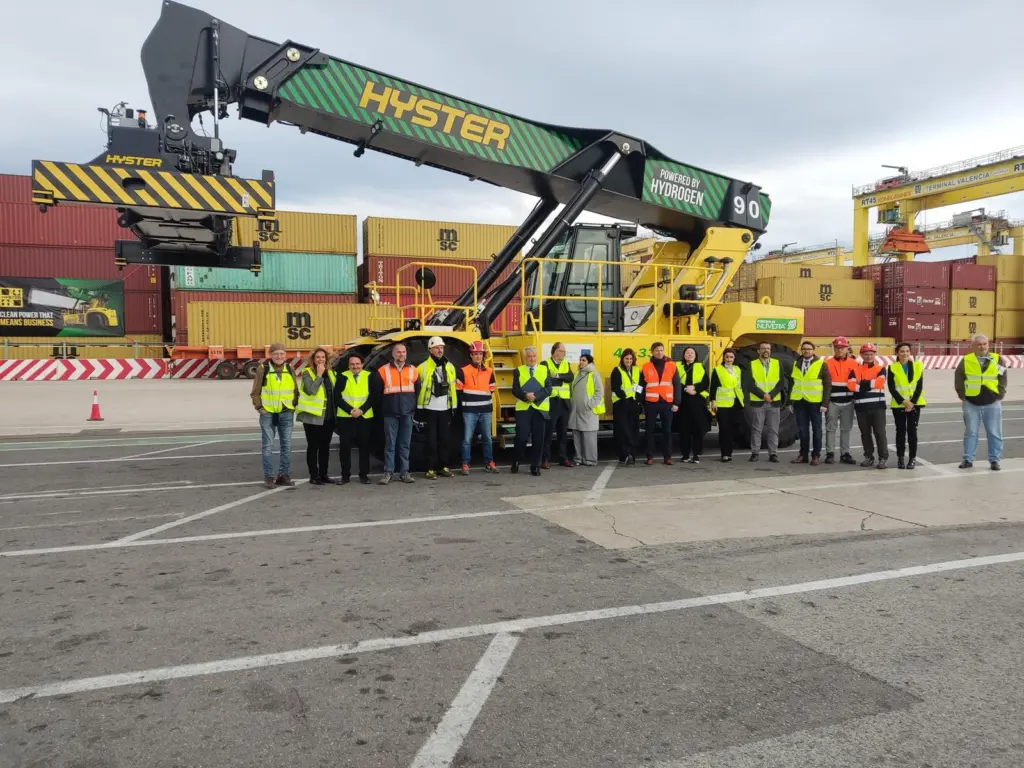
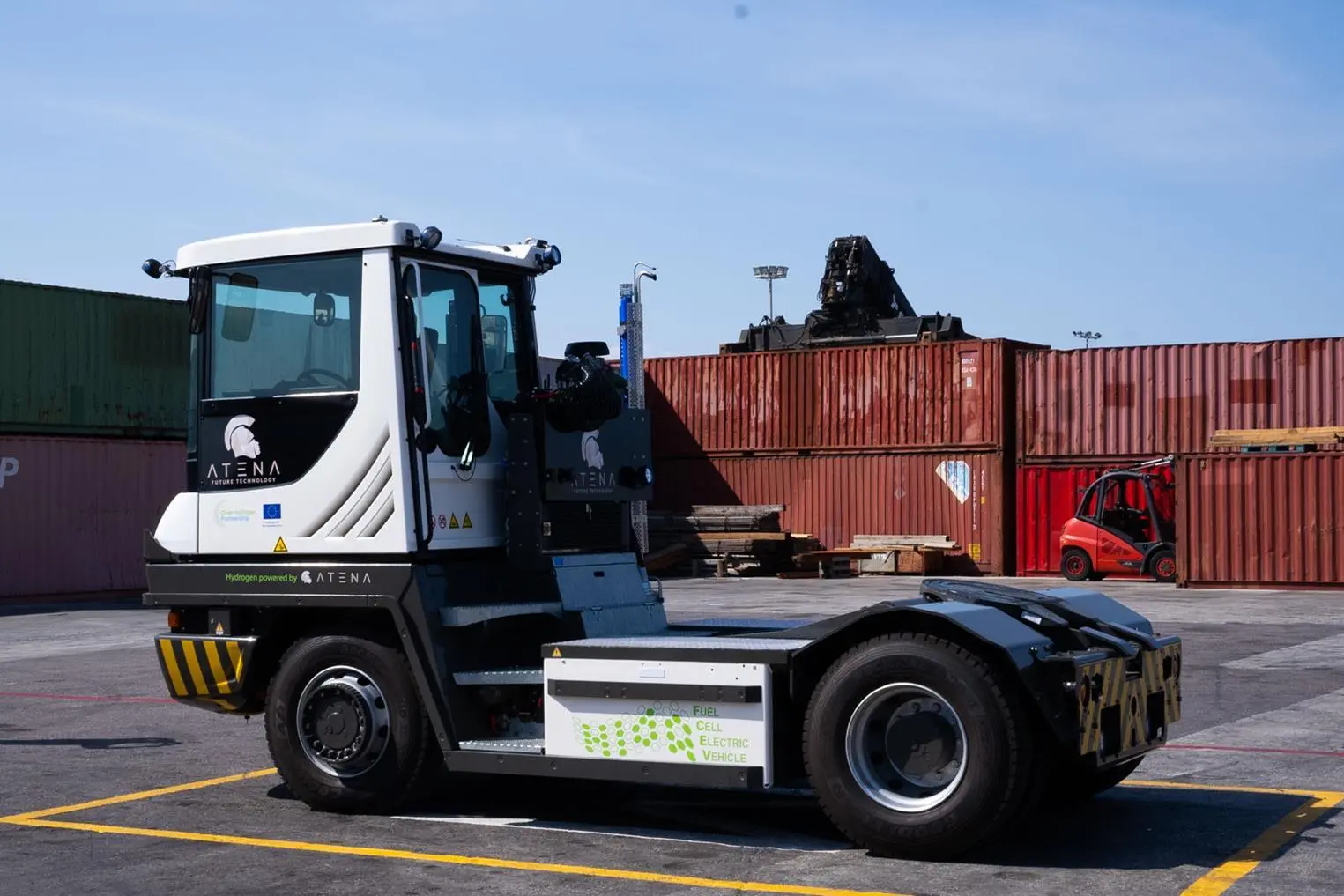
Now in service under normal operational conditions at the port of Valencia is a hydrogen powered reach stacker at the MSC Terminal Valencia and a hydrogen powered terminal tractor at the Grimaldi operated Valencia Terminal Europa. Introduced in late 2023, well known cargo handling equipment supplier Hyster is the force behind the development of the reach stacker and the ro-ro tractor was developed by ATENA, a research and technology hub based in the Campania Region of Italy. Both units are acknowledged to be highly innovative and the first of their kind to be put into operational service, albeit on a test basis. Prolonged testing – for up to a year – will enable performance assessment of the machines in their own right and in comparison to conventional diesel powered units.
Developed as part of the H2PORTS project, a clean hydrogen partnership involving the Port Authority of Valencia, the Valenciaport Foundation and a range of other participants including the two terminal operators referenced above, the expectation is that the fuel cell powered Hyster reach stacker will offer a performance comparable to a diesel powered version in terms of capacity and lift and drive speeds, utilising independent traction and hydraulics with different electric motors to serve different functions. In terms of operational duration, Hyster reports that when combined with the right application and operating intensity it expects the machine to be able to work for two shifts before a hydrogen refuelling is required. As far as this process is concerned, the reach stacker is designed to interface with the standard hydrogen filling station connection thereby facilitating wide usage.
The design provides for four hydrogen tanks as a standard option to store hydrogen in the body of the reach stacker.
The hydrogen fuel cell supplies power to the electric motors or returns it to the batteries depending on the demands of the task in hand, while simultaneously considerably reducing greenhouse gas emissions and noise pollution compared to a diesel unit.
As the Port Authority of Valencia underlines, Hydrogen is a clean energy carrier with the inherent advantages of easy storage and, when used, the production of no emissions other than heat and water.
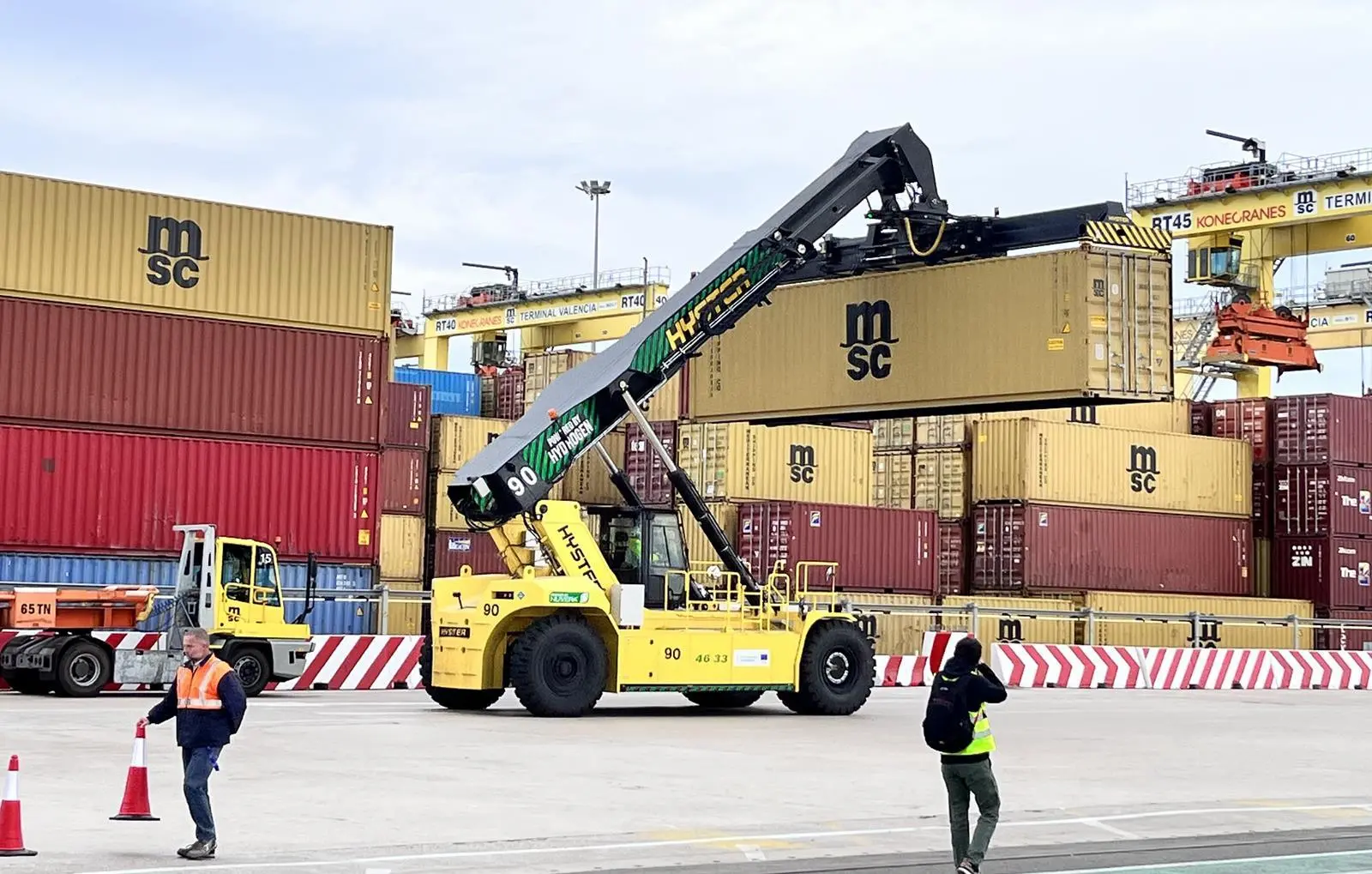
The hydrogen fuel cell converts H2 into electricity, resulting in zero-emission equipment that, when combined with the use of environmentally-friendly hydrogen, is also carbon neutral. The technology generally is seen to have some advantages compared to other available zero-emission technologies such as pure electric. As touched upon above, this hydrogen powered reach stacker is seen to have a good range as well as low fuel consumption. It can also handle containers weighing in excess of 30 tonnes.
REFUELLING CHALLENGE
The challenge with refuelling the reach stacker is to get the time required to do this down to five minutes from the current 15 minutes it now takes.
The hydrogen supply station includes a fixed part dedicated to the reception, storage and compression of hydrogen up to delivery pressure and a mobile part that stores the compressed hydrogen and has a dispenser for refuelling the reach stacker and terminal tractor.
The tractor design features a fuel cell/battery hybrid powertrain which reportedly allows the vehicle to perform all the intensive tasks that are required during roll-on roll-off operations. Its hydrogen storage system, made up of four Type 3 cylinders (350 bar), has an overall capacity of around 12 kg, which is said to guarantee a continuous operation of at least six hours before refuelling is required – this corresponds to the average duration of a working shift.
The electric motor utilised is described as a “light and efficient device, particularly suitable for power demanding applications.” It is fed by a high-performance LiFePO4 battery, with 25 kWh energy capacity, and a 70 kW Ballard fuel cell module. The electric motor can receive power for traction from the fuel cell and battery simultaneously or charge the battery during braking or decelerations. At the same time, the fuel cell can provide power both to the electric motor and the battery, if needed. The hybrid powertrain is said to facilitate high operational efficiency, since it takes advantage of a significant share of kinetic energy recovery.
PROJECT COORDINATES
The European project – H2PORTS – Implementing Fuel Cells and Hydrogen Technologies in Ports is coordinated by the Valenciaport Foundation in collaboration with the Port Authority of Valencia. It is financed by the Clean Hydrogen Partnership programme and has as its stated core objective to test and validate hydrogen technologies as applied in port machinery which “allow applicable and real solutions without affecting the performance and safety of port operations and producing zero local emissions.”
Total investment in the H2Ports project is put at around €4 million and involves, in addition to the Valenciaport Foundation and the Port Authority of Valencia, the National Hydrogen Centre, as well as the private companies MSC Terminal Valencia, Grimaldi Group, Hyster-Yale, ATENA Distretto Alta Tecnologia Energia Ambiente, Ballard Power Systems Europe, Carburos Metalicos (Air Products Group) and Enagas.
The Port of Valencia claims to be the first port in Europe to incorporate hydrogen technologies to reduce the environmental impact of its operations. The trials of both the reach stacker and terminal tractor will run through to the end of 2024 ensuring comprehensive performance assessment.
Related Articles
 TERMINAL OPERATIONS
 DIGITAL
 DIGITAL