![PortStrategy[GreenPort]](https://www.portstrategy.com/wp-content/uploads/2026/09/PortStrategyGreenPort.svg)



Lighting up with LED
LED and smart solutions are prominent in the port lighting sector
SECTOR ANALYSIS: LED AND SMART SOLUTIONS TO THE FORE
The ports lighting supply sector is moving rapidly towards energy efficient LED solutions, on the back of the drive for sustainability, operational cost reductions and less maintenance.
The case-by-case supplier news below highlights the move towards LED with both new launches and retrofit projects favouring this solution. They also highlight the drive to reduce the impact of port lighting on sensitive marine eco systems, an area being spearheaded by DarkSky International (see below). According to the global light pollution authority, more than 22% of the world’s coastal waters are exposed to artificial light at night.
Alongside LED and sustainability, there has been a rise in smart lighting systems that boost safety and real-time monitoring. United Kingdom Ports Terminals Lighting Market Research Report, 2025-2032 says: “Emerging applications include adaptive lighting systems that respond to vessel traffic and environmental conditions, aligning with Industry 4.0 trends.” It adds that “breakthrough innovations in wireless controls and AI-driven lighting management platforms are enhancing operational efficiency.” As the below shows, smart lighting systems are a growing focus for ports globally.
DATA ANALYSIS: INSTALLATIONS, RETROFITS, SUSTAINABILITY, COST REDUCTION
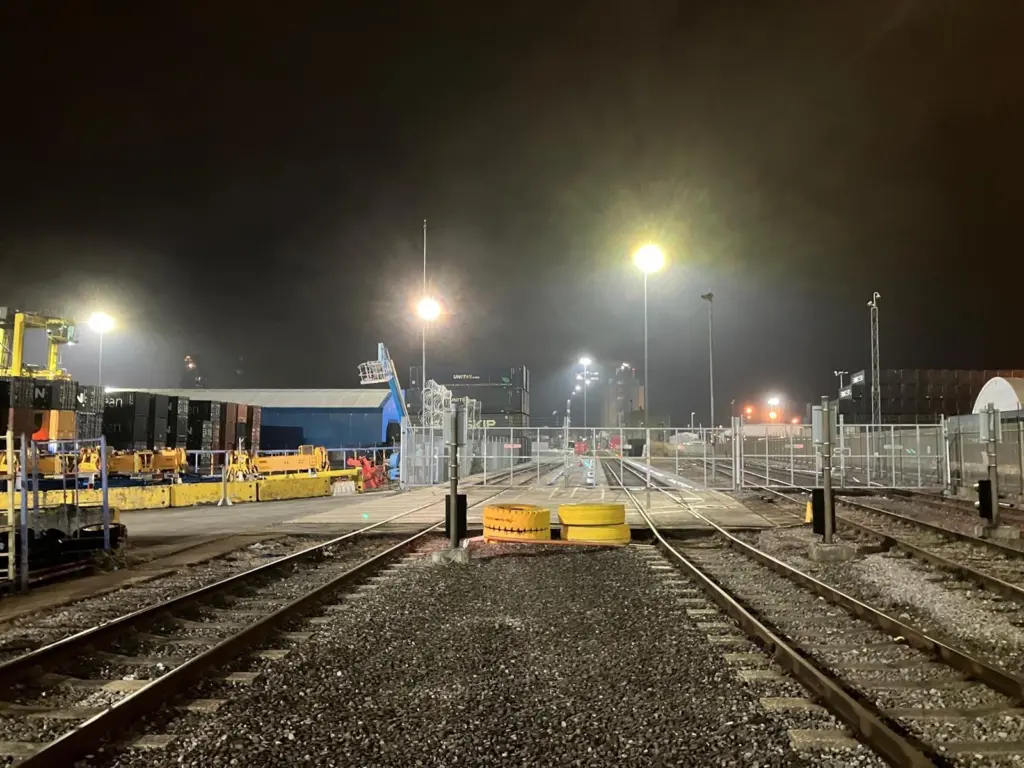
Abacus Lighting: Abacus Lighting has recently completed what it calls a “landmark” retrofit project at the Port of Tilbury, enhancing the port’s operations with energy-efficient Challenger 1 floodlights. The floodlights, which are mounted on masts equipped with internal climbing ladders for safe maintenance access, provide “excellent illumination”. Abacus Lighting notes: “The upgrade offers significant benefits to the port, including enhanced safety for workers and drivers, reduced energy consumption, and a lower carbon footprint due to the superior efficiency of the Challenger 1 technology.” Elsewhere, UK-headquartered Abacus provided new lighting as part of the Aberdeen Harbour expansion project, to ensure safe and efficient operations, particularly during night shifts and adverse weather conditions. The solution incorporates a new LED lighting system which aims to enhance Aberdeen Harbour’s operational efficiency with reduced energy consumption and maintenance costs. A wireless control solution was installed throughout, that can be dimmed through a computer system in the gatehouse.
Continental: German manufacturer Continental has expanded its NightViuÒ LED Driving Lights to include 10 more models. Engineered for Construction and Off-Highway Use, including ports, the new lights have been designed to help improve operational safety by increasing nighttime visibility. They feature rugged aluminium die-cast housings with cataphoretic coating, and resilient shatterproof polycarbonate lenses. Depending on the model, they are rated IP69K or IP67K for Ingress Protection (IP) from dust and water. NightViuÒ Multi-function Driving Lights and Lightbars feature free-form reflectors that direct the light beam to where it is needed. Elsewhere, NightViu® reversing lights feature Fresnel lenses to create a broad field of illumination directly behind the equipment. NightViu® Driving Lights provide up to 5,500 lumens and a beam field length of up to 440 metres. They also include integrated electronics driver and a thermal management system to allow them to operate safely from -40°F to +190°F. They produce from 50-100 lumens per watt, depending on the model.
Cree Lighting: The US headquartered company has expanded its Dot. family of retrofit LED engines with Dot.wall and Dot.fuel gen2. Dot.wall is the only Dot. available with a dedicated housing, making it a full, stand-alone luminaire. Dot.fuel gen2 now comes pre-assembled and is available with up to 12,000 lm per LED module. “… Dot. reaches new heights of sustainability thanks to its modular design. With Dot., ageing led installations can be easily updated without the need to replace entire fixtures. This can save up to 68% of raw material and is an important step towards the circular economy,” says Alberto Gerli, Sales Director, Cree Lighting. Dot. Is suitable for urban and industrial applications. The family’s energy-saving toolkit includes LEDs, dedicated lens optics, auto-dimming, and smart lighting modules, including Zhaga sockets and sensors, which enable communication between the environment, drivers and LED modules. Last year also saw Cree Lighting highlight its role within terminal lighting with its participation in the British Ports Association (BPA) Conference, in the UK. Showcasing how its marine lighting solutions are specifically designed to perform in marine environments, it explains that they are available with a specialised C5 anti-corrosion coating, along with the company’s LiteStrong™ non-corrosive housing material.
CU Phosco: UK headquartered CU Phosco, which designs, manufactures and installs high mast lighting, singles out how one of its specialist areas is port lighting. CU Phosco undertakes contracts at ports worldwide, working with large port operators including DP World, APM and ICTSI. Recent projects include the ABP-owned Port of Southampton. Most of the large areas in the port are lit using high masts. The main objective of the project was to reduce the cost of illuminating and maintaining these high masts by converting them to more efficient LED products and installing fixed head lantern carriages to reduce maintenance costs further. CU Phosco was appointed as the main contractor. Telensa CMS nodes were installed in each lantern to provide additional control and reporting information. Singling out the FL800R and P855 lights, CU Phosco says that they “provide exceptional optical control minimising obtrusive light, without compromising the lighting performance”. Following the successful completion of the project, ABP has awarded CU Phosco a second phase of high mast LED replacement works.
DarkSky International: Global light pollution authority DarkSky International has launched a new certification programme to bring responsible lighting to industrial-scale ports. The DarkSky Approved Port Marine Terminal Lighting Programme is designed to significantly reduce light pollution, safeguarding sensitive coastal ecosystems and nearby communities. Initiated in 2023 in partnership with Port Tampa Bay, the port engineering team selected LED fixtures with advanced optical controls, dimming capabilities, and shielding to reduce glare and minimise light trespass beyond the port property. DarkSky Approved Port Marine Terminal Lighting is the latest addition to the DarkSky Approved programmes suite, a third-party validation programme that recognises lighting products and projects that protect the night. A statement says that the new certification “fills a critical gap, guiding ports in transitioning to LED lighting with proper optical control, shielding, and dimming systems. These solutions ensure light is used only where and when it’s needed, while virtually eliminating unnecessary spill into surrounding areas.” Throughout 2024, DarkSky and Port Tampa Bay engaged lighting designers, marine infrastructure experts, and environmental advocates to ensure the programme meets both operational needs and ecological goals. The resulting guidelines are now available for adoption by other ports and marine facilities worldwide.
Phoenix Lighting: The US company has introduced next-generation lighting solutions spanning High Mast LED, wet docks and port cranes over the past five years. It first launched its ModCom Series – designed for applications including port cranes – LED floodlight in 2010. In 2023, it introduced its upgraded ModCom 3 Series, which incorporates end user and industry feedback. Highlighting the upgrades, the company says: “The ModCom 3 delivers powerful illumination at 130 LPW, providing more light for less cost. It has survived extensive testing, including temperature, impact, vibration and salt spray. It now also includes heat monitoring technology, which will preserve the life of the fixture in extreme heat, dust, and debris.” The series is available in three different sizes – LO, HI and MAX. A patented no-glare/ perimeter optic delivers light only where it is needed and minimises glare to operators. Its next-generation Soar Series High Mast LED is designed for high output illumination across ports and terminals. The fixture delivers up to 130,000 lumen output performance in a sleek design with all components housed in a IP66-rated, marine grade die-cast aluminium enclosure. The fixture mounts to a standard 2-3/8 inch (60 mm) mast arm with adjustable +/- 5 degree tilt capability. The company has also released DLAW 2, its next generation wet location LED task light. The DLAW 2 boosts productivity by optimally lighting more challenging applications including spray down areas, cold storage, and docks exposed to outdoor conditions. Other improvements include a lighter weight, and more compact polycarbonate head for less strain on the arm and better stability.
Schréder: Germany headquartered Schréder has played a major role in the provision of smart and sustainable lighting within the Port of Rotterdam’s Maasvlakte 2 development project. This expansion included the creation of an empty depot of approximately 16 hectares for Star Container Services. Schréder was chosen to provide lighting for this new outdoor area. To ensure safety and optimal visibility in all weather conditions, it proposed the energy-efficient and high-performance BRITELINE floodlight, which was coated to meet C5 standards for highly corrosive environments. A total of 78 floodlights were mounted on fourteen 45-metre-high Valmont masts and strategically positioned to provide uniform lighting across the area, taking into account shadows from the containers. Brent Compeer, Area Sales Manager Industry, Sport & Transport, Schréder, comments: “For this project, we conducted a detailed lighting study, taking into account the shadows of the containers on the site. Although this was not explicitly requested in the tender, we felt it was important to incorporate this additional aspect to achieve the best possible result.” All the floodlights are controlled by the Schréder EXEDRA lighting platform, which can adapt the lighting to exact requirements. Schréder said that as the platform is open and interoperable, it offers a futureproof solution for integrating devices or applications.
Related Articles
 TERMINAL OPERATIONS
 DIGITAL
 DIGITAL