![PortStrategy[GreenPort]](https://www.portstrategy.com/wp-content/uploads/2026/09/PortStrategyGreenPort.svg)





Port call impetus
Optimising vessel movements port to port and thereby maximising efficient berth usage is now a highly relevant area of attention. Mike Mundy charts the key initiatives and benefits cited
Thor Thorup, Chief Commercial Officer and Co-Founder at Portchain highlights the fact that in two short years around 130 ports and terminals have signed up for its Portchain Connect system – a system which through a digital handshake aims to efficiently align berth availability with vessel arrivals on a just in time basis.
Reflecting on the formation of Portchain, Thorup states: “We saw a challenge in the interface between lines and terminals. Vessels arriving at ports out of sync with berth availability is an inherently wasteful process. If the vessel arrives too soon it can create congestion and invariably involves excessive fuel consumption and emissions. From the terminal side it was plain that vessels arriving too soon or too late posed major challenges in terms of resource planning – equipment, labour and so on – and therefore with new generation technology available and coming online we set about optimising the port to port vessel movement, digitalising the process, enhancing planning and throughout employing quality data.”
The latter element is actually key coupled with capturing all the indicators which facilitate accurately forecasting arrival time. The latter include: departure time from the previous port of call; the impact of exceptional events such as heavy weather/port closures/port congestion, accurate vessel tracking and other influential factors. Digitalising this information basically provides a highly accurate overview allowing much greater accuracy with the alignment of the timing of the vessel process. If it can be seen the vessel will arrive too soon, it can be slowed down reducing bunkers and emissions by 6 to 14% according to Portchain. Conversely, it is possible to use the information to speed a vessel up to hit a particular spot and thereby expedite vessel turnaround.
Portchain also offers its Portchain Quay module which complements its Portchain Connect product. Thor Thorup describes this as a planning tool employed by terminals to match terminal resources – labour, equipment etc. “it speeds up workflow,” he underlines.
GROWING INTEREST
To some extent Portchain can be regarded as a pioneer in the business of optimising port to port vessel movements and thus berth usage – having drawn together all the treads that facilitate a digital handshake between ports/terminals and shipping lines.
This field, however, and allied fields can be seen to be the subject of growing interest on diverse fronts on the part of ports own initiatives focused on berth optimisation and at a wider level that of industry associations
In the latter context, it is noteworthy that the Supply Chain Resilience Taskforce (SCRT) has recently released its study, Port Call Optimisation through Data Quality. SCRT points out that the rationale for the study arose out of, “The urgent need to implement The IMO Compendium on Facilitation and Electronic Business in the maritime sector and harmonising communication and the electronic exchange of operational data for port calls. The approach the study takes is an interesting one – it centres on presenting “essential findings and key insights from various in-depth interviews with port authorities and maritime stakeholders on how they implemented Just-in-Time Arrival best practices.
The SCRTis made up of chainPort, IAPH, DCSA, tic 4.0 and IPSCA thereby offering a good cross section of views and experience. Briefly, major points highlighted in the report are:
- The need to adopt international standards and standard identifiers. “It is a big task to digitalise all the data for the entire port process and the report notes that in some cases ‘data is manually submitted once a day, highlighting a mixed approach of automation and manual input.”
- Achieving the optimal position is not always possible in the short-term. “Integrating systems with non-standard identifiers and ensuring synchronisation of data is challenging but necessary for consistency,” the report notes.
- As best practice the study recommends ports focus on the accuracy and reliability of real time data, and implement and synchronise key timestamps including ETA berth, ATA berth (Actual Time of Arrival) and RTD (Requested Time of Departure).
- The deduced benefits of port call optimisation are significant. Notably a reduction in “turnaround” (call planning time) from an average of eight hours to two hours and the ability to plan operations three or four hours ahead.
- Finally in conjunction with the Port Call Optimisation through Data Quality report it is worth underlining it is not just a sector report but provides some very helpful information onj how to about moving purposefully down this path. Two key examples are:
- A seven point checklist on data quality regarding implementation of port call optimisation, and
- In the fourth chapter of the report best practices and recommendations that go beyind the topics mentioned by the interview participants. These are categorised under three main headings Data Collaboration and Standardisation, Digital Platforms and Systems and Data Quality.
INDIVIDUAL INITIATIVES
In terms or recent individual initiatives in the sector, which wholly or partially contribute to berth/port call optimisation the following are particularly noteworthy:
- The Maritime and Port Authority of Singapore (MPA) has announced that it is planning to use artificial intelligence (AI) and digital twins to optimise vessel route planning to enhance safety and reduce emissions. Bottom line, the Authority states: “The aim is to achieve just-in-time arrival to reduce the turnaround time for vessels in port.” To facilitate moving towards this goal it has signed a memorandum of understanding with Microsoft and generally emphasises: “The focus lies on technologies including cloud computing, AI, data analytics, robotics and cybersecurity to develop digital and green solutions for the maritime industry.”
MPA states that together with Microsoft it will, “…co-develop digital solutions or leverage existing Microsoft products to support small and medium enterprises, focusing on demand aggregation and energy efficiency in shipping and port operations.”
Another interesting project only recently announced is the European Space Agency’s DECARDIS project (Decarbonisation through Digitalisation in Shipping). It has a powerful group behind it, Awake AI, ABB and Wallenius Marine. They will collaborate on the development of technologies to assist ships in adjusting their speed and arriving at the destination port at the right time – not early. The goal is to eliminate fuel wasting which is also a goal of the Blue Visby project. The reported path to achieving this is by “developing an integrated an interoperable system to integrate decision making on ship routing and speed to achieve just-in-time arrival processes at the berth.”
The Blue Visby programme is bulk carrier focused and has recently conducted some prototype trials 2which confirmed double digit savings over a 10-voyage test programme.
SCRT for its part states “…the benefits of port call optimisation are significant. They include a reduction in ‘turnaround’ (call planning time) from an average of eight hours to two hours and the ability to plan operations 3 to 4 hours ahead.”
TOS INFLUENCE
Terminal Operations Systems (TOS) are generally not involved in the mainstream of port to port vessel movements. Having said that as Chad Van Derrick, Global Transformation and Innovation Leader of US-based Tideworks Technology explains the modern TOS systems are progressively being developed so that they can contribute to this process – the use of AI, for example, to predict vessel arrival dates or digital twins to predict multiple scenarios and plan accordingly regarding the terminal’s vessel calendar.
Nevertheless, such initiatives remain largely firmly fixed on terminal resource planning which when done at the highest level can have the much-desired effect of freeing up capacity due to optimised terminal operating arrangements.
VERY RELEVANT
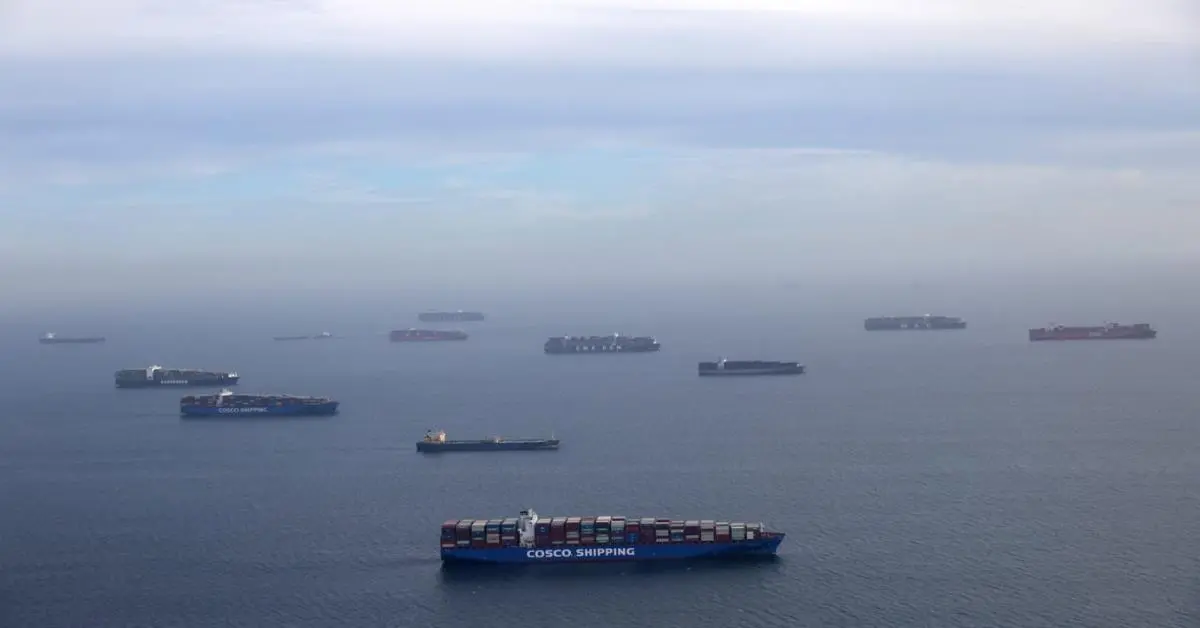
The potential that the above referenced systems and initiatives have to optimise port to port vessel movements with allied benefits regarding reduced emissions is extremely relevant today. We have seen the huge negative impact that Covid had on orderly vessel movements, vessel bunching etc. The consultancy Sea Intelligence has recently suggested that in Asia Europe trade the same level of problem now prevails – driven by the Red Crisis and other local factors such as labour strikes.
The example of the port of Singapore is given which is said to have seen about 90% of vessels arriving off-schedule, compared to an average of 77% in 2023. Port stays are also said to have increased in Singapore by 22% when compared to the same period in 2023.
Clearly, there is a strong need to focus on port-to-port vessel movements and optimising the process. A much higher level of efficiency is required and the commensurate effort to achieve this.
Related Articles
 TERMINAL OPERATIONS
 DIGITAL
 DIGITAL