![PortStrategy[GreenPort]](https://www.portstrategy.com/wp-content/uploads/2026/09/PortStrategyGreenPort.svg)





Portsmouth pilots a new smart energy system
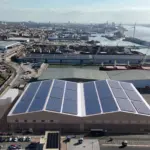
Portsmouth International Port is piloting a new smart energy system as part of its strategy to significantly decarbonise operations at the port and further afield.
The port, located on the south Coast of England, is working with Swanbarton, ESC and MSE International on an initiative that has been dubbed the Port Energy Systems Optimisation (PESO) project.It employs smart grid technology and energy storage to reduce the adverse impact of ports on air quality.
The PESO system involves using a dual chemistry battery and a multi-level control system that utilises AI-based capabilities. The control system learns from historic energy consumption profiles to ensure that the battery can deliver as much stored energy as possible when demand is high. A predictive ‘digital twin’ model boosts the storage capacity of the battery to fully use energy generated by on-site renewable generation procured from the power grid when prices are lower.
This project is co-funded by Innovate UK, an agency that works to show how port infrastructure can meet the UK Government’s ‘Clean Maritime Plan.’
The partners in the project maintain that most ports will contract with a third party provider to build and operate the PESO system, with the first locations expected to be where ships are obligated to utilise shore-based power to comply with policy developments in air quality and carbon emissions.
“Terminals and recharging sites will be required and PESO has a critical role to play in minimising costly impacts on the local grid. It will do this by smoothing the power demand of the recharging sites and by prioritising as much power draw as possible at times of excess capacity in the grid (e.g. at night). The energy stored in PESO can then be made available to vessels when needed,” explains Portsmouth International Port, adding that the consortium partners are expecting to advance the commercial deployment of the PESO concept during 2023.
Mike Sellers, Port Director, Portsmouth International Port, highlights the port’s objectives in more detail: “Our aim is to turn the port into a living laboratory of green technology. We were delighted to collaborate with partners on the PESO project, which has so much potential for the wider ports and shipping industry. Combined with other sustainability initiatives, the findings from the PESO project will help us achieve our ambition of reaching net-carbon zero by 2030, and becoming one of the UK’s first zero emission ports by 2050,”
Related Articles
 TERMINAL OPERATIONS
 DIGITAL
 DIGITAL