![PortStrategy[GreenPort]](https://www.portstrategy.com/wp-content/uploads/2026/09/PortStrategyGreenPort.svg)





Private 5G transforms port networks
Private 5G (P5G) networks are emerging as a critical technology to help support ports and terminals in their transition to fully automated, complex operations.
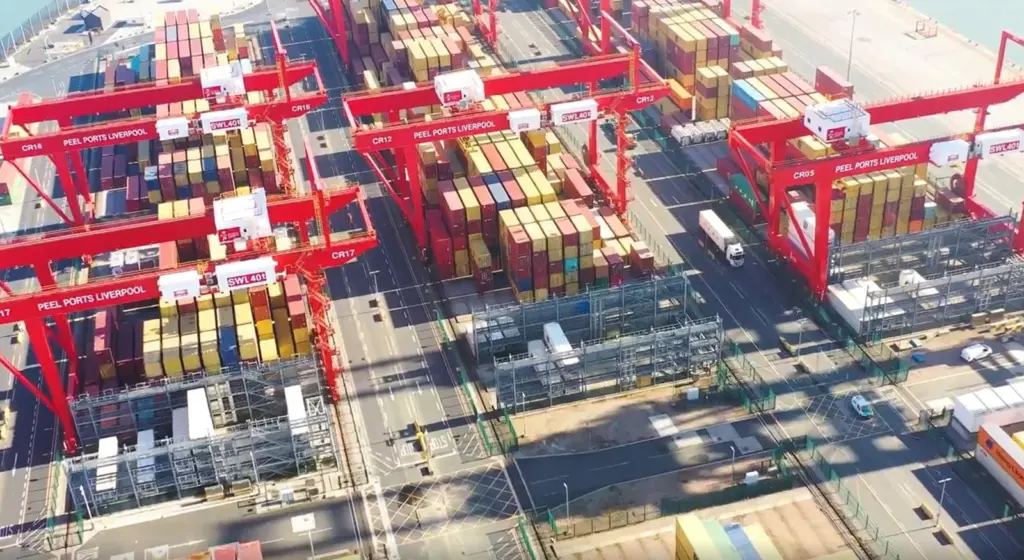
Ports must manage sensitive data and coordinate numerous moving parts across expansive areas. Legacy communication systems can struggle to keep pace with the real-time precision required whereas P5G networks offer a future-ready solution by providing dedicated, customisable wireless connectivity.
Julie Rimmer, technology and automation transformation director at Peel Ports Group, highlighted the benefits. “P5G will give us greater control over the connectivity that we need across the port,” she said.
“It will allow us to enhance security, reduce latency and also restrict bandwidth for certain functions.”
Peel Ports has been pioneering P5G adoption at the Port of Liverpool, where the network has dramatically improved operational efficiency and worker safety. The initiative was co-funded by Cisco and the UK Department for Science, Innovation and Technology.
Frank Rubotham, head of solution specialists at Logicalis UK&I which took on the role of key delivery partner during the trial, emphasised the technology’s ability to overcome port-specific challenges.
“Ports are very difficult environments to deliver wireless networks into, with lots of moving machinery and large metal structures, but P5G has made this much easier,” he said.
“It has delivered connectivity right across the port, enabling Peel Ports to develop in terms of efficiency, security and employee safety.”
As Britain’s ports embrace digital transformation, private 5G networks are poised to become the backbone of smart, secure and scalable port operations, setting a new standard for connectivity in critical infrastructure.
Related Articles
 TERMINAL OPERATIONS
 DIGITAL
 DIGITAL