![PortStrategy[GreenPort]](https://www.portstrategy.com/wp-content/uploads/2026/09/PortStrategyGreenPort.svg)






REEL CHALLENGES & ANSWERS
John Bensalhia reviews FLT clamp design for paper reel handling, the challenges and the latest solutions.
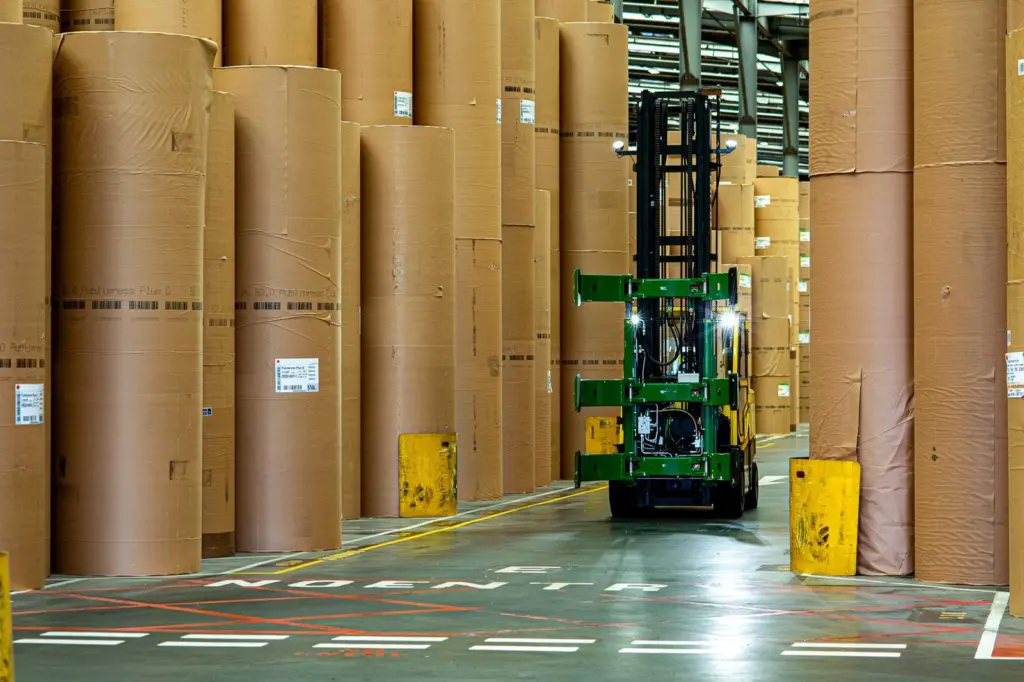
Due to their composition and size, paper rolls, out of the wide range of paper products produced, need particularly careful handling. In order to avoid potential damage and to maximise safety during the handling and transport by a forklift truck (FLT), port operators need to secure the rolls in place with purpose-built FLT clamp attachments.
There are a range of factors involved in choosing the right kind of clamp. Hyster explains that typical attachments used for paper handling include rotating paper roll clamps and non-rotating single and double tower clamps, as well as several other variations depending on a particular application’s needs.
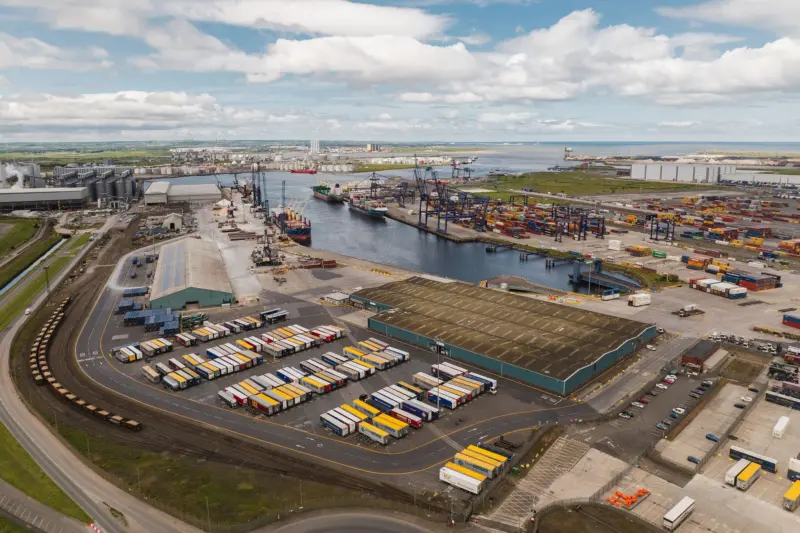
A key user elaborates: “One of the main considerations when choosing clamps is flexibility in handling products in respect to diameter and weight,” says John Russell, Asset Manager, UK Paper Hub (Port of Tilbury). “We have clamps varying from 1300mm diameter to 2300mm diameter which can lift up to 7.5 tons. We have single and double tower clamps which enable us to safely handle multiple reels at once.”
Cascade and Bolzoni Auramo are, historically, the main brands utilised by the majority of ports and terminals. Both continue to expand and refine their respective product ranges.
DAMAGE AND SAFETY
A key design consideration is making sure that the clamping force is right. Each case is different, meaning that a one-sizefits-all arrangement won’t work for many reasons. If the force is too great, this can cause damage to the paper reel, which runs the risk of deforming. If the force is too slight, the reel is likely to slide or drop out of the clamp and suffer costly damage. The reel is also at risk of damage if clamps are placed in weaker locations such as the reel edge.
A loose-fitting clamp also poses a serious risk to health and safety: “Other than damage, Health & Safety is paramount when choosing the correct equipment,” says John Russell. “Dropping a reel could cause serious injury and could even be fatal.”
Clamp design can play a part in reducing risk when working in closed or cramped working spaces. One approach is reducing the size of the clamp arm. Slimline arm designs, as developed by Bolzoni Auramo for example, not only maximise safety but also facilitate easier and more accessible operations in confined spaces.
GETTING THE PRESSURE RIGHT
In order to alleviate clamp related pressure level problems, innovative solutions in clamp design have been developed. The UK Paper Hub (Port of Tilbury), for example, has worked alongside Cascade and Briggs Equipment on a special clamp project.
“We worked collaboratively with Cascade and Briggs equipment to produce a clamp which automatically applies the correct pressure and maintains that pressure even when travelling which causes dynamic movement,” says Russell. “We have twin bore rams that can alter the initial threshold pressure to take into account of heavy but smaller diameter reels which require specific pressures.”
This clamping system provides two levels of clamp force. The operator doesn’t need to manually adjust the settings as the attachment is fully automated, providing accurate application of the required force. When the right force is applied, a light indicator informs the operator of this fact, as well as when the clamping arms are fully open. Cascade also provides the options of using Hydraulic or Adaptive Force Control as a means of ensuring the right pressure levels for paper handling.
While Hydraulic Force Control (HFC) automatically controls clamp force in relation to the load weight, Adaptive Force Control (AFC) utilises a pre-programmed ratio based on both the type and weight of the paper as a means of setting an optimal clamp force. Also available is Cascade’s HFC+, a combination of the HFC with a paper roll clamp dual cylinder system. This combined innovation allows the same paper roll clamp to handle multiple weight and diameter ranges of paper rolls.
The dual stage cylinder system has two alternative stages: Primary and Secondary. Primary is geared towards handling heavier, larger diameter rolls, while Secondary is used for lighter, smaller diameter rolls. Bolzoni Auramo’s paper roll clamp range includes a dedicated clamp for heavy-duty forklift truck handling of up to eight paper rolls at a time.
“Even if they have big capacities, these clamps offer excellent visibility and have the same damage reduction features as our smaller series of paper roll clamps,” says Lars Petersson, Bolzoni Group Paper Products Specialist, Bolzoni Group and Auramo OY. He elaborates, “With the new adjustable height option, the driver can easily adjust the height of the clamp according to the rolls being handled.” In order to reduce the risk of paper damage, the adjustable height option is part of the hydraulic adjustable top section. This can be fitted as optional on all tower clamps. “This is recommended both for single and the double handling of rolls.” “With this option, the driver can easily adjust the height of the clamp to fit the rolls being handled. This gives a secure grip on all rolls together with reduced risk to damage on the paper roll edges.”
THE RIGHT TOUCH
A further design feature to prevent damage is the contact pad. With tissue paper handling, for example, extra care is needed in order to prevent damage to this particularly sensitive material. Bolzoni Auramo’s tissue roll clamps include specially designed pads in a choice of single, triple or convex radius and a range of friction surface choices.
Each port-based paper handling task will require a different kind of attachment. Single tower clamps, for example, afford a high degree of clamp flexibility in that they can be used for a greater variety of roll configurations. Hyster says that there are also a choice of pre-set pressure settings, which means that operators can swiftly make the right choice for a particular reel type. Furthermore, slim profile split arms are strongly recommended for tight stacking, damage-free handling. With a contact pad on each paper roll, this gives a secure, safe grip.
Kaup’s split long arm clamp is designed to handle two lots of paper rolls at the same time. The Kaup clamp can manage rolls of the same and different sizes, securely holding them in place. Lars Petersson adds that the use of split arm clamps is a means of providing sensitive handling for the roll edges. “We all know,” he says, “that the paper roll’s most sensitive and weak part is its edges, and that to clamp roll edges is not recommended at all. That’s one of the reasons why,” he explains, “we always recommend split arm clamps. The optimum would be to have for each paper roll a dedicated contact pad, in order to evenly distribute the correct clamping force.”
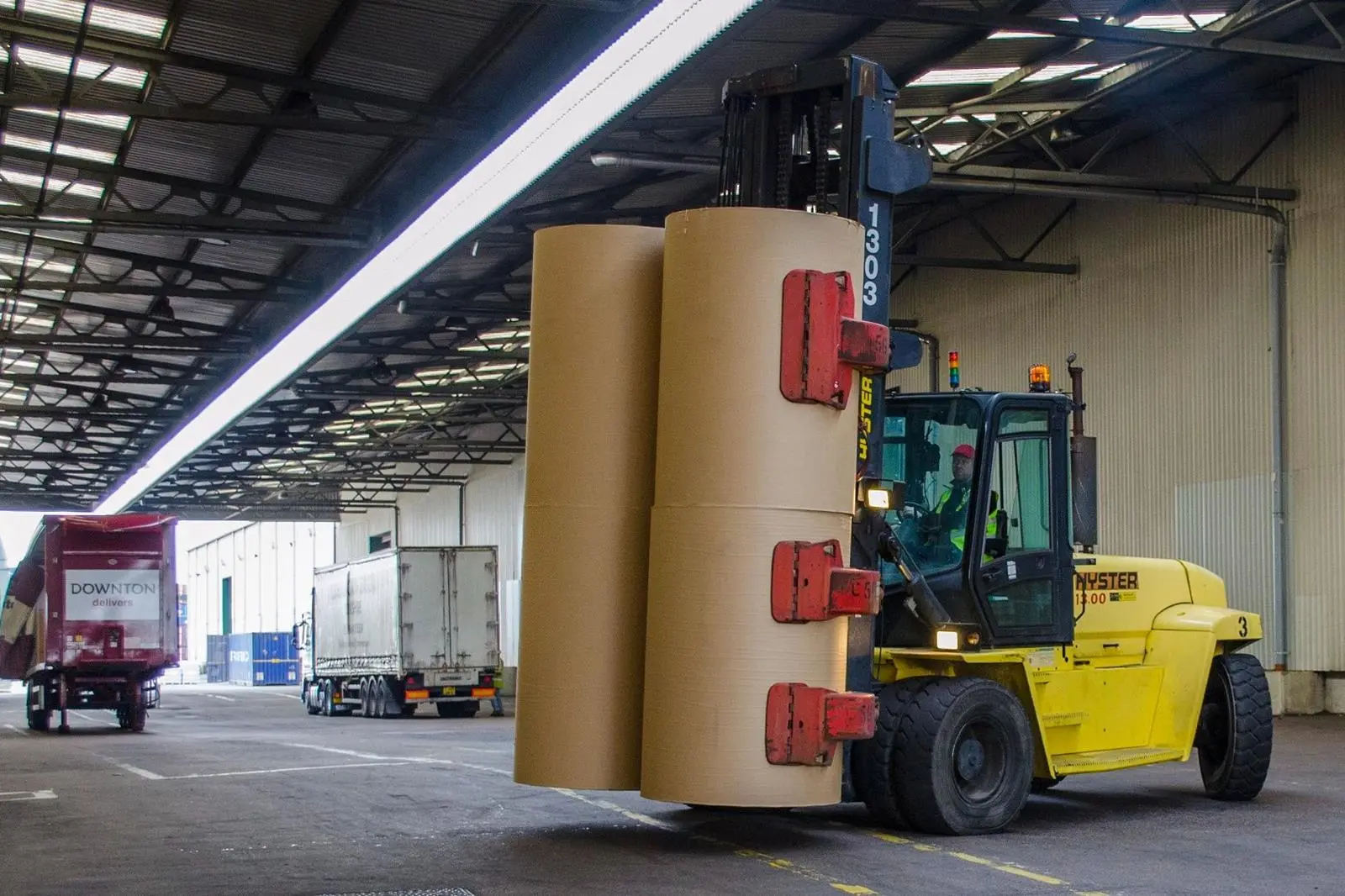
If an operator wants to achieve the work in a faster time, a double tower clamp is advised by Hyster. In particular, Hyster cites the Bolzoni Auramo double tower clamp that is capable of managing four to eight paper rolls with a capacity of up to 12,000 kg. Rotating paper clamps are another common choice. Hyster says that each clamp should have a fast, accurate rotation system with precise vertical stops and end cushioning.
FUNDAMENTALS FOR EFFICIENCY
As well as selecting the right clamp, ports must also choose the right kind of FLT that will accomplish the task in hand. “There are many clamp manufacturers with different and new technologies, all designed for specific applications, but quite often a FLT will be needed for multiple different uses in a port environment,” says Josie Fox, Industry Manager, Hyster. “Our lift trucks offer the benefits of quick disconnect hydraulic couplings, to easily switch between clamps, forks and other attachments. Our FLTs also have features such as ‘return to set tilt’ to ensure, for instance, that a paper reel can be put down flat, reducing edge damage.”
Ongoing advances in paper roll clamp design are progressively contributing to more efficient handling processes. As well as conventional clamps, manufacturers are increasingly coming up with custom-made solutions, tailored to each customer’s needs. Extra help is also available with paper clamp service and advice.
“We have the most suitable attachment for any sort of logistic and material handling need,” says Lars Petersson. “But that is not all! We can offer our competence on everything involving paper roll clamps in the logistic chain. Knowledge together with the right products is the key to achieve efficient and damage free handling,” he underlines.
Related Articles
 TERMINAL OPERATIONS
 DIGITAL
 DIGITAL