![PortStrategy[GreenPort]](https://www.portstrategy.com/wp-content/uploads/2026/09/PortStrategyGreenPort.svg)


Remote bandwagon runs on
Bigger ships mean bigger ship-to-shore container cranes and as a corollary to this increased interest in automation with remote operation leading the charge. Mike Mundy reviews sector developments
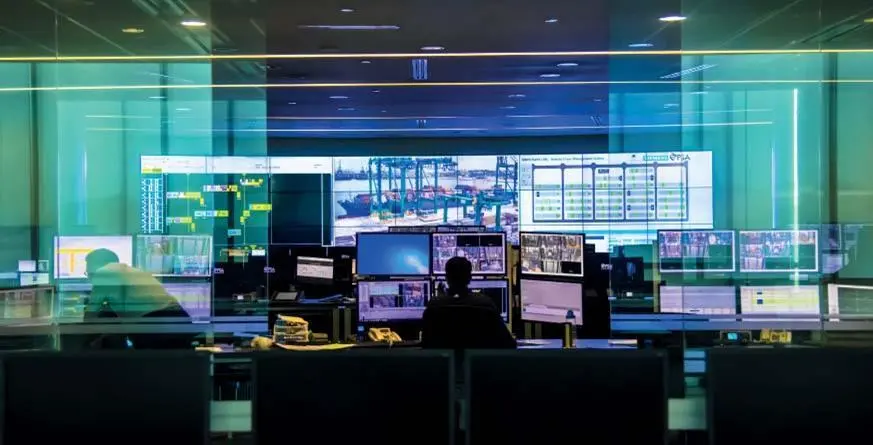
Interest in ship-to-shore (STS) container crane automation continues to build. The recent opening of Evergreen’s new Terminal 7 in Kaohsiung, Taiwan and similarly the creation of the Port of Duqm’s new container hub in Oman both signal the wider adoption of automation in STS crane design. Remote control incorporated in the crane design, as is the case at Terminal 7 and at Port Duqm, is a particularly strong indicator of this interest. Introduced as far back as 2013 – Hutchison STS cranes in Saudi Arabia – momentum in this respect has been building progressively. Table 1, highlighting select STS crane projects featuring remote control and other innovative design features, provides confirmation of this.
Terminal 7, Kaohsiung is designed to be one of the world’s most advanced container hubs, equipped with five berths with a draft of 18 meters, a quay length of 2415 meters, and 24 ZPMC built STS gantry cranes, including 19 remote-controlled units. Sixteen gantry cranes are designed to be 55.5 meters high and can handle ultra-large container ships with 25 rows of containers on deck, effectively improving the quayside operation efficiency. The five berths will be inaugurated in two phases. Currently, Berth S5, S4 and S3B have become operational while Berths S1, S2 and S3A are scheduled to commence operations during July 2024. When fully operational next year, Terminal 7 will be able to handle four 24,000TEU container ships and two feeder vessels at the same time. With a yard area of 149 hectares, the facility is able to accommodate 89,238TEU of laden containers and 43,656TEU of empty units.
The Port of Duqm has been established to work in conjunction with the largest Special Economic Zone in the Middle East and to fulfil a hub port function capitalising on its location outside the Straits of Hormuz and adjacent to the main east and west trade lanes. The container terminal overall is intended to be a state-of-the-art facility designed to serve Ultra Large Container Vessels (ULCV). The four Liebherr ship-to-shore cranes installed are high performance cranes which are, in the words of Hamburg Port Consulting (HPC), “remotely operated, equipped with cutting-edge automation technology and ensure efficient and precise container handling operations.”
HPC provided a comprehensive engineering inspection service for the Port of Duqm’s four new STS plus 12 rubber tyred gantries. as well as implemented automation commissioning including rigorous testing of the remote operation function. HPC worked closely in collaboration with Liebherr right through from crane manufacture to commissioning.
The company makes the noteworthy point that: “With increasing levels of automation and digitalisation in ports, the requirements for commissioning are becoming more interdisciplinary.”
As the Terminal 7, Kaohsiung and port of Duqm projects highlight, STS crane production now increasingly forms part of a terminal system, a handling process that, drawing on modern digital and other advanced technology, aims to seamlessly achieve expedited container movement. Effectively, today’s modern STS cranes are being developed to work at optimum levels in a smart port concept.
As a number of the dimensions referenced in Table 1 confirm – especially the crane specifications for the Tuas Terminal – STS crane structures are also continuing to grow in size. The requirement for the new, larger, STS cranes, able to serve megamax vessels, promises to continue to grow – the big indicator of this being the current container vessel order book which, at the time of writing, features 254 vessels with a combined capacity of 4.46 million TEU with this incorporating 59 vessels with a capacity of 22,000TEU or above. The current fleet possesses 391 units with capacities of 14,000TEU or above.
Scaling up promises to continue hand-in-hand with the growing interest in automation.
As Trevor O’ Donoghue, Marketing Manager, Liebherr Container Cranes, succinctly puts it: “As customer size requirements continue to increase, so will our crane sizes.”
THE DRIVE FOR AUTOMATION
There is a direct relationship between the scaling up of STS crane size and remote crane operation and automation.
Extended outreach invariably dictates the need for greater trolley speed and/or with a dual trolley system the need for enhanced overall control. Faster operating cycles underpin improved production, especially with a move towards handling multiple containers. As crane control systems supplier ABB notes: “STS crane automation makes these complex machines manageable for operators and terminal logistic systems, ensuring uninterrupted and predictable production.”
ABB also makes the point: “Automation is machine friendly. It runs the operation smoother than a human operator and reduces damage to the equipment and goods.” This, in turn, ABB suggests, “reduces the maintenance costs for machinery.”
Remote operation is seen as very complementary to the automation process or generally as a catalyst to improved production. Remote operations improve operator performance, principally via improving visibility though offering multiple views. Operators cite the camera angles as making a big difference – the ability to zoom in on a container and generally to gain a better overview of the working situation. The improved working environment of the operator is also seen as a contributary factor to improved production. Operators have cited the ability to achieve a longer production run compared to when operating from a crane cab which is identified as a more exhausting workplace.
ABB summarises: “Combining STS crane automation with remote operation from a centralised control room allows the crane capacity to be fully utilised at all times.” It cites the functions available as part of its automated solution as: continuous load sway and skew control; ship profiling and optimum path control, OCR identification of containers and vehicles for automated handoffs, vehicle position measurement and guiding of vehicles, automatic container landing on platforms, ground and vehicles, and interfacing with Terminal Operating Systems for work orders, bay layouts, container and vehicle information.
The fine tuning of all such elements and new areas of system development are a continuous process. PSA, for example, as well as developing an automated double-trolley quay crane with an outreach of 25 containers rows across, is known to be looking at aspects such as video analytics and robotics-based solutions for quayside coning and deconing operations. This is an area of ongoing attention which if technologically mastered can offer significant labour savings, enhanced production and improved safety arrangements. Similarly, another development area in which PSA has been active is the exploration of technologies to make sensors more accurate – removing the need for crane operators to make fine adjustments typically at the end of an automated operational cycle.
REMOTE KEYNOTE
There is a consensus of opinion that suggests that with today’s large, modern STS cranes remote operation is the highway to increased production. As ABB puts it: “To stay competitive, terminals need to look for ways to improve productivity. The most cost-efficient way to do that is to increase net motion time by implementing remote operations. Remote operations throughout the terminal, now also including the remote checker, will minimise the requirement to transport people to and from cranes. Shift changes and breaks can also be handled smoothly at the desk in the control room. Automation and digitalization are key enablers in making this happen.”
| Company | No of Units | Manufacturer | Dimensions | Key Design Features | |
|---|---|---|---|---|---|
|
Port of Ashdod, Israel |
5 (delivered) |
ZPM |
Outreach: 71m |
Remote Operation Semi-automated Twin-Lift |
|
|
Port of Duqm, Oman |
4 (delivered) |
Liebherr |
Lift Height: 50m Outreach: 71m Backreach: 18m |
Remote Operation Automated Ops |
|
|
ECT, Rotterdam, The Netherlands |
3 |
Sany |
Outreach (beyond 25 box rows) |
Remote Control Automation |
|
|
Eurogate, Wilhelmshaven, Germany |
2 (on order) |
Liebherr |
Lift Height: 54.5m Outreach: 73m Span btw legs: 30.48 Back reach with Secondary Trolley: 26m |
Remote Operation Double Trolley |
|
|
Georgia Ports Authority, USA |
7 (2 delivery mid-2025) |
Konecranes |
Lift Height: 165ft Outreach; 230ft |
Snag Prevention Anti-Collision |
|
|
HHLA, Hamburg, Germany |
3 (on order) |
Liebherr |
Lift Height: 53m Outreach: 75t twin Lift at 61m Backreach: 24.5m Span btw legs: 35m |
Remote Operation Automated Ops Double Trolley Energy Regeneration & Capture |
|
|
Patrick Terminals, Australia |
1 (delivered) |
Liebherr |
Lift Height: 40m Outreach: 54m Backreach: 48m Span btw legs: 25.3m |
Remote Operation |
|
|
Tuas, Singapore |
12 12 |
ZPMC Hyundai Samho Heavy Industries Co. |
Lift Height: 55m Outreach: 73m |
Remote Operation Dual Trolley Automation |
|
Related Articles
 TERMINAL OPERATIONS
 DIGITAL
 DIGITAL