![PortStrategy[GreenPort]](https://www.portstrategy.com/wp-content/uploads/2026/09/PortStrategyGreenPort.svg)


Reshaping Port Training
Simulation based training is overtaking on-the-job learning in ports due to cost savings and operational efficiency benefits.
MARKET ANALYSIS: SIMULATION TAKE-UP IS ON THE MARCH
The port training simulation market is rapidly growing, with major drivers including efficiency and its associated cost savings versus traditional, on-the-job, training. Zero fuel consumption is one of the biggest cost saving elements when it comes to using simulation compared to on-the-job training. This has the added advantage of drastically reducing CO2 emissions compared to real crane training. Fewer on-the-job training activities also see maintenance costs reduced as well as less insurance exposure from training-related incidents. Greater productivity also results due to port equipment not being taken out of service. According to GlobalSim and Hutchison Ports ECT Rotterdam, which deploys the former’s simulators, an Ship-to-Shore (STS) crane is fifty times more expensive to operate than a simulator, while simulation can save 20% – 40% of overall training costs. On top of cost savings, simulation offers enhanced and more productive training. Not only can training programmes run 24/7, but, as CM Labs Simulations says, “Multiple trainees can develop skills simultaneously on separate simulator stations—something you simply can’t do with actual equipment due to availability limits. Advanced simulation engines let trainees practice complex manoeuvres and emergency scenarios that would be too dangerous or impractical with real equipment.” Further, an undoubted benefit of using simulator-based training is the new technology it embraces, making it more useful and realistic than ever before, as the below company-by-company reviews highlight.
PARTNERSHIPS, HARNESSING NEW TECH’, UPSKILLING, SCENARIO TRAINING +
CM Labs Simulations: Montreal-based CM Labs Simulations has launched a new operator training pack for STS cranes. Part of its Vortex solution of port equipment simulators, the STS Crane Simulator Training Pack is designed to “bridge the gap between the classroom and the real equipment”, the company states, adding, “It provides progressive learning for safe lifting operations, improved STS crane productivity, and real-world crane operator skills.” It can be deployed 24/7 in all climate conditions, enabling operators to learn or upskill, even when the real equipment is in use, or undergoing maintenance. The new pack incorporates reporting and instructor tools, including an exercise builder that allows instructors to create an unlimited number of exercises, a customisable scoring system, and a real-time container path trace reporting tool. It allows trainees to operate a simulated spreader that locks onto 20-foot, 40-foot, 45-foot, and twin-20 containers. It includes operational flippers and twist-locks, and also manages chain lifts, a personnel platform, and an over-height frame. The soluSmart Training Technology deployed, which uses algorithms and includes real-time simulation features, means that training is based on real data and machines. In December last year, CM Labs announced that it had acquired GlobalSim, a Utah-based developer of advanced training simulators.
GlobalSim: GlobalSim last year struck partnerships with ports in Malta and France to build crane simulators. In May 2025 it announced that it had inked a contract with Terminal Investment Ltd’s Terminaux de Normandie to build a custom Full Mission Crane Simulator, which will be used to train crane operators in Le Havre, France. The new simulator will train STS operators and be equipped with a customised articulating tandem spreader, specific to the equipment used in the terminal. “We expect the end product to feature an incredibly detailed virtual environment that goes beyond an accurate simulation of the crane but also provides an incredible amount of detail and customisations specific to the terminal in Le Havre,” says Brad Ball, Vice President, GlobalSim. The Malta Freeport Terminals project with GlobalSim is focused on providing a Full Mission Crane Simulator. Operators will receive high-level training in the use of STS and Rubber Tyred Gantry (RTG) cranes as well as other modern crane types. US-headquartered GlobalSim, Inc. specialises in developing and manufacturing high-end simulators. As reported above, CM Labs acquired GlobalSim at the end of last year. Ball explains: “GlobalSim and CM Labs have pushed each other to innovate for nearly two decades. Joining forces allows us to combine the very best technology, engineering talent, and industry expertise from both organisations.”
Huynh Thy: Vietnam-headquartered Huynh Thy has launched a Simulation Training Centre that specialises in training operators for STS and RTG cranes. The company has partnered with GlobalSim, which has provided its Full-Mission Simulator for the centre, based in Vietnam. This simulator is designed to deliver a “highly realistic” training experience, Huynh Thy reports, allowing trainees to become familiar with crane operating procedures in a safe environment before working on actual equipment. With advanced virtual reality (VR) technology and a 3DOF motion system, trainees can experience crane operations with a level of realism comparable to real-world port environments. The training goal is over 33 moves per hour for STS cranes. Huynh Thy says in a statement noting also that the training programme is not only for beginners: “The programme is also suitable for those who want to improve their skills, hone their practical abilities, or prepare for periodic examinations”. At the heart of the training is a flexible simulation training model, which allows the learning solution to be tailored to each individual. As well as training, Huynh Thy offers STS and RTG crane assessment services.
Kongsberg Maritime: South African ports group Transnet has invested in Kongsberg Maritime simulators to boost port operators’ training. The simulators are for tug wheelhouse operations, ship navigation, engine room activities, vessel traffic services (VTS) and for using equipment that communicates with the Global Maritime Distress Safety System (GMDSS). The simulator package includes five full-mission K-Sim Navigation simulators, including one configured as a tugboat bridge; a full-mission K-Sim Engine simulator for advanced engineering training; a K-Sim VTS simulator for managing vessel traffic in ports; and a classroom of K-Sim GMDSS simulators for emergency communications training. These are embellished with a database of models covering the geographical sailing area of South Africa’s coastline and harbours to ensure realistic and practical training. The simulators replicate all immersive training aspects of a port environment and possess customised models and software covering different geographical sailing areas. The aim is to improve maritime training and development, thereby enhancing safety and operational efficiency at South Africa’s ports. Kongsberg Maritime’s K-Sim simulation systems are tailored to six different areas within the maritime industry, including ports and coastal operations. Here, it singles out its Advanced Vessel Traffic Service (VTS) simulator for operator training and certification. This can be combined with K‑Sim Navigation bridge simulators strengthening coordination and communication between ship and shore. Trainees can practice traffic monitoring, communication procedures, navigational decision‑making, emergency handling and coordination of Search and Rescue (SAR) operations.
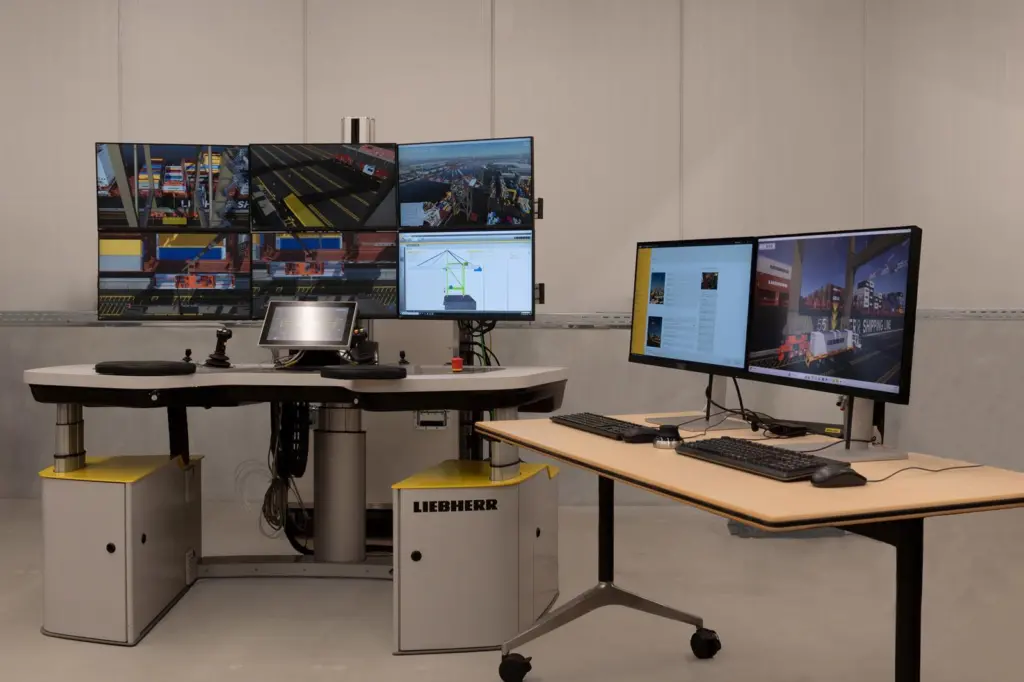
Liebherr: Liebherr Container Cranes Ltd has introduced two new training simulators: LiSIM ROS, a crane simulator designed for Remote Operator Station (ROS) controlled STS container cranes, and its LiSIM move mobile simulator. From crane start-up and shutdown to container handling on deck, in the hold, and during hatch cover operations, the LiSIM ROS mirrors the workflow of STS operations, while different vessels and terminal scenarios are included. Beyond initial training, LiSIM ROS supports operators from recruitment through to retention, including the refining of skills, practice of various load handling scenarios, and refresher courses. The instructor station features dual screens, a 3D controller, and a drone-like 360° view. With the LiSIM Driver Analysis, all moves are recorded and quantified, providing measurable results that show how each operator is performing. Elsewhere, Liebherr’s portable training simulator LiSIM move is suited for temporary training programmes, remote locations, or expanding port operations, offering a scalable solution that adapts to evolving workforce needs. The system includes original Liebherr controls, a lifelike VR environment, and a user-friendly instructor interface. Operators can practise 16 container handling exercises, five bulk handling tasks, and six breakbulk operations, each based on real-life port conditions.
Mevea: Finland-headquartered Mevea unveiled new features in its training solutions at TOC Europe 2025. These include its enhanced Report System. After completing an exercise, operators automatically receive detailed performance reports. These reports are now tailored to different stakeholders who each receive the relevant insights needed to support their objectives. Elsewhere, Mevea Training Software, traditionally managed from the Instructor Station, can now also be operated via the company’s new Instructor Tablet. This addition reportedly gives instructors greater mobility and flexibility, allowing them to access simulation data and reports in real time. Mevea specialises in physics-based digital twin simulation. Recent uptake: Ecuador’s Terminal Portuario de Guayaquil (TPG) container terminal, part of Hanseatic Global Terminals, has strengthened its operator development programme with Mevea’s high-fidelity training simulators. By integrating the Mevea Pro 5 and Pro 8 systems into its daily routines, TPG states that it has improved safety, reduced the use of critical resources, and accelerated operator readiness, without interrupting terminal operations. Before adopting continuous simulation-based training, TPG trained its operators primarily with real equipment. Josué Mena, Chief of Training and Development, TPG, explains: “We used the actual equipment and spent resources. There is a high risk when training this way, and costs are affected (they are higher).” The two Mevea simulator packages are precisely tailored to the terminal’s training needs.
Related Articles
 TERMINAL OPERATIONS
 DIGITAL
 DIGITAL