



Can ports be green in the recession?
Sian John, Director – Environment UK, Royal Haskoning, interprets their recently commissioned survey of environmental policy in UK ports
Ports are under pressure – from their customers to provide faster and more streamlined cargo handling, from their communities to become better neighbours, from legislators to become greener, and from their owners to remain profitable at a time of falling income. Hence in this current climate of reduced trade and investment, it is becoming increasingly difficult for ports and terminal owners to achieve the necessary environmental improvements being enforced by legislation. In today’s economy most ports are inevitably seeing reduced trade and income, presenting them with tough decisions about where available funds should be prioritised and invested. Clearly the majority of these resources are aimed at efficient operation, with ports having to weigh up their contribution towards environmental improvements (and potentially even compliance).
Encouragingly though, many ports have already taken strong environmental management actions, with some having implemented certified Environmental Management Systems. In order to retain this accreditation they must adhere to a continuing environmental management process whilst, at the same time, being responsive to new legislation that they will be required to comply with.
Royal Haskoning’s ‘Green Ports’ initiative has been developed with this in mind. The initiative is built on the four key themes of:
- Sustainability
- Environmental management
- Emissions management
- Climate change
It is founded on the concept of a Green Ports Audit, which is essentially a strategic review of the approach of a port to its environment in terms of the risks and benefits that it faces – based on a red, amber and green assessment. A red issue, for example, would be an area of non-compliance (e.g. an unlicensed discharge); while an amber issue would be one where the operator was compliant, but where legislation was about to change and have a material effect; and a green issue might be one that the operator has resolved sufficiently (e.g. energy efficiency).
Examples of relevant issues might be:
Air Quality: In the past traffic and industrial emissions have been subject to stringent limits, but shipping emissions remain a source of health concern in some coastal locations. The IMO has now agreed to a 0.5% limit on sulphur in fuel by 2020, which will affect the shipping lines. It is expected that more stringent rules for ports will follow, where local authorities will put emphasise on receptors around ports. As an example, to improve local air quality, onshore side electricity (cold ironing) can be implemented. This technology is not feasible in all situations, but is especially beneficial for ports near residential areas and where the vessels have a long waiting time. Work in this area can help to assess the effect and the feasibility of onshore side electricity, as well as to ensure its realisation.
Invasive aquatic species: These species, usually introduced through ships’ ballast water, are one of the greatest threats to the world’s oceans and can cause extremely severe environmental, economic and public health impacts. To help address this issue, several countries are currently progressing towards ratification of the International Convention for the Control and Management of Ship’s Ballast Water and Sediment. Furthermore, certain countries are putting in place unilateral, mandatory ballast water management conditions for ships calling on their ports, and therefore port clients and other operators in the maritime transport sector may face serious operational constraints in the case that ballast water management requirements are not met.
Climate change: Climate change has the potential to affect all business sectors. For ports, impacts mostly relate increasing risks affecting infrastructure and operations, particularly as a result of sea level rise, extreme temperatures, or more extreme storms. But by adapting thorough design to the changing climate ports can build resilience in vulnerable areas, and also realise opportunities that will present themselves.
Introducing Royal Haskoning’s Green Port Quick Scan
Royal Haskoning has recently developed a tool to help ports think more strategically about sustainability. ‘Quick Scan’ is a web based programme that draws data from a number of environmental aspects around a port to provide a holistic, at a glance picture of an individual ports’ sustainability performance. The ‘Quick Scan’ helps to structure communication between the port and the consultant by taking the user through a series of short questions. Together we arrive at an instant sustainability review identifying potential risks the port might face as well as highlighting where priorities for investment lie. The quick scan results in outputs relating to environmental receptors, management initiatives and potential environmental risks (an example of one such output is illustrated in Figure 1). If necessary, more detailed assessment can be provided.
Environment: high on agenda
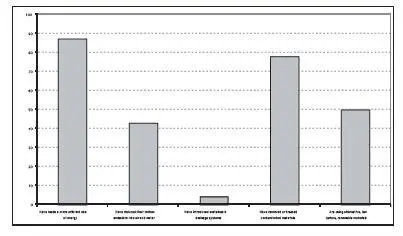
As part of a Green Ports initiative, Royal Haskoning commissioned ICM Research to undertake a survey of 100 port decision makers in Britain, which revealed that many ports recognise the growing importance of environmental management, with the majority (89%) of respondents stating that they already have an environmental policy in place. However, an equal number do not feel they are doing enough and have made a commitment to bolster their environmental skills base in the coming year. The survey also revealed that, during the last year, economic uncertainty has forced operational and cost efficiency to remain high on ports’ agendas as they attempt to manage the effects of the global recession. However, port decision makers predict a shift in priorities over the next 12 months as the global recession eases and renewed demands are placed on marine and maritime industries to implement their environmental strategies. One in five UK ports claim environmental compliance is already their number one priority, but this figure is expected to rise, with 81% of UK ports planning to train their existing employees to increase their environmental skills base. This shift in priorities within British ports is already underway, thanks to the expected increase in regulatory scrutiny, but also to a growing eco-consciousness and a recognition of the long-term environmental, social and economic benefits achieved by effective environmental management. More than half (57%) of UK port decision makers feel they must take responsibility for providing resources in order to achieve environmental compliance and have already taken steps to improve the environmental sustainability of their ports. Notably:
• 87% claim to have made a more efficient use of energy;
• Four out of five claim to have reduced their carbon emissions into air and water;
• 43% cent have introduced sustainable drainage systems;
• More than three quarters (78%) have removed or treated contaminated materials;
• Half of those surveyed are also using alternative, low carbon, renewable materials.
Encouragingly, a quarter of port decision makers would invest in implementing ‘green’ technologies, whilst almost one in five (19%) would be interested in future proofing and ‘what-if’ scenario modelling. But whilst an interest and willingness to improve their green credentials exists, many ports do not know how to apply this in practical terms. Despite significant steps having been made in the right direction, the research reveals that UK ports are in need of support in order to meet the increased environmental requirements being placed on them.
One in five port decision makers (18%) only feel somewhat prepared in establishing and maintaining their environmental strategies, and almost a quarter (22%) don’t feel they have enough access to resources to help them meet these regulatory requirements. In addition, about one in ten UK ports do not have an environmental policy in place, whilst one in twenty question whether climate change will have any effect at all on their ports!
UK ports are steadily recognising the need to implement environmental strategies and it is encouraging to see that so many acknowledge that they still have a long way to go in terms of doing enough. But there is still a sizeable number that are failing to take any action at all, with almost one in ten ports (9%) not planning to do anything in the next 12 months or unsure of what they should be doing.
Ports are extremely important to local and national economies, and it is therefore imperative that they remain compliant, particularly in light of mounting pressure to adhere to new legislative demands even during testing economic conditions, to introduce and maintain practical measures that will enable them to both comply with legislation and achieve the objectives of their environmental policies.
For more information on Royal Haskoning’s Green Ports White Paper, go to: www.royalhaskoning. co.uk
Related Articles
 ALTERNATIVE FUELS GREENPORT