![PortStrategy[GreenPort]](https://www.portstrategy.com/wp-content/uploads/2026/09/PortStrategyGreenPort.svg)





Dry bulk covered storage options
For reasons of wind-blown dust pollution, open air stockpiles for bulk commodities such as coal and iron ore are nowadays considered to be environmentally unacceptable, especially if they are located close to urban areas. The alternative is to store this type of material under cover and here there is a choice of traditional silos, dome structures or other types of horizontal storage.
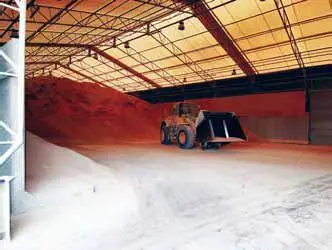
When dry bulk materials are stored under cover, this is normally either to protect them from the weather (notably rain) or to safeguard the environment from dust which might otherwise be blown from material stockpiled outdoors. Silos and domes are traditionally employed to provide protected storage of materials such as cement, grain, animal feeds, foodstuffs and polymers which would otherwise become damaged by wet weather. Recently, however, they are being increasingly employed to store other materials which are not damaged by rain but which present dust pollution problems such as coal and iron ore. Owing to greater environmental awareness and a recent tightening of air-quality regulations, even in developing countries, outdoor storage of these and other bulk commodities is becoming less and less acceptable, especially when stockyards are situated in proximity to residential property.
Vertical storage: gravity discharge with a small footprint
One silo manufacturer which has benefited from this trend is ESI Eurosilo of the Netherlands, one of the world’s very few engineering firms capable of designing very large silos with capacities of 50,000m3 and above. The company is currently working on a project to provide the Lünen power plant of Trianel Energy, Germany, with a 2 x 100,000m3 silo storage facility for steam coal. Each of the two silos will be 55m diameter and 42.5m high, providing an in feed capability to 1800t/h and out feed of 800t/ h. They are scheduled to be completed in 2011. ESI Eurosilo has in the past built giant silos for coal, potato starch, ammonium sulphate, salt, limestone and potash, but by far the most common material is FGD gypsum. Of the 12 most recent silo systems installed by the company since 2002, all have been for this difficult-to-handle product. The heart of the Eurosilo system consists of sturdy screw conveyors and, if necessary, a central slotted column which has been developed to ensure reliable discharge of sticky materials such as FDG gypsum. Material to be reclaimed is fed through the slots formed by horizontal fl at rings and subsequently it descends freely under gravity through the vertical channel. The fully automated inner mechanism fills and reclaims the stored material in horizontal layers. In this way sidewall loadings are kept to a minimum and at all times they remain symmetrical and predictable. Filling and reclaiming can be carried out simultaneously. Traditional vertical storage systems offer two key advantages. The first is that most free fl owing materials such as grain and cement will normally discharge under gravity, thereby removing the need for costly reclaim equipment. Secondly, because these storage structures are normally taller than they are wide, they occupy minimal ground space which is an important consideration in port zones where real estate values are high. Drawbacks are that large silos are slow and costly to install and cannot easily be relocated at a later date. They therefore represent a long-term investment and because they are usually purpose-built to suit the handling characteristics of a specific dry bulk cargo, they cannot easily be modified to store different types of material. Consequently port operators need to be confident that the dry bulk trade for which this type of storage vessel is to be used will continue for years into the future.
Domes: versatile and quick to erect
Dome structures on the other hand are comparatively quick to install and they can be employed to store a wide range of different materials. Disadvantages are that they take up more ground space than conventional silos and they require a mechanical discharge system, whether in the form of wheel loaders or a more sophisticated permanently installed reclaim arrangement.
Dome shaped, fabric airform. Later inflatable airforms were employed which were sprayed with polyurethane foam to provide initial rigidity, then rebar was added followed by continuous spray concrete to form the completed structure. Dome Technology’s finite element engineering analysis sets a very high standard that models not only the dome shell, but structural interaction and integration of all key dome system components ranging from site soils, tunnels, vaults, escape tunnels, ring beam foundations, stem walls, floors, dome shells, shell openings, point loads and dynamic loads to curbs, head house placements, towers, conveyors and loading and reclaiming systems. The company works in close association with manufacturers of materials handling systems to ensure a fully integrated, custom-built storage facility. Carmelo, Puerto Rico’s leading aggregates producer and manufacturer of concrete products, recently commissioned a 55,000t capacity Dome Technology dome to store fl y ash for its new subsidiary, Ecologica Carmelo, Inc. Built on Pier 16 at San Juan Bay, the structure occupies only 2000m2 of ground area. A dome was selected in preference to other types of storage system because of its rapid construction, greater structural integrity and higher cost efficiency compared to other construction techniques. In addition a dome provides the most efficient structural system to withstand hurricane force winds. Their versatility is a key attraction. For example, about two years ago a dome structure in Port Everett, Washington State, USA, which had originally been built to store alumina, was successfully converted by Lehigh Cement Company to handle cement. Dome Technology of Idaho Falls, ID, USA, which this February celebrates its 30th anniversary, has to date built about 300 storage domes in more than 20 countries. Ranging in size up to 300ft diameter, they are being used for accommodating various bulk materials including fl y ash, limestone, potash, cement, grain, fertiliser and coal. Some of these larger structures use over 1000 cubic yards of concrete and more than 450t of rebar. The company developed and patented the technology of building thin-shell monolithic concrete domes by spraying foam and concrete to the inside of a pressurised,
Construction of the dome, measuring 51m diameter x 30.6m high, from inflation stage to the finished shell took only 42 working days. This was carried out by two small crews. One placed the rebar on the domes interior and the other sprayed the shot crete in place. The thickness of the shot crete for the finished dome is 13in at the base thinning to 9in at the top. The total structure comprises 8000 cubic yards of concrete. This dome is an air-tight structure by design. In addition to the airform membrane which is inflated to maintain a positive pressure during construction, a 2in thickness of polyurethane foam provides additional sealing qualities. In fact the structure is so air-tight that the inside can if required be maintained in a state of partial vacuum. This completely air-tight shell is able to guarantee a one hundred per cent dust free environment which, owing to its urban location, was a planning condition stipulated by the city of San Juan. Temcor based in Gardena, California, has specialised in design, engineering, manufacture and assembly of bulk storage systems since 1964 and is now the world’s foremost builder of aluminium dome structures. The company has more than 7000 installations worldwide, none of which as ever failed even in storm conditions. Since these domes are built entirely from light-weight aluminium they are far less heavy than steel structures of equivalent capacity, with the result that foundation costs are significantly reduced. The company has perfected a unique centre tower erection method by which the dome is built on the ground from the centre outwards while attached to the centre tower. As each ring is assembled, the dome is raised until construction is complete and it is then attached to its foundation or retaining wall. This method requires a relatively small crew that works safely at ground level. The company states that a typical 300ft diameter dome can be erected by an average crew of 12 over a period of about 12 weeks, which is much more economical than the construction for a typical building. The inherent corrosion-resistant properties of aluminium add to the value of Temcor domes by keeping them virtually maintenance- free for the entire life of the structure. Recently Hyundai Steel Co. awarded Temcor one of its largest ever contracts. Five domes are to be built as part of a new steel plant being constructed in Dangjin, South Korea: three 120m diameter domes will be used for iron ore storage and the remaining two 130m structures for iron ore blending facilities. Hyundai is investing $5.7bn in the plant which is expected to be operational by 2010. The three iron ore storage domes will have a rise of 40m above their 20m-high concrete walls and the two 130m blending domes will have a rise of just over 30m on concrete walls 7m high. The span-to-rise ratio of each dome was determined by the clearance requirements of the stacker/reclaimer to be located inside each dome for handling the ore. The addition of the three storage domes will allow 900,000t of iron ore to be kept under cover, along with an additional 180,000t in the two blending facilities.
Underground reclaim
Smaller domes and horizontal storages often have side doors which are wide enough to allow access for wheel loaders to enter and reclaim the bulk material stored inside. However, where there is a requirement to store large volumes of material this system is slow, labour intensive and environmentally undesirable and automated reclaim systems are usually specified. In the case of domes this often takes the form of a radial reclaimer rotating around a central column and feeding a below-ground conveyor system. Aumund of Germany has recently developed a completely submerged reclaim system called the Mole which was originally designed for handling clinker in cement plants. Since the device is located below ground it does not take up valuable space inside the storage structure. In July Temcor completed a 90.5m diameter clinker storage dome for Riverside Cement Company’s Oro Grande, CA, plant. This employs an Aumund Mole reclaim system in which the storage area is filled via a stacking tube in the centre of the building. To accommodate this tube, Temcor modified its centre tower erection method by attaching winches to the top of the tube and then using lift lines to raise the dome as it was assembled.
Demountable structures: shortterm cost efficiency
Specialising in the supply of relocatable storage structures, UK-based Rubb Buildings offers bulk storages that can be quickly delivered and installed. They feature a high-strength, PVCcoated polyester architectural membrane cladding which is corrosion-proof and allows for differential settlement without the need for expensive foundation piles which are normally required for silo installations. A typical recent installation was delivered in 2006 to the Department of Transportation in the town of Hollis, New Hampshire, USA. Here there was a requirement to provide covered storage for 4600m3 of salt and sand, which was met by a Rubb 27.4 x 35.7m A-frame structure with 7.9m sidewalls. The galvanised I-beam foundation was secured with ground anchors and an interior berm wall constructed of ecology blocks. Rubb was able to erect this storage facility without need for a poured concrete foundation, resulting in significant cost saving for the client. A couple of years ago the stevedoring company Logistec in Brunswick, Georgia, USA, needed to replace aging wooden covers for two circular bulk storage structures being used to house urea. This commodity, employed in the production of fertilisers, needed to be protected from the elements and, because of the corrosive nature of the urea, Rubb was not able to follow its usual practice of post fabrication hot dip galvanising of the steel structure. This was resolved with the production of a black steel frame and the application of special paint. Rubb also designed a custom built canopy linking the structures to allow dry transfer of materials between the two storage facilities. The company, which is quality certified to ISO9001: 2000, has production facilities in the UK, Norway and USA.
Related Articles
 ALTERNATIVE FUELS GREENPORT