![PortStrategy[GreenPort]](https://www.portstrategy.com/wp-content/uploads/2026/09/PortStrategyGreenPort.svg)



Ecoceane vessels clean up oil operations
France-based Ecoceane is continuing R&D on its range of pollution-cleaning vessels designed to help boost the efficiency of oil spill clean-up operations.
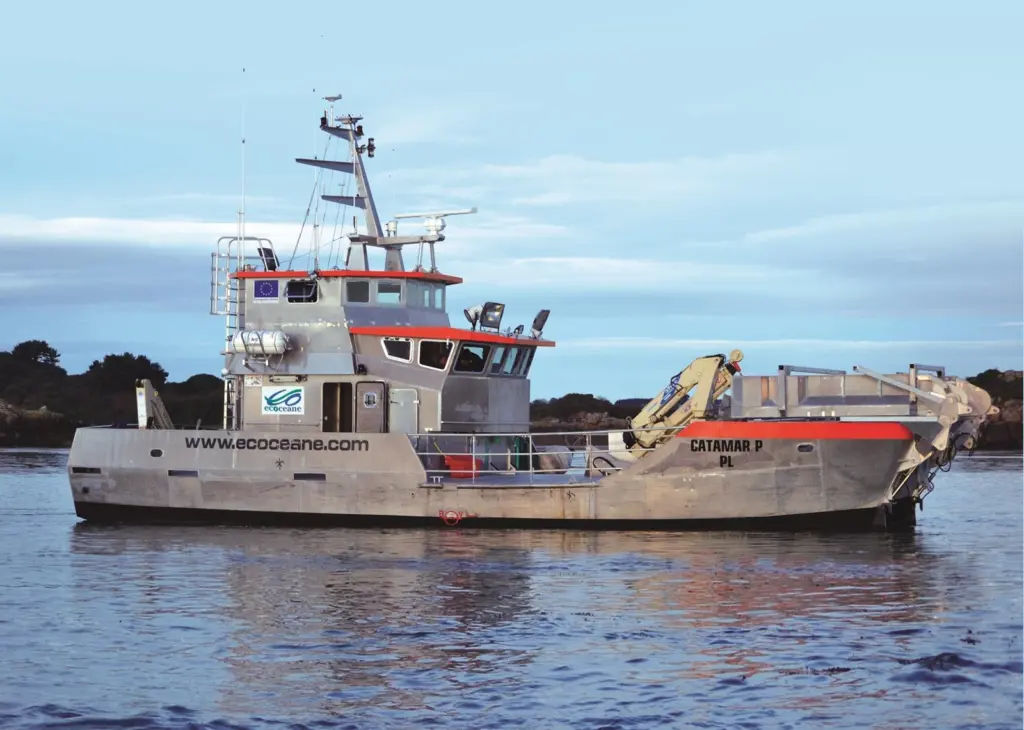
After years of R&D and an investment of more than €10m, Eric Vial and Robert Gastaldi, co-founders of Ecoceane, realised that despite significant means and efforts employed to recover hydrocarbons after an oil spill, very few hydrocarbons were recovered at sea before reaching the coastlines and causing irreparable damage.
Ecoceane’s patented technology equips clean-up vessels that can collect more oil and waste per hour, with a capacity said to be ten times that of traditional vessels, and separates water from hydrocarbons that prevents emulsion.
“With our technology, we avoid a mayonnaise-like emulsion when collecting hydrocarbons that would otherwise require a specific process to separate the hydrocarbons from the water before they can be stored in tankers. We gain in efficiency this way,” explained Eric Vial, president, Ecoceane. “Our technology is unique and our boats are the only ones capable of collecting hydrocarbons at sea up to a wind and sea force of 6 or 7 on Beaufort scale and at speeds of 4 to 5 knots.”
The company’s vessels transfer only pure emulsion-free hydrocarbons into tankers as they work. Once a tanker is full, another can take its place.
“This continuous exchange of storage means our vessels have an unlimited 24/7 recovery capacity during a clean-up operation,” Mr Vial added. “More than 80 vessels have been sold in over 25 countries around the globe since Ecoceane was created. There is strong demand for our technology.”
To develop its vessels, Ecoceane uses Dassault Systèmes 3DEXPERIENCE platform, with CATIA for design, SIMULIA for virtual product simulation, DELMIA for digital manufacturing and 3DVIA for communication with shipyards and customers.
Ecoceane says the link between CATIA and SIMULIA enables its architects to seamlessly use the 3D Digital Mock-Up created in CATIA to run simulations of the boat performing under working conditions as it sucks up water and pollutants into the vessel.
“We virtually simulate the vessel collecting water and hydrocarbons and visualise the flow of these liquids through the different compartments of the boat where filters separate the hydrocarbons from the water,” added Benjamin Lerondeau, Ecoceane’s naval architect.
The company’s latest line of pollution-cleaning vessels, ReverseGlop, launched in 2013, Ecoceane proposes a way for shipyards to incorporate its technology in the stern of any boat under construction that is more than 25m long. Its technique is said to preserve the vessel’s normal functions in the aft and transforms it into an oil spill response vessel when the boat shifts into reverse.
Ecoceane provides clean-up vessels to government agencies, harbour managers, ship owners and shipyards for a range of scenarios, from harbour, lake and river clean-up and coastal protection to out-of-port operations to recover all floating waste and oil spill monitoring and recovery in high seas.
Related Articles
 ALTERNATIVE FUELS GREENPORT