![PortStrategy[GreenPort]](https://www.portstrategy.com/wp-content/uploads/2026/09/PortStrategyGreenPort.svg)






EcoPorts: Sharing environmental experience
Herman Journee, Chairman of EcoPorts, reviews some of the environmental issues facing Port Managers – and explains how the EcoPorts Foundation is working to exchange experience and best practice.
Environmental issues are now a key element in the management of ports and the logistics chain. Good environmental management is essential for stakeholders to continue their support for port and logistic chain operations. A large – and rapidly growing – number of environmental laws and regulations are intended to preserve and improve the environment by the broader approach of sustainability.
Implementing environmental laws
Port authorities and port operators, as well as operators in the logistic chain, all have to find ways to implement these laws and regulations in practice. Many different solutions are found for the same issues, with different costs and different environmental impacts – but sometimes these solutions don’t come out with the expected results. Differences in costs influence competition between ports and organisations or companies, operating in the logistic chain.
Exchanging environmental solutions
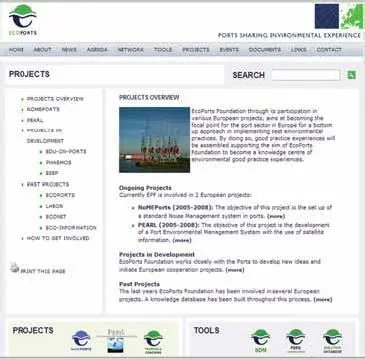
Since 1993, EcoPorts has operated a well functioning network of participants in the port sector, involved in the implementation of environmental laws and regulations in daily practice. EcoPorts assists ports, businesses in the port sector and the logistic chain – as well as governmental bodies – with tasks in their daily environmental management. This is done by exchanging best practice and sharing solutions to common problems. This kind of experience is often not available commercially but is only exchanged within a network of colleagues that are facing the same challenges in their daily work. Sharing solutions avoids “inventing the wheel” twice and provides important information why certain solutions are useful in certain types of ports and businesses and others are not. The EcoPorts Foundation was set up in 1999 by nine European seaport authorities, as a formal structure for the exchange of experience in the areas of environment and sustainability. All founding organisations are members of the European Seaports Organisation (ESPO). EPF is strongly supported by the European Commission, and has good working relationships with the European Sea Ports Organisation (ESPO) and the European Federation of Inland Ports (EFIP). This helps to strengthen the exchange of practical experience and policy development
Activities, secretariat and network
EcoPorts has two main areas of activity:
1. One is concerned with the EcoPorts Projects, the development of knowledge and tools for environmental and sustainable management. This is mostly done in cooperation projects, often funded by the European Commission.
2. The other area is called EcoPorts Tools, directed at using knowledge and tools in the daily port practice. This is done by the exchange of solutions, training on using the tools and the certification of environmental management, assisted by our independent auditor, Lloyds Register. This year the partnership of EcoPorts has extended to ports in the USA. Further relations exist with the United Nations Environment Program. EcoPorts Partners include: seaports, inland ports, dry ports, industrial companies in the port area, world wide container terminal operator, environmental authorities with responsibilities in the port area, together with universities in five countries.
Product portfolio
EcoPorts offers a Portfolio of products and services to support Port Communities.
Tool 1: Environmental Self Diagnosis Method (SDM)
This is a professional system, based on ISO 14001 elements, that reveals the main environmental issues in the port area and can be used for setting priorities and to gain a first insight into environmental risks of managing a port area. It is possible to make a benchmark of your results against the European average.
Tool 2: The Port Environmental Review System ( PERS) methodology and Environmental Certificate for Port Environmental Management
The PERS methodology is based on ISO 14001 elements. It can assist ports and companies to implement a basic Environmental Management System and enables the creation of a periodic Environment / Sustainability Report. This can provide environmental information to senior port management, the public and other interested parties regarding the environmental impact and performance of the ports significant environmental aspects. More then 40 European seaports are certified, from very large ports to very small. The experience in all ports is that a very important value of certification is that it starts a process, in the ports organization, of awareness of environment and sustainability. The process stimulates the personnel to bring in creativity to improve the environment and to reduce costs. Certification is possible for EcoPorts Partners only.
Tool 3: Nomeports: a Noise Management system for the Port City Area
This year a new tool has been added, again, produced by ports for ports. The tool helps ports to implement the Noise legislation that prescribes an important reduction in the noise levels of activities in the port area and the general noise level of a port area. This objective system helps in the complicated decision making on port development versus city development.
Development of Tools
EcoPorts is involved in several cooperation projects intended to develop management tool for actual environmental issues, such as the Nomeports tool. An overview of current environmental issues in ports is periodically prepared in cooperation between ESPO and EcoPorts. It reveals a top 10 of environmental issues in seaports, issues such as dredging, air quality, noise, port city relations. At this moment EcoPorts is involved in projects concentrating on issues such as: the use of satellite information for port environmental management, the analysis and description of good practice solutions of which green lanes consist, with ports as key parts in it.
Conferences, workshops and training
A key part of the EcoPorts’ activities is the exchange of practical experience with solutions. This is done in workshops and in its yearly international conference. EcoPorts supports the organisation of workshops. They can be set up internationally as well as nationally, using the national language. They concentrate on specific actual environmental issues wherefore several ports need a practical solution. Examples include: air quality and ship emissions, fumigation of cargo and its effects in the logistic chain. The 2009 international conference will be held in Naples on 25 and 26 February, with the key themes: Environmental solutions in “Port City relations and the logistic chain”, “Climate Change: projects for solutions”. EcoPorts has established a co-operative agreement with Greenport in the organisation of the conference, which brings policy and practice together. Workshops are organised to introduce and train the Ecoports tools. The EPF Secretariat provides a Helpdesk facility and possibilities to organise port assisting ports in the implementation of tools or environmental solutions.
Related Articles
 ALTERNATIVE FUELS GREENPORT