![PortStrategy[GreenPort]](https://www.portstrategy.com/wp-content/uploads/2026/09/PortStrategyGreenPort.svg)




EFFORTS demonstration in Le Havre
The EFFORTS Demonstration Event on Clean Energy Management, on Water Quality and on Air Quality in Le Havre drew a large and interested audience
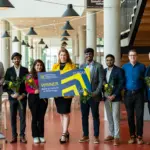
On September 22nd and 23rd, an international audience gathered in the Port of Le Havre to learn about the work done on clean energy management, water quality and air quality in ports within EFFORTS. After a warm welcome from the GPMH Manager Jean-Yves Le Ven and a project briefing from Yann Tréméac of TL&A, delegates visited the Port of Le Havre and its surroundings.
Clean Energy Management
The afternoon of the 22nd was devoted to Clean Energy Management. Jean-Francois Emery and Pascal Galichon of GMPH quite explicitly explained, why clean energy management should be a matter of concern to all ports.
This led over to the detailed presentation of Jonathan Roberts of AREVA, who prepared the study together with Olivier Harnois and Sylvain Mouillac of CORYS TESS. After introducing the methodology and specifying the tools needed for the investigation, he showed by means of a simulation, how these tools can be used in practice. Jonathan concluded the presentation by specifying future research work.
Water Quality in Ports
The following day was devoted to water and air quality in ports. Here, too, EFFORTS has done some landmark research.
Dr. Daniel Masson of IFREMER started off the morning with an introduction to the existing and upcoming regulations on ballast water management, in particular the new Ballast Water Convention. After talking briefly about the legal basis and the enforcement time scale, he explained what effects this convention will have on ports.
Dr Masson’s presentation was followed by Dr David Corroler of the University of Caen. David introduced the project work done on Ballast Water Quality during Ship Reception. He started with characterising the main harmful micro-organisms that can be carried in the ballast water of ships and explained the laboratory tests they developed to ascertain the efficiency of three selected substances against bacteria, phytoplankton and zooplankton, finding the best compromise between biocide efficiency and environmental acceptability. The selected biocide was first tested in a laboratory “ballast water” environment, before it was taken for real life. Jukka Sassi from VTT Finland picked up the thread by introducing the Requirements for Ballast Water Treatment Technologies on Vessels and stated five prerequisites that treatment technologies must fulfill to be acceptable: They must be safe for the ship and for the involved personnel, they must not harm the environment or public health, they must be practicable and fit in with shipboard operations, they must be biologically effective, and they must incur as little as possible costs. He underpinned these points with illustrious examples. Turning from the ship to the port, Dr Daniel Masson reported on Ballast Water Management in Ports. By using very vivid real world examples, he illustrated the necessity for proper ballast water management in ports and outlined the basic features of such management scheme. In the essence, control of compliance must be fast, simple and reliable. Any necessary treatment must be efficient and the costs must be covered according to the “polluter pays” principle.
The second part of the morning was devoted to Aluminium toxicity in ports and was introduced by Christophe Gautier of GPMH. In ports, there are many steel structures that are prone to heavy corrosion through the aggressive environment. As this corrosion occurs mainly through galvanic currents, aluminium anodes are used to divert the negative effects of the galvanic current away from the steel structure and onto the anode. In the process, metal of the sacrifice anode goes into solution with the water. The task was to find out, if this process poses a health risk to people and other living species. In order to set the scene and to provide the audience with the necessary background knowledge, Professor Giovanni Pagano of the Naples Frederico II University presented a learned paper on Aluminium Toxicity in Environmental Health. In the paper, he briefly reported the results of 80 years of research on aluminium toxicity, that were the starting points of the research the university’s team conducted. By assessing the effects of aluminium on sea urchins’ early development the team observed that toxicity was present, when the metal came into the water by dissolving the metal’s sulphate salts, but not, when the metal came into the water through sacrificial anode solution, as it is the case in ports. Dr Christelle Caplat and Cedric Gabelle of the University of Caen continued with a very interesting and depictive presentation of Aluminium Pollution related to the Protection of Ports Infrastructures. They explained how they first assessed the aluminium concentration in water, sediment and living organisms in the port environment and how they then assessed the aluminium toxicity on marine organisms and the potential environmental impacts of the use of sacrificial aluminium anodes. They concluded their presentation with a plea for active bio-monitoring in ports to gain more knowledge and experience in this matter. Laurent Walle of TL&A picked up the idea and presented Recommendations and Tools to Help Ports to Assess Impacts of Quay Protection with aluminium anodes. He started by introducing corrosion issues and rehabilitation techniques, gave an assessment of these techniques and introduced some interesting tools, before giving his recommendations. His plea was to think first, before starting to build installations and to consider other technical feasibilities, costs and the environment. There might be better choices than anodic protection.
Air Quality in Ports
The afternoon of the day was devoted to Air Quality in Ports. Jean-Paul Raffini of GPMH started of with a brief introduction of work the Port of Le Havre is doing to reduce air pollution in the port through the implementation of an Air Protection Plan. He talked about ships’ emissions, which account for 9% of emissions in the port, and of emissions attributed to port handling, which account for 80% of the port’s emissions.
Jérôme Taranto of Biowind introduced an innovative system for the treatment of pollutants generated by port operations. The new system is based on photo catalysis and employs an advance oxidation process that allows a near complete removal of cancer-causing volatile organic compounds. After laboratory tests, a prototype “air cleaner” was developed and tested in the field on diesel engine exhaust fumes and on fuel vapours during fuel loading. The tests showed that photo catalysis treatment of fumes and vapours is more effective and less costly than treatment with activated carbon.
Related Articles
 ALTERNATIVE FUELS GREENPORT