![PortStrategy[GreenPort]](https://www.portstrategy.com/wp-content/uploads/2026/09/PortStrategyGreenPort.svg)




Eurogate Terminals go green
Eurogate, which operates ten container terminals in Europe, is focusing more and more on environmental issues. Hanna Pötter, responsible for environmental improvements, explains what has been done so far.
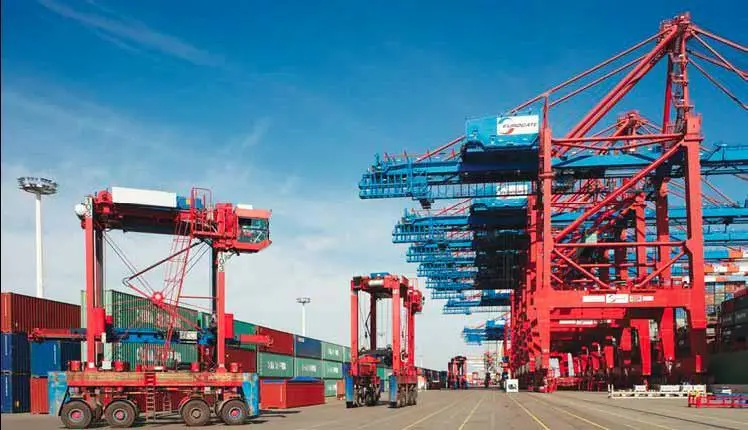
Cargo terminals are, by their very nature, a very rough and tough business to work in, with most activities involving huge vehicles and cranes. That’s why it is an imperative issue for container terminal operators to care about emissions and resource use – and many operators do care about this matter. The company’s first environmental activities date back to 1987, when the technical department in Bremerhaven installed its own little gas power plant to simultaneously generate heat and electricity for buildings and halls/workshops. The plant was accompanied by a heating plant fuelled with waste dunnage wood, one in Bremerhaven in 2006 and another in Hamburg in 2008. Further projects to use renewable energies – such as wind or solar power – have been seriously analysed and calculated, but so far cannot be undertaken due to the lack of a safe and worthwhile location.
Energy consumption
When it comes to energy utilisation, quayside cranes and reefer plugs account for about 70 percent of the company’s electricity consumption. While the design of container refrigeration systems cannot be influenced by terminal operator, crane design can. So, since the early 1990s, Eurogate’s cranes re-feed to the grid the energy surplus from decelerating the drivers cap or dropping the load, which may add up to 25 percent of the total energy use. Just by employing this crane technology, Eurogate saves the global atmosphere around 3000t of CO2-emission every year. Further big electricity consumers are illumination and IT-applications, which are continually being optimised. However, the largest energy consumers remain the straddle carriers, which transport the containers around the port. The amount of Diesel used per hour has already decreased by more than 1/3. This technology shift alone has led to an annual CO2-reduction of 50,000t. This figure illustrates the huge environmental impact of the vehicles and motivated Eurogate to invest significant sums into further research. On the one hand, the resource-saving potential of hybrid engine technologies has not yet been fully exploited; while, on the other, research of hydrogen-powered carriers and rope-way container transportation could lead to a completely new generation of internal container transport systems in ports. Beside these technological improvements, the drivers themselves can also help reducing CO2 and noise emissions. Thus Eurogate – inspired by the Port of Gothenburg – is presently analysing how this theoretic idea can be converted to a practical rules for the drivers.
Sustainable culture
Finally, environmental awareness is not only demonstrated by huge CO2-savings which sometimes are triggered just economically. Importantly, in less “high-profile” management decisions, the true understanding of sustainability becomes obvious. One good example is Eurogate’s decision to use only recycled paper for internal purposes. As the global CO2-Emission by deforestation is four times higher than that of global shipping, this action might contribute significantly to a longer lifespan of our planet. www.eurogate.de
Related Articles
 ALTERNATIVE FUELS GREENPORT