




Keeping cement terminals clean
Apart from alumina, cement is one of the most dusty dry bulk commodities. Spillage prevention during loading and unloading operations poses a major challenge.
Large volume shipments of cement present more of a problem to marine terminal operators and port authorities than almost any other commonly traded dry bulk cargo. Not only is the fine-particle material inherently dusty, and therefore a source of air pollution, but it also needs to be kept dry at all times. On top of this it is highly abrasive, which means that handling equipment needs to be robust and protected at vulnerable points by antiwear linings. Obviously cement needs to be stored under cover as well as being protected as much as possible when being conveyed. Negative-pressure pneumatic conveying, despite the drawback of normally higher energy costs, offers an excellent transfer method because it is totally enclosed and the vacuum effect ensures that there is no emission of dust.
Ship-to-shore transfer
Moving cement between a marine vessel and the quayside presents the greatest challenge. An ideal solution, if dust pollution is to be totally avoided, is to transfer the material directly from the ship’s hold all the way to the quayside silo by means of an uninterrupted pneumatic pipeline arrangement. However, this requires the ship to be specially converted as well as a dedicated receival system on-shore. As a recent example of such an arrangement, MacGREGOR of Sweden reports that Indonesian shipping company PT Rimba Segara Lines in April of last year ordered a Nordströms cement handling system to be installed on a 7500dwt converted bulk carrier. The new system has been designed to achieve mechanical loading at 750t/h as well as pneumatic loading directly from eight road tankers. It is capable of discharging mechanically at 500t/h and has a pneumatic unloading capacity of 2 x 300t/h. The system was built by MacGREGOR’s bulk handling division in Enköping, Sweden, and installed on the vessel at a shipyard in Indonesia. Delivery to the shipyard took place in the second half of last year and the vessel is expected to be fully operational in the first quarter of 2009. Cyclonaire of York, NE, early in 2008 supplied pneumatic transloading equipment to a bulk logistics company operating in the region of New Orleans which wishes not to be identified. The requirement was to transfer cement from railcars to barge at a rate of 100t/h. Because of time constraints it was not feasible to install pits or wait for installation of elaborate equipment. Cyclonaire supplied an HC-150 conveyor, featuring dual 8in suction lines supplying a 10in conveying line which was installed beneath a rail track and roadway. At the point where it emerged from the ground a manual hose switch station was installed allowing the selection of one of three entry points into the barge for even loading. Two CycloLift railcar connectors, with pneumatically actuated lifters, were also supplied to streamline unloading by attaching to both outlets of the railcar simultaneously. These are designed to reduce time and eliminate spillage associated with coupling the conveying equipment with the hopper car outlets. The whole system was up and running in just eight weeks.
Auxiliary dust-restricting measures
Frequently, however, cement needs to be loaded to and from ships by traditional quayside equipment such as shiploaders and grabcranes and here some degree of spillage and dust pollution is almost unavoidable. Although special designs of grab are available for handling powdery materials, they are far from infallible and much also depends on the skill of the crane operator if an unacceptable level of dust nuisance is to be avoided. A common method of minimising this problem is to install one or more aspirated receival hoppers on the quayside. Here the rim of the hopper is fitted with a vacuum cleaning system which sucks in airborne dust before it has time to spread across a broader area. Aspirated grab receiving hoppers of this type have been installed at the new environmentally sophisticated 600t/h capacity cement terminal at Lorient, north-west France, which was built by RBL-REI and commissioned in 2007. Similarly loading of cement into ships can be rendered almost dust free by the use of retractable chutes connected to the head of the shiploader boom. These normally feature a flexible outer shroud, the lower extremity of which rests on the pile of material being loaded into the hold. Normally these chutes incorporate an integrated filtering system to collect airborne dust within the outer shroud. Leading manufacturers include Cimbria Bulk Equipment of Denmark and Cleveland Cascades of the UK, this latter company also offering a chute which provides dust free loading by constraining the material to flow in a zigzag path through a vertical series of inclined cones. This arrangement limits the material flow velocity which at the same time avoids dust being generated. An advantage of this system is that there is no need for energy-intensive dust extraction systems which require regular servicing. Retractable dust free loading chutes of the same basic design are also available to prevent spillage during loading of road powder tankers and tank railcars.
Dry fog
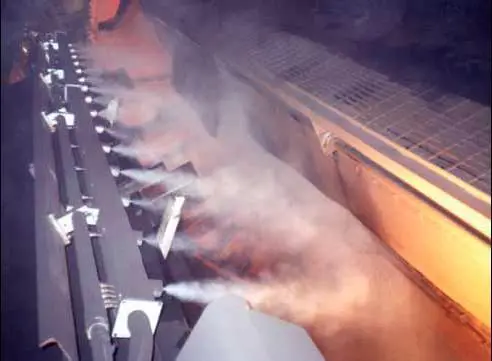
A radical alternative to containing and aspirating dust during loading operations is to treat it in such a way as it ceases to be airborne. Dust Solutions Inc. (DSI) of Beaufort, SC, reports that it has successfully implemented its Dry Fog agglomerative dust suppression system to eradicate dust pollution from a wide range of bulk handling applications, including cement. Unlike some competitive dust treatment systems, no chemicals are required to increase the wet-ability of the water to overcome surface tension since the system functions at a sub-micron level. Furthermore, it is also said to be effective in below freezing temperatures as the ‘fog’ lacks sufficient mass to freeze, a phenomenon which according to DSI is known as cloud physics. For use in cold-weather conditions protected against freezing is provided by way of heated and insulated enclosures and supply lines. DSI sales manager David Gilroy says that dust reductions in many bulk handling applications have exceeded 96% efficiency without wetting the material. Typical moisture addition is said to be less than 0.05%, making the system attractive to organisations handling moisture-sensitive materials such as cement. He mentions that the Dry Fog system has recently allowed cement ship unloading operations to be continued at a number of environmentally sensitive sites which otherwise would have to be closed down because dust pollution exceeded statutory limits. DSI employs a modular format that simplifies installation. This saves time and money by allowing most of the installation work to take place with the plant in operation, thus reducing shut-down time to a minimum. For ship unloading the system was made portable to allow it to be easily located in the vicinity of the ship hold. The control module is mounted on wheels so that it can be easily moved to the next hold. Manifolds are draped over the side of the hold so that fog is directed over the open hatch, capturing airborne dust particles before they can escape. The operator of the ship unloader can control fog output by means of a radio remote control device. Every Dry Fog system is tailored by DSI engineers to meet the requirements of each specific application.
Related Articles
 ALTERNATIVE FUELS GREENPORT