![PortStrategy[GreenPort]](https://www.portstrategy.com/wp-content/uploads/2026/09/PortStrategyGreenPort.svg)





Logistic Chain Management: from environmental protection to sustainable business
The logistic chain must not just focus on environmental protection, but increasingly it must work towards becoming a “sustainable business”. The newly established ECO SLC initiative is aimed at assisting organisations with this challenge. Some of the key issues are analysed by Herman Journée and Chris Wooldridge*
Reduction of the environmental impact of activities related to ports, transport systems and logistics, is increasingly driven by environmental legislation. Successive European Directives dictate an increasingly strict reduction of such environmental impacts, albeit in a phased approach. In many cases, compliance requires large investment by both the public and the private sector. Experience from current best industrial practice and associated R&D projects confirm that, often, the most practicable and cost-effective solutions and management options are derived from collaborative initiatives that lead to mutually beneficial innovations. Such co-operation is based on the exchange of knowledge and experience, the shared desire of ‘a level playing field’ (in terms of enforcement of legislation) and recognition of the need to agree, maintain, and demonstrate, appropriate performance standards. It can reasonably be suggested, therefore, that the objective of the functional organization of the Logistic Chain in terms of environmental management must broaden its focus from merely environmental protection to encompass the components of sustainable business, namely, economy (investments, costs, profits), people (awareness, knowledge, training, cooperation), and condition of the Planet (neutral use of the environment). The European Commission gives a high priority to co-modality as the desired approach to make the transport of goods sustainable in European economies that show ever-increasing road congestion. This in turn hinders the further development of ports, airports and industrial estates. At the same time, the sum-total impact on the environment continues to increase through the plethora of socio-economic expectations and demands.
Ports and environment
The European Sea Ports Organisation (ESPO) advises its members via its Environmental Code of Practice (www.espo.be) to implement environmental management systems on the basis of voluntary, self-regulation using tools and methodologies such as those developed by the Ecoports Foundation. The Ecoports’ concept is based on a step-by-step approach to assist all ports (large and small) to address their environmental liabilities and responsibilities in a structured, cost-effective manner. Fifteen years of ‘ports-assisting-ports’ through sector-based collaboration has produced a wealth of shared experience, enhanced benchmark performance, practicable solutions and an agreed standard of Environmental Review (www.ecoports. com). Raising environmental awareness, creating a knowledge base, and developing the necessary skills (and attitudes) lie at the heart of any effective programme of environmental management. The starting point, the user-friendly ‘Self- Diagnosis Methodology’ (SDM), is widely acknowledged as an excellent tool from which to launch a phased approach towards such formal standards as ISO 14001 and EMAS. SDM also offers the option to benchmark the individual Port Authority’s performance (in confidence) in comparison with the port sector average of Europe or the National results of that country. Next in sequence is the option of introducing the Port Environmental Review System (PERS). This guides the Port Authority on how to set a policy, identify its significant environmental aspects, create an inventory of legislation and introduce the necessary organization to deliver compliance. Successful completion of the PERS document based on specifi c criteria gives the option of a Certificate of Validation based on an independent review by Lloyds Register. Ecoports (R&D) started this approach in 1993 and the Foundation was set up in 1999. From January 2011, ESPO will manage the Ecoports Tools, Methodologies, service support and database for its member ports in Europe and neighbouring countries. Enquiries for Ecoports Tools from outside Europe will be responded to by ECO SLC, a new Foundation. ESPO will support this approach to ensure that a database is built up that can used for benchmarking and research purposes as the global impacts of the port sector become even more critical.
Sustainable Logistic Chain
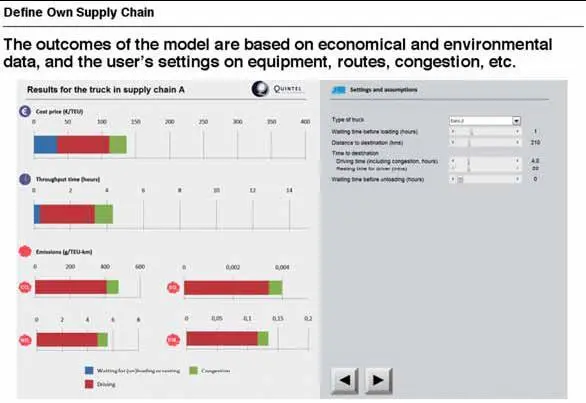
Transport has a high impact on the environment and is the largest industrial source of CO2 emission. The European Commission has developed policies and presented several communications, with new concepts such as co-modality, to reduce the impact of goods transport on the environment. Further Directives are being developed that could have a strong influence on how the Chain needs to be managed in order to ensure compliance and to satisfy the imperative of sustainability. A mix of regulatory measures and stimulating measures (bonus and malus) will set the context for transport operations. So far, however, the regulatory system may be considered relatively limited, but an increasing number of initiatives are likely to be introduced specifically to reduce CO2 emission from transport. Almost all measures concentrate on companies with a role in the supply chain and only a limited number focus on management of the logistic chain in total. Recent experiences show that influencing activation of sustainable measures on the chain as a whole delivers far more effective results than targeting the individual companies that make up the components of the chain. First estimates show that, in terms of reducing impacts, results from pressure on the chain as a total system can be 30% to 50% more effective than if every company involved undertakes the initiative separately. Therefore, to make a logistic chain sustainable, it requires co-operation between all partners with an operational task in the supply chain, private as well as public. For example, the European Authorised Economic Operator (AEO) certificate is an internationally recognised quality mark which tells people that their role in the international supply chain is secure, and that their customs controls and procedures are efficient and compliant. This approach aims to reduce costs as well as environmental impact. The Environmental Protection Agency of the USA is also active in this type of initiative. Large container terminal companies such as APM Terminals, Hutchison and DP World are introducing systems deliberately designed to reduce the environmental impact of their operations. Similarly, large shippers such as IKEA, Nike and Siemens are also active in this endeavour. These are proactive and positive initiatives but a complete logistic chain (systems) approach still remains a challenge. Several key issues have to be solved before companies and governmental bodies can deliver a genuinely integrated environmental management system for the complete supply chain. Major considerations are agreement on methods of calculating CO2 and other emissions for benchmarking and demonstrating compliance, transparency to in order to create trust between competing companies, and the provision of support systems, especially IT based tracking and tracing systems. Quality management systems, certainties on legal positions with respect to liability, the level of knowledge of all partners involved, and a totally new systems approach will also be necessary. In order to set up sustainable logistic chain management, each part of the chain will need to establish its own systems and organization to an appropriate standard and in a format that can be configured towards integration with all stakeholders. The conceptual approach is familiar to the port sector where the bottom-up approach delivered tools and methodologies that although generic in principles, allowed adaptation to port-specific circumstances. Given the diversity of global supply chain systems it can be argued that a ‘one-size-fits-all’ based on top-down approach would not be practicable or acceptable. A recently set up neutral and independent Foundation (ECO SLC) aims to bring together proven sustainable logistic concepts and established supporting, sustainable management systems with associated training packages that could assist to implement them.
Regulations to support SLC Management
New legislation will continue to drive companies to evolve their management in order to deliver sustainable operations. For example, some Municipalities are introducing environmental zones within which they limit access to parts of the city by trucks which have an environmental impact of more than certain limits. For some categories even a total ban is foreseen. The Ports of Rotterdam and Marseille recently introduced limits for trucks to enter parts of the port area. The limits have been specified in the land lease contracts. Such measures have the potential to have a profound impact on the movement of trucks.
Worldwide initiatives to introduce SLC approach
An initiative by the African Ports Organizations in close cooperation with the Ghana Port Authority to set up of an independent organization for the introduction of sustainable management systems in ports and the logistic chain is under consideration. In Canada, a program is being set up to make activities in ports and the chain more sustainable, especially around the St. Lawrence Seaway where cooperation between all the parties, both public and private is being formulated. In Asia, a program is underway to introduce environmental management tools in ports in several Asian countries. In Europe, the European Intermodal Research Advisory Council (EIRAC) is preparing basic solutions to create sustainable chain management in a network of large shippers and also other companies involved in chain management. The EIRAC Members are facilitated by CAESAR, a project funded by the EU www.eirac.eu.
Future
Progress on sustainable development throughout the ports, shipping and supply chain industries confirms the lessons and experience of the last 15 years – that is, that collaboration between overtly competitive stakeholders is a sine qua non for the development and implementation of effective environmental management systems. The new organization ECO SLC is now set to work with other organisations and agencies to assist with achieving the goals of sustainability and looks forward to the next Greenport Logistics Conference in 2011 when the first results will be presented and further opportunity will be provided for the exchange of knowledge and experience.
* Herman Journée works for the Port of Amsterdam and is Chairman of the Ecoports Foundation; Chris Wooldridge is Senior Lecturer at Cardiff University and Science Coordinator at the Ecoports Foundation.

Related Articles
 ALTERNATIVE FUELS GREENPORT