![PortStrategy[GreenPort]](https://www.portstrategy.com/wp-content/uploads/2026/09/PortStrategyGreenPort.svg)

London congestion insights
A study comparing emissions of freight vessels to that of trucks offers valuable insights into pollution.
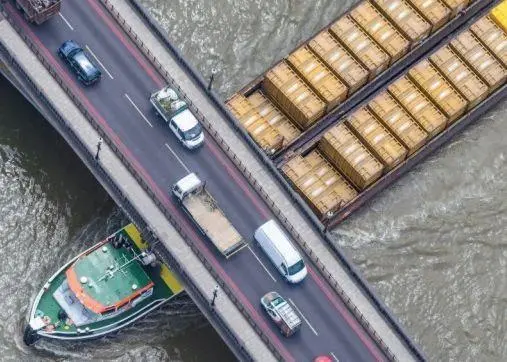
James Trimmer, director of planning and environment at the Port of London Authority (PLA), spoke about air quality on the River Thames at the Cross River Partnership’s ‘The Future of Sustainable Shipping and Trade in London’ webinar.
Trimmer shared findings from the PLA’s 2018 Air Quality Strategy and related research which showed some types of emissions are much reduced in vessel transport than road transport.
“As part of the air quality strategy, the PLA monitored real time emissions from two different freight vessels and compared the real time monitoring with comparable road movements between origin and destination, using likely routes, congestion modelling and the latest emission factors,” he explained. “Effectively there was a comparison between the freight vessel and equivalent number of lorries carrying that volume of cargo.”
Less PM but more NOx
The study found the vessels produced less PM, significantly less CO2 in grams per tonnes km , but more NOx. The reason was due to the large difference in engine standards, said Trimmer.
Other factors to consider include projected growth of traffic on the Thames and lower emissions rules for vessels than for vehicles. Vehicle fleet is improving at a faster rate than vessels, as vehicles have a faster turnover.
But the study also found the distance of emissions from people was key, with significantly less impact and therefore health hazards for people, than road vehicles.
PLA research showed carbon intensity is much less when moving freight by river than by road.
The PLA is looking into how the river can play a part in last mile distribution as light freight, just in time cargo from distribution centres and warehouses has increased.
Future challenges include infrastructure – that is how access points are used and developed and fit in with neighbourhoods.
Alternative fuels – to make the most of the decarbonisation advantages that the river offers, we need to consider where fuel can be bunkered and what role the river can take in transporting fuel before pipelines for future fuel are used.
Mobile power – how can this be provided and what can it be paired with? E.g. a hydrogen power barge, shore power .
“The challenge is to invest in the most appropriate solution,” said Trimmer.
The 2018 Air Quality Strategy in 2018 involved the first port wide air inventory between Teddington Lock and the South End, undertaken using AIS. This will be updated next year. The inventory showed most of shipping emissions occurred to the east of London, east of Dartford Crossing, where the vast majority of the port tonnage is handled.
Related Articles
 ALTERNATIVE FUELS GREENPORT