



Looking after Ghent’s inland waterways
The lock complex at Terneuzen is the gateway to the ports of Terneuzen and Ghent and provides a good shipping connection between the Netherlands, Belgium and France, but the new lock project will make the flow of the inland waterway even better, writes the new lock project team at the Port of Ghent.
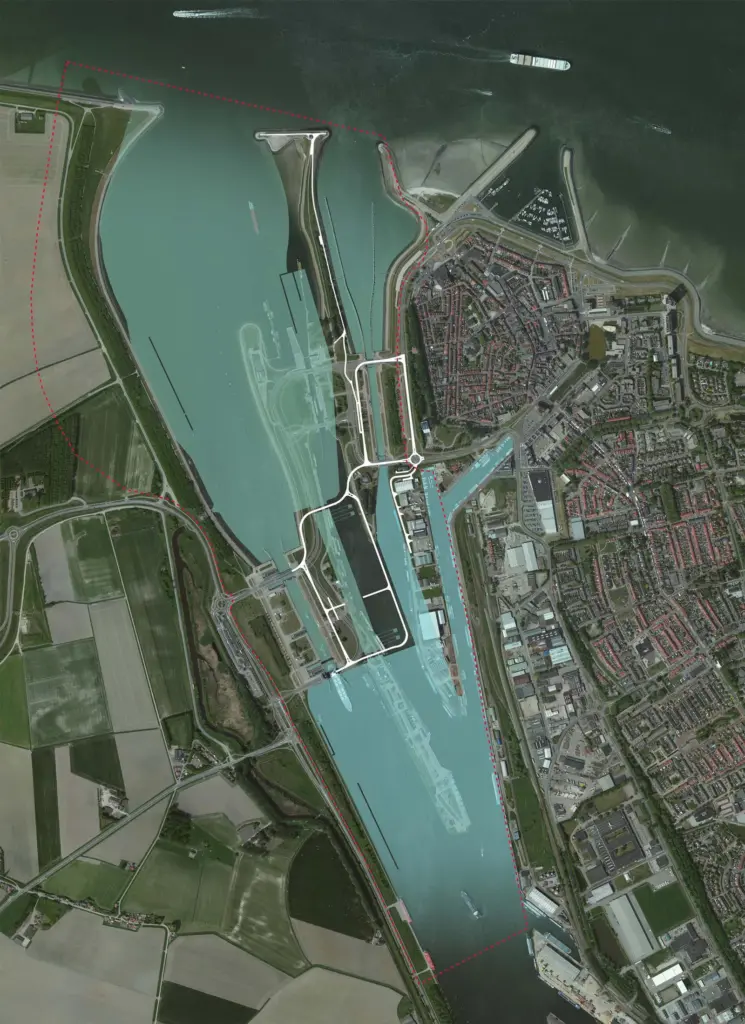
At the moment the locks in Terneuzen, together with the Seine Nord Canal, form the major bottleneck in the Rotterdam-Paris inland navigation connection, which is why a new lock will be situated in the existing lock complex to improve traffic flow.
The new lock project is being carried out by a team from the Flemish-Dutch-Scheldt Commission. By teaming up together, the Netherlands and Flanders are cooperating in order to turn the Scheldt estuary into an area that is well-protected from storm tides and has optimum accessibility for vessels, while making sure that the estuary’s wildlife is well protected.
Planning preparations
At present, the New Lock Terneuzen project team is in the plan execution phase in which all official procedures are passed through. At the end of April 2015, the draft planning decision and the Environmental Impact Assessment (EIA) will be available for perusal and it will be possible to have one’s say on these documents.
Following the EIA, it is expected that the final planning decision will be ready by the end of 2015, finalising the plan phase. Then there is the bridging phase to be undertaken. During this phase, land is purchased, cables and pipes are mapped out and alternative locations are sought for companies that will have to move because of the construction of the New Lock.
The New Lock project team is making full use of experience gathered through the construction of other locks in the vicinity during the planning phase. The New Lock will be similar to the sea access lock at Zeetoegang IJmond, near Amsterdam in the Netherlands. It’s also learning much from the construction of the Deurganckdok lock in the Port of Antwerp. This will be the biggest lock in the world, construction for which is set to be completed in 2016.
The costs for the New Lock amount to €920m. The Netherlands will be paying €155m and Flanders will bear the remaining costs. Of the Dutch contribution, the Zeeland region will take care of paying €10m. From the Flemish side, Ghent Port Company will take up 15%, a contribution that will vary between 71 and €95m.
The Netherlands and Flanders now intend to jointly apply for European TEN-T subsidies from the European Commission to help fund construction.
In 2016, the European call for tenders procedure will be started. The assignment for the New Lock will be tendered as a design and construct contract. It is expected that the contractor should be able to start the construction of the New Lock in 2017 with a view to completion in 2021.
Why a new lock?
Better access and smoother traffic by water are important both to the Netherlands and to Flanders and good connections are crucial for existing and new economic activities in the entire Canal zone.
So back in February 2015, the Dutch Minister Schultz van Haegen of Infrastructure and Environmental Matters and Flemish Minister Weyts of Mobility and Public Works signed a treaty in which the arrangements for the construction of the lock were laid down.
Minister Schultz of Infrastructure and Environmental Matters in the Netherlands, said at the time: “This border-crossing project links up perfectly with the ambition of the Dutch Maritime Strategy. It strengthens the competitive position of the maritime sector in Northwest Europe for inland shipping and seagoing navigation as well as for the ports.”
Minister Weyts of Mobility and Public Works in Belgium, added: “The realisation of the New Lock Terneuzen is one of the priorities that were included in the Flemish coalition agreement to ensure the accessibility of the Flemish seaports.”
Ghent and Zeeland Seaports are situated at the crossroads of the European inland waters, motorways and railway lines. The Terneuzen lock complex connects the Western Scheldt with the Ghent-Terneuzen Canal and is one of the busiest navigated canals in Europe.
So the New Lock will bring three benefits to ports in three countries. It will:
- Get rid of the bottleneck where the Terneuzen meets with the Seine Nord Canal, which forms the main bottleneck on the Rotterdam-Marseille inland waterway route
- Increase the capacity for the passage of inland vessels between the Netherlands, Belgium and France
- Give an economic boost to the Zeeland region and Flanders
- Improve the robust entrance to the ports of Ghent and Terneuzen for large sea-going vessels.
In addition, the total capacity of the lock complex will be increased, meaning that the corridor possibilities in the direction of France will also improve.
When completed, the new lock will be roughly the same size as the upcoming Panama Canal, measuring 427m in length, 55m wide and have a depth of 16.44m. It will be built inside the current lock complex at Terneuzen.
The bigger picture
With the bigger picture in mind, Ghent Port Company is also looking to reduce emissions and improve air quality with the New Lock Terneuzen construction.
The new lock will reduce waiting times for inland navigation, which in turn will help reduce emissions and improve air quality as the vessels will have shorter waiting times before passing through.
The Environmental Impact Assessment (EIA), which is part of the formal decision in the planning procedure, will ensure that necessary measures are taken when it comes to having a minimal impact on the environment during the construction of the New Lock.
During the construction, all kinds of monitoring will be undertaken, including the use of water gauges and vibration metres and real-time bird life watchers. Monitoring is especially important to make sure that the Natura 2000 values of the nearby Western Scheldt is protected.
Ghent is known for its environmental stewardship and its commitment to making the supply chain greener. It is currently studying the residual and secondary flows of heat and CO2 through the port.
In 2014, it was one of four Belgian port authorities – Antwerp, Ghent, Ostend and Zeebrugge in Flanders and two Dutch seaports – Terneuzen and Vlissingen in Zeeland, to join forces to promote sustainable development.
A learning network was established under the “Duurzame Zeehavens” (Sustainable Seaports) project for discussion between the project partners, with the aim of providing a wealth of information on sustainable activities back to key stakeholders.
Readers can watch the movie on the New Lock Terneuzen (available in English) online at: www.youtube.com/channel/UCli628lGUiWcypf1WPGQQIQ
Facts & Figures
Timetable
2012-2015 Project study phase
2015 Treaty Flanders-the Netherlands
2016 Selection of contractor
2017 Start of construction phase
2021 Operational locks
Present shipping locks
Eastern lock (1968): length 280m, width 24m, for inland vessels only, built in 1963
Middle lock (1910): length 140m, width 18m, for inland vessels and sea-going vessels with a draught up to 7.2m, built in 1910
Western lock (1968): length 290m, width 40m, for inland vessels and sea-going vessels with a draught up to 12.5m, built in 1963
New Lock Terneuzen
Size: 427m x 55m x 16m
Vessels up to: 366m x 49m x 15m
Video courtesy of New Lock Terneuzen project team
Related Articles
 ALTERNATIVE FUELS GREENPORT