



Looking towards the hinterland
An inland port may be defined as a strategic, multimodal node that includes at least a ship or barge terminal with connection to other ports before reaching oceanic trade, writes Xavier Seguí, Master in Chemical Engineering, Martí Puig, PhD candidate and Dr Rosa Mari Darbra, associate professor, Universitat Politècnica de Catalunya and Dr Chris Wooldridge, senior researcher at Cardiff University, UK.
They have developed at strategic locations, facilitating the global trade towards the hinterland and acting as planned nodes in the whole complex of the logistic chain.
The increase in the demand for transportation, the inland congestion generated by trucks and the associated costs related to energy consumption have promoted the progressive development of the inland waterway system. Investing in inland ports has been identified as an eco-friendly alternative for freight distribution, since it decreases the congestion near maritime terminals and encourages more efficient management of the supply chain.
Look both ways
Both sea and inland ports are under increasing pressure from a wide range of stakeholders to demonstrate their environmental credentials by transparency of action and public reporting of progress and trends against benchmarked performance based on key indicators.
Although the common characteristic between inland ports is their hinterland location and not their size, it is generally acknowledged that they may be classified as relatively small ports. As such, they share the same environmental challenges as faced by other small ports in terms of the challenges of compliance, sustainable development and environmental protection.
Some of the difficulties include the costs and expertise that may be required for monitoring programmes, the lack of appropriate training for port employees, the multiplicity of agencies involved, and the plethora of legislation and regulation. Environmental challenges in terms of port activities and their impacts may be ubiquitous, but the resources of finance, personnel, experience and knowledge may be more constraining in such ports depending on circumstances.
A license to operate
With the emergence of Network Corridors and the Ten-T Comprehensive and Core Networks, inland ports have both liabilities and responsibilities and opportunities to influence the environmental management of the hinterland connections and performance of logistic services. As seaports have taken on the remit of environmental considerations to include port-city links and the logistic chain, so the brief for inland ports has evolved exponentially to include considerations far outside the immediate port area.
Nevertheless, there are many examples of environmental initiatives and good practices carried out by inland port authorities. Since each inland port acts in a different situation depending on the needs and resources of the surrounding area, the way to enhance sustainable management often presents a wide range of possibilities. Some examples are provided below:
- Biofuel production
Biofuel production can be an initiative to reduce pollution in inland ports since the authority provides ships with a cleaner energy than the traditional fuels. The biofuel can be used not only for bunkering but also for the self-supply of port facilities. There are different types of biofuel, such as biogas and biodiesel. Both alternatives are considered greener fuels that can help to improve the behaviour of the port regarding the environment.
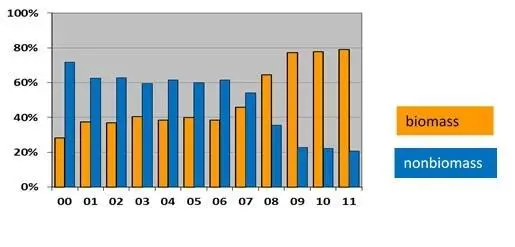
One example of this kind of practice is Port Straubing (Germany) that has three different companies that supply biomass to produce biodiesel, achieving an eco-friendly inland navigation. In fact, during the last decade, this port has considerably enhanced its environmental performance by increasing the share of biomass, reducing substantially the consumption of other fuels (see Figure 1).
- Eolic energy
The use of Eolic energy is an alternative that can improve the environmental performance of inland ports located in windy regions, such as the North of Europe. A good example of that is the Magdeburg Port (Germany) located in the Elbe River (See Figure 2). Its Eolic energy facility has a windmill and various electricity suppliers that provides enough energy to reduce the diesel consumption to around 40% of the total consumption. This reduction implies a 50% decrease on the emissions of contaminant compounds (CO2, NO2, SO2, etc.) to the atmosphere and a noise reduction of 10 dB (A).
- Onshore Power Supply (OPS)
Onshore power supply consists of replacing the auxiliary engines used to provide the energy required on-board, generally running with diesel for electricity generated onshore. By doing this, noise and the emission of CO2 and air pollutants are reduced, improving local air quality as well as the health of both port workers and nearby residents.
It is one of the strategies recommended by the World Port Climate Initiative for reducing the environmental impact of seagoing vessels in ports and it is already in several ports around the world, mainly along the North American East coast and Northern Europe.
- Liquefied Natural Gas (LNG) powered vessels
LNG is a cleaner and more economic source of energy when compared to black products (fuel oil and diesel). For this reason there exists a strong willingness to implement this type of fuel into the inland navigation. Proof of this is the LNG Masterplan for Rhine-Main-Danube which aims at facilitating the implementation of LNG as fuel in inland navigation.
- Environmentally differentiated port fees
Most inland ports have a particular governance composed by many different companies that do not have a common standard regarding environmental performance. For this reason, some port authorities apply financial incentives to support and encourage companies to reduce environmental impact themselves. There exists four main incentives applied in inland ports – reduction of vessel speed, ships using bunker oils with low sulphur content, ships using particle filters and companies that use inland waterways for freight distribution.
Stay in control
Where special projects may often qualify for funding and collaborative effort, the day-to-day imperative of environmental management is the attempt to control the impacts of the port’s activities. Successive surveys show that the accurate identification of these significant activities, products and services remains a major challenge, especially for smaller ports. In order to assess the state-of-play within the inland port sector, an environmental survey was conducted among EU inland ports in cooperation with the European Federation of Inland Ports (EFIP) within the framework of the PORTOPIA project.
The EFIP is an organisation that contributes to promote the role of inland ports, to assist them in facing challenges and to ensure the proper performance of the European inland ports in terms of socio-economics, environment, safety and security. EFIP represents more than 200 inland ports in 18 countries of the European Union, Moldova, Switzerland and Ukraine.
The survey demonstrated it is difficult for some ports to identify and select Significant Environmental Aspects (SEAs) on a comprehensive and scientific basis, due to their special circumstances in terms of dedicated resources. In response, the use of a Tool for the identification and assessment of Environmental Aspects in Ports (TEAP) has been promoted.
This tool was developed within the EU-funded project PERSEUS: Policy-oriented marine Environmental Research in the Southern European Seas, and it is freely available on-line at www.eports.cat . Initially, the respondent has to enter his/her own contact details. All the information is confidential and only the user of the tool will have access to its results.
By selecting the activities that are carried out in the sea or inland port, the tool provides a list of the aspects that are related to these activities, ranked in descending order. Figure 3 shows an example of the list of aspects and, coloured in red, there is the top half aspects, which are taken to the next step.
The port environmental aspects coloured in red are reviewed and assessed against a set of criteria, for instance legal compliance, frequency, or duration of the aspect. After this assessment, a final list of SEAs is obtained which will assist inland ports in knowing where to focus their efforts. Apart from the SEAs, the tool provides a list of Environmental Performance Indicators (EPIs) associated to each of those aspects.
Working collaboratively
Collaborative programmes and the exchange of knowledge through port organisations, such as EFIP and ESPO, can act as catalyst for implementation of good practice and enhanced efficiency in the pursuit of compliance, environmental protection and sustainability. An example of these collaborative programmes has been the development of the TEAP tool.
Since inland ports may be located in highly valuable and vulnerable natural areas, a broad mix of measures have to be applied for the effective management of potential environmental impacts. TEAP is one of these measures, since it assists port authorities in the identification and assessment of environmental aspects in a user-friendly, practicable and time-effective manner. It is available to all European ports, including all types of size and commercial profile.
Related Articles
 ALTERNATIVE FUELS GREENPORT