![PortStrategy[GreenPort]](https://www.portstrategy.com/wp-content/uploads/2026/09/PortStrategyGreenPort.svg)
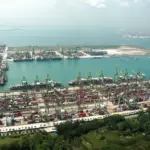





Offshore hubs for a greener future
As ports look to expand to adapt to ever-increasing vessel sizes, offshore hubs are the way forward for a greener future, says USA-based engineering and construction company, Bechtel.
The industry is facing a number of challenges, not only when it comes to being sustainable, but also in terms of port capacity as economy of scale becomes more and more important in bulk and container shipping and with the new Panama Canal and Suez Canal expansion.
Marco Pluijm, manager, port and marine sector, Bechtel, told GreenPort: “Offshore ports is something we’ve been working on for a couple of years and is a viable option for main ports looking for more capacity.”
Bechtel’s offshore hub concept originates from the mining industry in Africa, where more efficient and more environmentally-friendly infrastructure was needed. An offshore facility means no dredging of existing ports is needed, no larger cranes are needed, and the hub can handle Cape Size ships and larger.
“In addition to increasing handling capacity, offshore infrastructure offers savings in capital and operating costs, versus modifying existing onshore ports,” Mr Pluijm explained.
The offshore terminal facilities are purpose built and minimal surface area is required as the hub is “tailor made” for each type and quantity of cargo. Located at “adequate water depth” means no dredging offshore is required either, while the hub can directly serve the main carriers all together, followed by direct forward-moving of cargo.
Spread cargo flows over more than one port onshore because many of these are in urbanised areas with limited hinterland connections and capacity so there’s a lot of traffic involved. By spreading it, it spreads the traffic and reduces congestion.
These offshore hubs, which are already in use in Abu Dhabi and China, can also be a source for ecological developments, supporting renewable energy and marine habitat development through artificial reefs.
Mr Pluijm adds that the industry will continue to deal with the current upscale for at least five to seven more years and will set the trend for the decades thereafter, while the New Panama Canal and the Suez Canal expansion mean even larger vessels are expected. “Not knowing the future, flexibility is key,” said Mr Pluijm.
In the US, Mr Pluijm says east coast ports have or are about to reach their limits. Currently, up to 70% of the west coast containers move east by rail and road. Bechtel says shifting these containers from overland transport to the east coast ports like New York and New Jersey direct via the Suez Canal on larger carriers could reduce emissions by around 20-30% and 40-50% in overland emissions.
An offshore hub for the US east coast would also reduce congestion on land and provides “unlimited growth potential”. Bechtel told GP it’s currently in discussions with the US government to see if it’s a viable option.
Bechtel operates through four global business units that specialise in civil infrastructure; power generation, communications, and transmission; mining and metals; oil, gas, and chemicals; and government services.
Related Articles
 ALTERNATIVE FUELS GREENPORT