



Plan for clean energy freight charging points
The Port of Rotterdam Authority, national government and four provinces have made agreements to develop charging points for clean energy along the two most important freight transport corridors heading for Germany.
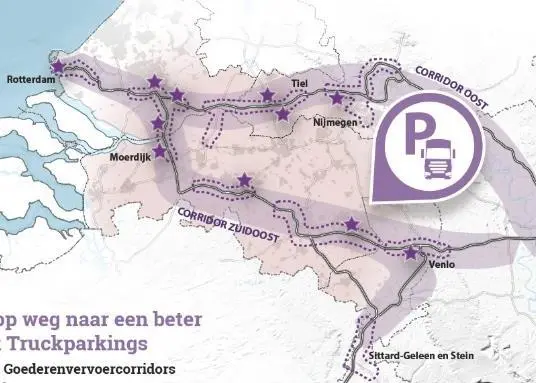
As part of an initiative to ensure that traffic and freight flows can run as flexibly as possible, particularly in the Rotterdam region and German hinterland, the group involved want to reduce diesel use as fuel for freight transport by introducing a network of filling points for sustainable fuels and other energy carriers for road transport and inland shipping, with the goal of reducing CO2 and particulate emissions and noise nuisance.
As operator of Europe’s largest port, the port authority sees developing such ‘Clean Energy Hubs’ as being in line in with its policy of playing a leading role in the European energy transition.
The routes identified for these charging points include the East corridor (road transport via A15, inland transport across the Waal, rail transport via the Betuwe Route) and Southeast corridor (Rotterdam-Moerdijk-Tilburg-Venlo).
The initiative also aims to create more secure parking spaces along these corridors, where there is a shortage of secure parking, especially for trucks.
With both aims combined, the project team wan to ultimately facilitate a smooth, reliable, robust, secure and sustainable transport system.
A declaration of intent was signed by the Minister of Infrastructure and Water Management, delegates of the Provincial Executives of Zuid-Holland, Noord-Brabant, Gelderland and Limburg and COO of the Port of Rotterdam Authority, Ronald Paul.
Related Articles
 ALTERNATIVE FUELS GREENPORT