![PortStrategy[GreenPort]](https://www.portstrategy.com/wp-content/uploads/2026/09/PortStrategyGreenPort.svg)




Ports’ key role in the sustainable logistics chain
Sustainability in operations is no longer just an attractive option. It is fast becoming a commercial imperative to reduce costs and drive competitive advantage. Kate Royston investigates how it is remaining firmly on the agenda through the economic downturn
This article focuses on key areas being addressed by Terminal Operators and Shipping Lines to enhance the sustainability of their operations, their inter-dependence with Port Authorities and the importance of co-operation and communication.
At a recent Royal Haskoning Ports conference in London, a number of major Terminal Operators agreed that sustainability has become an integral aspect of today’s business and its risk management. Whilst the current economic situation has had an impact on investment in sustainability, it has not reduced attention in this area. It may in fact have accelerated attention to measures which, in particular, can deliver cost reduction with limited investment. A number of areas are of common interest to Terminal Operators including:
• Safety and good housekeeping: ensuring the safety of employees and operations
• Energy efficiency and carbon reduction
• Air quality management
• Resource efficiency and waste management
• Sustainable supply chain management Above all, the message is that measurement is the cornerstone: “if you don’t measure you can’t manage.”
Safety is seen as the starting point and foundation for sustainability. Sharing best practice is an important aspect of improving safety between different operations within the logistics chain.
In recent years there has been increasing attention to Air Quality Management in the US, led by California. There is now growing concern globally for particulate management, expected to be a key element of forthcoming European Commission (EC) legislation. This will require increasing work and investment in the future.
Effective management of Waste and Resources can reduce costs and provide opportunities.
For example, Eurogate Terminals has extended its combined heat and power generation at Bremerhaven with an additional woodchip heating plant fuelled from port dunnage, thus generating renewable energy from waste resource. A similar plant has now been installed in Hamburg.
Supply chain pressures are increasing. Customers such as global retailers Ikea and Wal-Mart are exerting pressure through their supply chains to understand the sustainability of their supply chain partners and products. In the last few months Terminal Operators have begun to receive requests from Shippers for carbon footprinting data to meet Shippers customer’s requests.
Energy efficiency and carbon management
Energy efficiency and carbon management appears to be at the top of the agenda and is reviewed here in some detail. It provides an opportunity for taking cost out of the business and must be addressed to meet customer pressure and the demands of developing legislation (e.g. the Carbon Reduction Commitment (CRC) legislation in the UK).
Energy monitoring and management and carbon footprinting are valuable tools to help understand an operation and its opportunities and priorities. Accurate and detailed data is increasingly critical as the scope of energy monitoring efforts expand.
DP World terminals have been measuring and reporting their fuel and electricity usage since 2000. They have an ambitious target to reduce CO2 emissions by 27% from January 2009 (staggered over five years) normalised against TEU. A web based Carbon Calculator tool has been developed to facilitate data capture. Hutchinson Port Holdings UK (HPHUK) has benchmarked all their terminals for energy use and encourages competition between them.
The profile of terminals’ energy use will vary according to geography and available energy sources. In Europe, for example, the typical split of diesel fuel to electricity usage is 70:30 depending on the types of equipment used. Diesel fuels the mobile equipment and electricity is purchased to power cranes, reefers, electrically powered mobile vehicles, lighting and buildings.
Improvement strategies, signalled from energy monitoring data, should ideally focus firstly on reducing energy consumption. Target setting helps focus attention. For example as part of its Eco-efficiency programme APM Terminals has set a goal of reducing its CO2 emissions by 15% per TEU handled within 3 years.
Reducing energy consumption
Reducing consumption will require changes in usage behaviour, operational practices as well as the technical aspects of the equipment itself.
In the current climate HPH-UK’s Andrew Marston stresses that the small things can add up to make a difference and deserve attention e.g. boiler controls and insulation. They have sought the support of the Carbon Trust (a government agency) in auditing and developing investment business cases. DP World’s Global Environmental Manager Charles Haine notes that important gains can be achieved at low or no cost. He added that DP World actively encourage engineers to brainstorm potential energy saving solutions.
Supporting behaviour change is essential. HPH-UK is investing time working with its Tug and RTG operators to secure their understanding of the importance of energy efficiency practices and how they can be achieved. An example is ensuring that equipment is set from engine idling to plug in mains supply when not in use.
Hand in hand with this is the need for optimisation of operating systems across the whole business including streamlining processes and procedures, reducing waiting or idle time and improving overall equipment utilisation.
Both DP World and HPH-UK have introduced Vehicle Booking Systems which have improved efficiency. The main aim is to spread haulage arrivals evenly across the 24 hour day generating benefits through reduced congestion and operational efficiency, whilst increasing air quality.
Accessibility on and off the port will impact efficiency and is an area where the Port Authority must play a key role in coordination and securing access and intermodal facilities.
Modal shift
In the face of rising congestion and air quality issues the Port of Rotterdam Authority foresaw accessibility issues for its Maasvlakte II (MVII) development. To encourage co-modality MVII Terminal Operators concession agreements stipulate the need for a modal shift allowing a maximum of 35% container movement by road by 2035. The Port Authority is supporting this goal with a number of initiatives including the development of a container transfer facility in the hinterland serviced by inland vessels.
Greening the equipment
Equipment can be improved through retrofitting or investing in new eco-plant, especially where old stock is due to be replaced. Powering equipment represents a major cost element. One of the key priorities of the Terminal Operator is to understand energy consumption patterns of each plant through data tracking. An important consideration is the whole life cost of the purchase, operation, maintenance and disposal of the asset. DP World engineers are now asked to consider not only cost and maintenance but also carbon reduction potential when assessing new equipment. With asset lives in excess of 15 years, investment decisions today will influence future sustainability. Consideration of implications and business risks such as legislation and carbon pricing is leading to the role of Engineer and Finance Manager becoming as important as Operations and Health, Safety and Environment (HSE) in this area of plant decision making and carbon management.
Retrofitting
In the current climate, emphasis is falling on retrofitting to facilitate more energy efficient ‘sweating’ of installed assets. DP World for example has a long term programme underway to address the efficiency of its mobile equipment and plant at terminals.
The Engineering department at DP World’s Jebel Ali operation in the UAE achieved significant fuel consumption and cost benefits by refitting engines on RTGs. Twenty seven original diesel engines have been replaced by smaller Volvo engines with the installation of inverters in order to balance power and performance requirements.
The payback period has been one year and achieved a 50% energy saving. Eurogate is one of the Terminal Operators working with its engineers and equipment providers to capture energy from electrical container cranes within the port. When a load is lowered or when the driver’s cabin comes to a halt, energy is released. Since the mid 1980’s work has been underway to find a way to capture and re-use this energy.
Eurogate is now employing a technology that returns 20-25% of the total energy released back to the power mains system and thus available to other consumers. This reduces cost and achieves reductions in CO2 emissions of about 4,000 tonnes every year.
Lighting is another area where efficiencies can be gained by both Terminal Operators and Port Authorities. At DP World Southampton, in the UK, the Engineering / Crane team initiated a Prismalense Lighting Project.
This involved replacing more conventional high pressure sodium units with 150W lights on Liebherr cranes and metal halide units with Prismalense lights on high masts in operational areas.
This pilot study, with a payback of 21 months, has generated a 50% energy reduction and savings of 310 tonnes of CO2 equivalent. Significantly workers feel improved lighting conditions are enhancing safety.
New plant
Looking to the future and the likely need to achieve CO2 reductions of 80% by 2050, step changes are required in plant efficiency. Driving out cost and carbon requires innovation and partnership with equipment providers, Shippers and Port Authorities. Charles Haine notes that a significant portion of his time is now spent working on CO2 initiatives, liaising with equipment providers of eco-technology and supporting pilot projects in different terminals.
APM Terminals have co-developed a more fuel efficient ‘Eco-RTG’ in collaboration with Siemens AG, with more than 100 RTGs in use throughout the Global Terminal Network in Europe and Asia. New Terminals and extensions provide opportunities for installing new eco plant with substantial energy advantages. DP World’s London Gateway and Rotterdam Gateway Terminals will provide examples of this.
Eurogate is working on a research project to investigate the feasibility of installing an eco-friendly cable car transport system to transport containers more efficiently through the terminal. This would enable the replacement of truck journeys and their high fuel consumption.
The Port of Los Angeles believes it has a key role to play in supporting its users and tenants in achieving lean and green operation. One mechanism is the Technology Advancement Programme (TAP) jointly managed by the Port of Los Angeles and Long Beach. Its aim is to accelerate the verification or commercial availability of new, clean technologies to move towards an emissions free port. (http://www.cleanairactionplan.org/tech/default.asp)
Alternative Energy Sources
Port located operations are often ideally placed to benefit from alternative wind, wave, tidal and solar powered energy generation. These should be exploited wherever feasible taking into account their overall sustainability and ecological impacts.
APM Terminals officially opened its new EUR 12.5 million power distribution network on October 16th 2009 at the Rotterdam container terminal which uses electricity generated through wind power. By switching from grey to green electricity the terminal reduces its CO2 emissions by 45% per year. The electricity is sourced from two nearby wind farms in The Netherlands.
Port Authorities can play an important role through investing in alternative energy infrastructure in collaboration with their tenants. The Port of Bristol is expecting to double its wind turbine capacity, in part to support its Deep Sea Container Terminal development. The Port of Rotterdam Authority plans to expand the wind energy generation in the port from 150 MW in 2009 to 300 MW in 2020.
In some cases a Port Authority provides tenants with utilities infrastructure such as electricity and water. Its sustainability has an important impact on tenants’ performance and may require a joint approach to investment and innovation. Where not already present, there will be a need to accommodate sub-metering measurement of utilities and facilitation of return flows from energy gains where relevant. The introduction of carbon footprinting and in the UK, the CRC legislation, will require discussion and agreement on boundaries, impacts, and beneficiaries of investment to name just a few!
Co-operation is crucial and will be discussed further below.
The Shipping Line View on Sustainable Operations
The shipping line perspective is represented by Maersk Line, part of the A.P. Moller-Maersk Group. The world’s largest container shipping line, it sees sustainability as being core to its operations. It seeks to achieve this through embedding environmental improvements into its operations as an ongoing process. This is facilitated through developing relevant environmental strategies and targets and employing innovation and investment in new technologies often together with supply chain partners.
A priority for Maersk Lines is reducing the environmental impacts of its own vessels, particularly fuel use. Some of the initiatives include:
• A Waste Heat Recovery system which saves 8-10% of fuel at optimum conditions. This has been fitted on 32 ships.
• Introduction of Slow Steaming. Reducing speed by 5-10% increases the number of days at sea but both fuel consumption and CO2 emissions are reduced by 15%
• The Quest project. This addresses energy consumption for cooling in containers through the installation of software in containers. At the end of 2008, with 69% of Maersk Line and Safmarines reefer fleet fitted with the software achieved CO2 equivalent savings of 260,000 tons.
Improving the efficiency of reefer containers is also important for Terminal Operators. Significant energy consumption is directed towards reefer cooling.
• The Voyage Efficiency System. Optimised voyage planning identifies the most fuel efficient route. Whilst these examples help to improve the efficiency of the fleet, optimal performance will depend on multiple factors. This includes the efficiency of Port and Terminal operators in handling the swift passage of the vessel in and out of port; efficient unloading and loading processes to minimise idle emissions; supporting sustainable energy use whilst in port; and in provision of waste management facilities. Shippers, for their part, must ensure frequent and effective communication between its ships and the port. The Port of Gothenburg has led the way in developing high voltage Onshore Power Supply (OPS) in conjunction with Stora Enso. Since 2000 its use has expanded and over 20% of all ship calls to the port are now connected to OPS. This work is the core of the WPCI OPS initiative to develop best practice guidelines for the industry. OPS is not always the answer and its overall sustainability depends on the source of electrical power.
The Port of London Authority (PLA) is working to improve access to the port through providing deeper, straighter channels where feasible. This reduces shipping lines’ time and fuel use. An example of this is the Princes Channel dredge in the Thames Estuary. Shortening the Thames Estuary route from Fisherman’s Gat/Knock John to Princes’ Channel is calculated to save 2,200 tonnes of CO2 per annum.
Co-operation is the way forward
The operations of Shipping Lines, Terminal Operators and Port Authorities are interdependant. Communicating and resolving these inter-dependencies is a critical part of both day to day business and improving the sustainability of operations between them and other players in the logistics chain.
“Greening the logistics chain” is fast moving from ‘buzzword’ into commercial necessity. Whilst much will be progressed as part of day to day working relationships, the complexity of some of the issues requires formal and informal forums to facilitate better industry wide understanding. These include:
• World Economic Forum’s Logistics and Transport Group which has recently released a report entitled ‘Supply Chain Decarbonisation’. DP World was an active participant in this effort helping to craft general approaches and innovation opportunities for Decarbonisation of the logistics chain
• The WPCI Carbon Footprinting project which brings together Port Authorities. A number of international Terminal Operators are holding their first informal meeting in October on this subject. Avoiding double counting and collecting comparable data’.
Collaboration and co-operation is necessary to support optimal performance across the whole chain, integrating the potential of systems and equipment innovations with vendors. The Port of London Authority has launched an initiative called the “End to End Study” which is examining how communication and the means of arranging all aspects of port entry, berth allocation and terminal operations can be made more efficient. Its aim is to reduce costs and ship delays which will also reduce emissions. There is growing agreement of the need for greater transparency, also demanded by stakeholders, with increased focus on reporting and the need for industry wide standards. These are critical to help create a common base to support co-operation and achieve the required results. APM Terminals believe that “common industry-wide standardised methods of measuring energy consumption and emissions of CO2 and particulate pollution would be a good start”.
Conclusions
The inter-relation of the operations of Shipping Lines, Terminal Operators and Port Authorities operations is self-evident. Whilst some improvements to the sustainability of operations can be achieved by individual players in the chain many do require communication, co-operation and collaboration. For Port Authorities this will include working towards more sustainable accessibility on and off the port, both seaside and landside; sustainable utilities provision and metering facilities; lease and concession agreements which provide support and direction and necessary integrated systems.
Above all, increasingly transparent communications and a shared vision and goals are becoming critical as we move towards the sustainable port of the future.
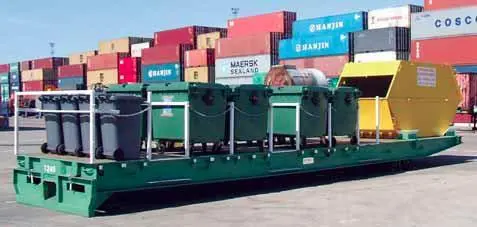
Shipping lines are increasingly maintaining separation of waste on board and welcome appropriate waste reception facilities. At the Port of Felixstowe HPH-UK has been able to demonstrate that maximum energy can be gained from separation at source. Their innovative skip trailer system (pictured) has resulted in overall recycling rates across the port of 45%.
Related Articles
 ALTERNATIVE FUELS GREENPORT