![PortStrategy[GreenPort]](https://www.portstrategy.com/wp-content/uploads/2026/09/PortStrategyGreenPort.svg)




Shore power analysis aids sustainability
Shore power analysis is in place at a Danish port to help cut emissions and boost sustainability.
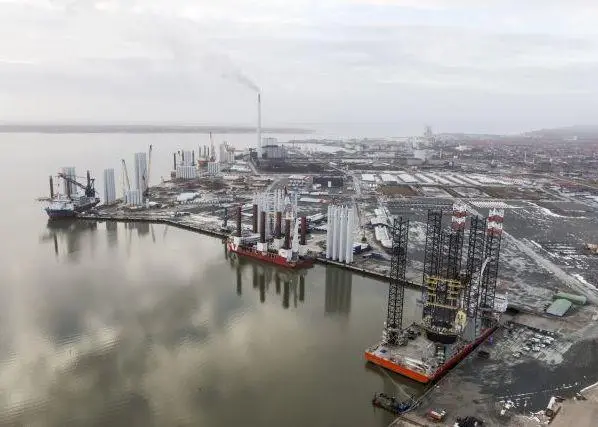
New shore power units at Port Esbjerg allow docked vessels to run on renewable electricity from offshore wind turbines. The impact is assessed by a carbon and energy management programme implemented as part of a partnership between Honeywell and Port Esbjerg to help reduce carbon emissions at the Danish port by 70% by 2030.
“Given the size and complexity of our operation, there was no simple, off-the-shelf solution for our green transition. We worked with Honeywell to fully customise a system that can monitor energy consumption and emissions, as well as pinpoint potential improvement opportunities,” explained Port Esbjerg CEO, Dennis Jul Pedersen.
Data at hand
The partnership enables the port to access data on the carbon footprint of vessels at any time through the Honeywell Enacto Carbon and Energy Management system.
This is a cloud-based, fully scalable solution that enables the port to monitor the emissions and resource consumption of every individual power socket, and every vessel, with 1,200 measurement points. The system uses artificial intelligence and machine learning algorithms in conjunction with data collection from energy-consuming or energy-producing assets at the port.
If consumption changes significantly, the port is alerted, meaning any abnormalities are immediately identified and action may be taken. The port aims to use the data to support operational investments in sustainable infrastructure, including use of renewable energy, and in the future – clean fuel technology.
Based on data generated by the Honeywell system, Port Esbjerg can optimise its energy and carbon footprint in real time. In the future, it will be able to prioritise financial resources where the most significant CO2 reductions can be made – generating tangible emissions-lowering results.
In the next phase of the project, Port Esbjerg and Honeywell will monitor and manage water consumption and heating, as well as the emissions performance of businesses around the port. The plan also features significant investments in electric vehicle technology and hydrogen-powered cranes. The target is for all port vehicles to be powered by electricity by 2025.
Related Articles
 ALTERNATIVE FUELS GREENPORT