

Venices challenge in becoming a carbon neutral port
The Port of Venice has hosted, for the first time, Energy for Green Ports & Green Port Logistics, two international events that have addressed issues related to the environmental sustainability of port operations, the management of ships emissions and the development of corridors and intermodal networks with particular attention to intermodal nodes and arcs of the entire supply chain.
The relevance of the speakers, institutional or otherwise, who attended the debates, has brought out clearly the intrinsic value of an eco-friendly implementation of port and logistic operations – a goal which responds to a supranational and collective interest – and, consequently, the increasingly urgent need to put these issues at the heart of international political and economic agendas. Because nowadays we are all called to take responsibly for the environmental consequences of our actions, both from the internal point of view and from the system.
Butterfly effect
The individual commitment and the best practices in this regard are absolutely necessary but not sufficient. It ‘s the “butterfly effect” – the metaphor with which it is assumed that the slightest flutter of a butterfly is able to cause a hurricane somewhere else around the world – transposed to ports and logistics systems.
Today, also thanks to technological development, we can say that the best practices are increasing. Even the Venice Port Authority, over time, acquired a growing environmental sensitivity and aims to becoming a carbon neutral port.
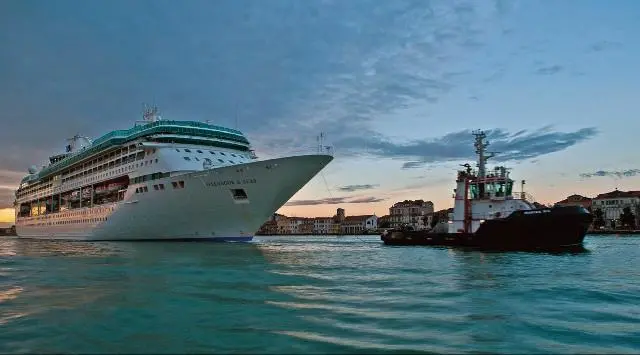
And to this regard there are many projects aiming to make the Port of Venice a neutral port, compatible with a delicate ecosystem and a unique cultural and historical heritage in the world. Starting from the installation at the Cruise and Ferry Terminal of solar panels and LED lights to illuminate the yard – reducing consumption over than the 80% – plus the cold ironing system being developed for large cruise ships but already operating on the docks of Santa Marta, this cold ironing system allows vessels to turn off the engine during the stop, avoiding the emission of CO2 in the air.
Preliminary agreement
Another interesting initiative is the electricity production from algae, a project that, by the signing of the preliminary agreement of cooperation with “Veneto Agricoltura”, has passed from hypothesis to reality. In fact, “Veneto Agricoltura” gives its willingness to install, as soon as possible, at the experimental Aquaculture site on the island of Pellestrina, a production plant of algal biomass, intended in particular to the closed-loop production of biofuels for electricity generation, which could also be used for engines of boats and vehicles.
However, the relevance of the Port of Venice, which nowadays handles more than 400,000 containers and more than 26 million tons of cargo a year, and aims in the long run to take a leap in scaling the volume of intermediated trades, requires a system vision linking the port of Venice with the national and European supply chain to which it is connected. By the conclusions and recommendations contained in the Fourth Report “The European Environment – State and Perspectives” (SOER 2010) it is demonstrated that, in the EU-27 – in contrast with other indicators – emissions from transport increased by 24% between 1990 and 2008.
Be lean, be clean and be green
This is a matter of concern that cannot let us indifferent. And the commitment of the Venice Port Authority to transform the slogan “Be lean, be clean and be green” as a strategy to make the Port of Venice an example of environmental best practices may not be enough, because energy efficiency and environmental compatibility of a single node, despite being a virtuous exercise, is likely to produce results that are inadequate to meet the collective needs to reduce polluting emissions in Europe.
On the contrary, the Venice Port Authority believes that, in order to produce concrete and lasting effects, it is necessary to assess which are the best actions – to be performed on the entire supply chain and not only on individual nodes – that embody sensitive environmental benefits. From this point a commitment to increase intermodal river barge transportation from Venice to Mantua arises and develops, implementing the connections between the Port of Venice with the European and national rail network.
Excellent location
This is how the need arises to rebalance the mediation of maritime traffic between Europe and the rest of the world. The North Adriatic ports have an excellent location, which allows them to offer the best transit time for traffic between Europe and the Far East (and of course with all the eastern Mediterranean) and best environmental performance. A container leaving Port Said and arriving in Munich via Venice instead of passing via Hamburg produces – ship and train – 56 kg/TEU CO2 instead of 134 kg/TEU or – ship and truck – 101 kg/TEU instead of 209 kg CO2/TEU. These data are very important but still not sufficient to convince the leaders of the world’s maritime traffic to go through the Adriatic region in order to make it a true alternative to the final destination, the North Sea.
Massive increase
If we want this to happen we should create organizational and infrastructural conditions (with reference to the entire supply chain) for a massive increase in scale of the North-Adriatic ports. An increase of at least an order of magnitude sufficient to render a convenient direct connection (without transshipment) between the North Adriatic and the Far East.
The national and European Logistics can win the environmental challenge only if the North Adriatic – as well as the North Tyrrhenian – join the system framework to become the exclusive departure/destination of its traffic from and to Suez, and not just an uncomfortable stopover, reached only by fewer services which connects them to few ports of transshipment, for traffic with different final destination in the North European Sea.
This is a bet that we can and must win if we want to cancel the “butterfly effect” and prevent the slightest flutter of a node to cause a hurricane on the entire logistics chain.
Related Articles
 ALTERNATIVE FUELS GREENPORT