![PortStrategy[GreenPort]](https://www.portstrategy.com/wp-content/uploads/2026/09/PortStrategyGreenPort.svg)




Reproducing reality
Safety, training and productivity – the benefits of simulating cargo handling operations are increasingly to the fore including new dimensions such as with automation and the handling of wind turbines. Felicity Landon reviews the state-of-the-art
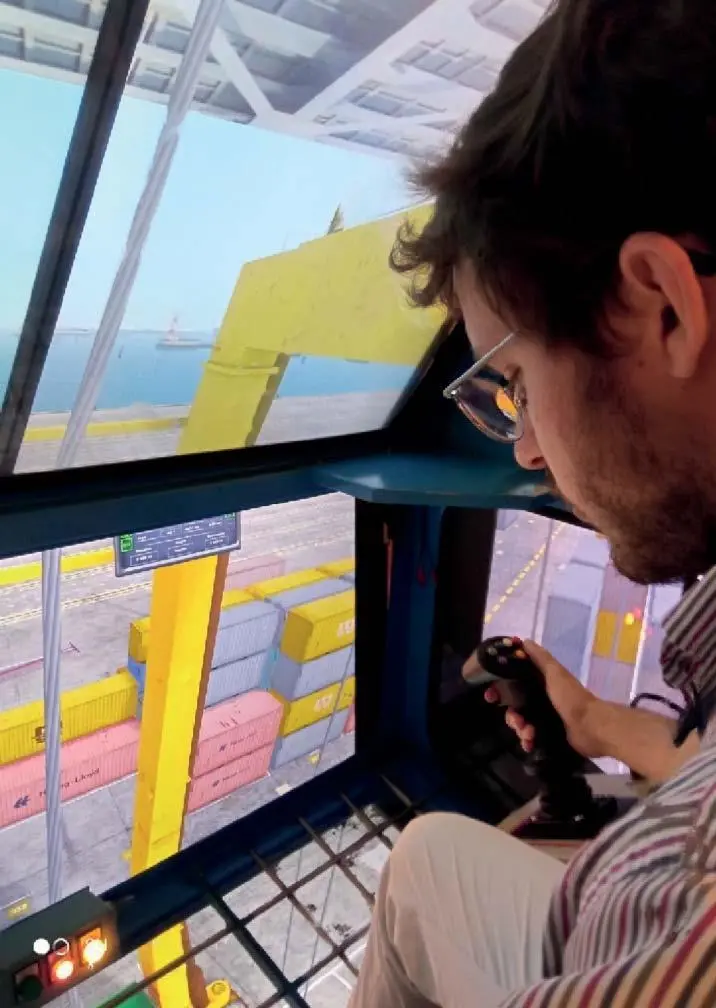
Why use simulation? It’s a question with multiple answers. Simulation removes the risks of using expensive ‘real’ kit to train novices or inexperienced operators, and avoids tying up expensive assets that should be deployed more productively. It helps to weed out early trainees who really aren’t going to make the grade. It enables port teams to practise and tweak operations, including in advance of a new or challenging cargo. It helps operators to polish up their skills.
“There are three overall benefits of using simulators – safety, training and productivity,” says Laurence Jones, Risk Assessment Director at the TT Club. “In terms of safety, you are lowering the risk of damage and injuries and increasing awareness. You can simulate accidents and practise emergency responses.
“Simulation can reduce the training time to when the operator is ready to finally operate the crane by themselves. When I was working in terminals, I used to see crane drivers do their training [on real equipment] and they would hit the wrong buttons, arms would be going up, they didn’t know what was going on and you would hear the ‘lucky I survived’ comment. With simulator training, they can learn from their mistakes and bypass all that before they get into the machine, at which point they will be much more confident.”
Simulators can also be used in a sort of ‘try before you buy’ exercise; if a new trainee doesn’t have the level of coordination and dexterity required, their unsuitability as a crane driver will be picked up early. “So, you are not wasting time and money and, as a result, you end up with more highly skilled crane drivers whose average performance is going to be much higher,” says Jones. “That all comes back to more moves per hour and doing it safely.”
Simulators have not been universally adopted in the industry but many more companies are now seeing the benefits, says Jones. “A lot of companies are doing simulator training – but a lot aren’t and still need to be pushed. The TT Club highly recommends the use of simulators for the training of operators for all cargo handling equipment.”
The obstacle in the past has been cost, he notes: “They are still not cheap, but they are a lot cheaper than they were. It is also becoming more common to share the cost, rather than spend half a million to buy one simulator. Training centres are starting to pop up, which is far more economical.”
As he points out, today you can source a simulator for nearly every machine – not just cranes but also forklifts, trucks, straddle carriers and others.
Training equipment operators using simulators instead of live and expensive equipment has delivered results, says Ross McKissock, Director of Unitised at Forth Ports, UK. Speaking at Coastlink in Liverpool, he said: “We let people fail digitally and become a better driver as a result. As a consequence of using models, we have slowed our equipment down. We made it slower because people then know that they can’t just nip into a little gap – so they are driving more safely to the conditions at a steadier rate, the fuel burn is improved, and maintenance is better because of reduced damage.”
Simulation equipment for ports has been mostly focused around ship-to-shore cranes because these are the biggest, most expensive and most dangerous pieces of kit, says Brad Ball, Vice-President of International Sales and Marketing at GlobalSim. In the past, a simulator for a forklift or reach stacker had to be bought separately. However, the technology has evolved to the point that GlobalSim can supply a large simulator adaptable for use as STS, RTG or other heavy equipment.
“Within a matter of five minutes, you can switch out the controls, put in a steering wheel and so on, to train on other equipment.”
VIRTUAL REALITY IMPACT
Another key development has been the impact of Virtual Reality (VR). “You put on the VR headset and plug into the computer program, and they offer an amazing ability for a desktop-type simulator. So, rather than having to have a huge simulator that costs hundreds of thousands of dollars, we can now set up a desktop system with one small screen and a lot of scenarios. For some types of equipment, it works really well.”
However, he does not expect VR to eclipse the larger simulators. “There are real advantages to this VR tech but also disadvantages. You have entire reality around you and also some depth perception. A client who has a lot of simulators wanted a VR product because they wanted to sense a fear of heights when training a new set of people. Instead of finding out a person is afraid of heights when they get up in the crane, why not train on a simple unit for a day first? With every form of simulator, a huge advantage is being able to test and train in a very controlled environment, very safely, before getting into the real equipment that is expensive and dangerous to operate.”
The disadvantage of VR, he says, is that you can’t have the headset on all day. “You can go about 30 minutes, maybe an hour, then you get weary. Some people get dizzy or queasy in that virtual environment. So the VR headset is great, but as an add-on to our systems, not really as a whole system in itself.” Meanwhile, the advance of automation and remote control (RC) is having an impact. GlobalSim has sold a number of RC simulators – instead of recreating motion, bumps, etc., this is typically a desktop process.
“I am fully invested in simulators but even I will tell you that a simulator is not a 100 per cent solution,” says Ball. “In virtually every case you still need to have some sort of training on real equipment; you can do 80 per cent on the simulator but at some point you need to graduate people to real equipment.”
That applies even with RC simulation, he says.
Laurence Jones says: “You might think that simulator training would be perfect for RC because it is similar – that is probably correct, but it all depends on the sensors and cameras installed on the crane that is remotely controlled by the operator.”
There have been accidents reported where the remote operator (not being on site) could not see everything, says Jones. “It is all to do with the set-ups of cameras and sensors, and having procedures for the truck drivers coming in to collect the containers. I am still waiting on a bit more feedback on remote operation quay cranes. It is still about interaction and the real world.”
Even when quay cranes are automated, there is a place for simulator training, he adds. “There are always going to be exceptions so you have to have the remote operators well trained because at some stage they might need to remotely operate the cranes.”
WIND TURBINE CHALLENGE
GlobalSim is reporting increased interest in simulation training for handling wind power equipment, particularly for the installation of wind turbines.
“These turbines are being manufactured in various locations and shipped throughout the world,” says Brad Ball. “How do you handle them? You need training on the crane to move these turbines, whether from an offshore vessel or at a port.”
Those involved want to train operators on a simulator, rather than ‘training’ with a real turbine when it arrives, he says. “They will be doing a tandem lift, which requires collaboration and communication between two crane operators. That type of training is very different. From a simulator standpoint, it is interesting and a little bit tricky because you have to have two simulators coordinating together. It is something we have done before for the US military, so we are working on that now, incorporating that same thing for commercial application.”
Related Articles
 TERMINAL OPERATIONS
 DIGITAL
 DIGITAL