![PortStrategy[GreenPort]](https://www.portstrategy.com/wp-content/uploads/2026/09/PortStrategyGreenPort.svg)






Celebrating uniqueness
Hand and finger print recognition can be a cost effective security solution, explains Alex Hughes
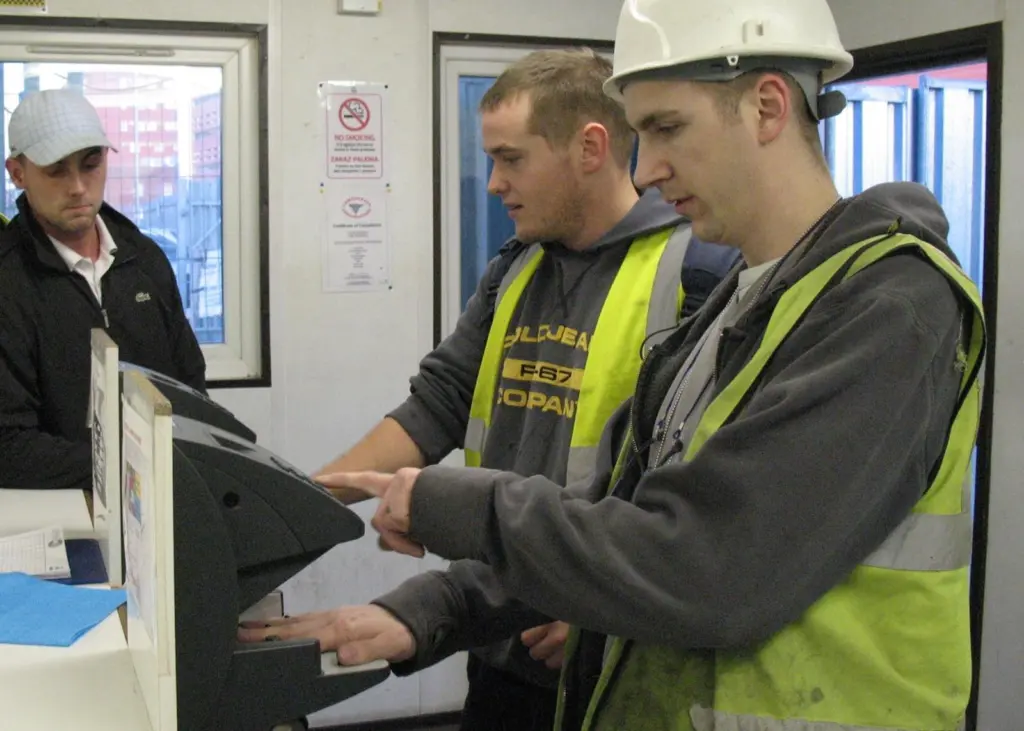
Port and terminal security is being addressed in a variety of different ways. However, it’s not just a question of hardware – operators have to have the relevant software network in place too.
Datastrip, nowadays a sister company to mobile software specialist Smart Media Innovations, manufactures hand held identity verification terminals, which can be deployed as access control devices on manned port terminal perimeters or for making mobile spot checks within terminals.
While company representative Dick Clark is happy to sell these terminals to ports – and Datastrip has technology in use at many maritime terminals around the world – he has reservations as to whether all operators are exactly sure what they are getting into.
“Operators buying one of our mobile devices have to realise they will form part of a much larger system, including a software application running the device itself, not to mention the not insignificant task of then somehow integrating that with the terminal’s own security system.”
He points out that there have been examples of terminals becoming the proud owners of security devices, only to then struggle to integrate them into an existing network.
Full integration
Writing software for a mobile platform is a specialised task, he says. If that software then has to be updated along with changes to the terminal’s own system, somebody will have to be found to do that. Indeed, many of the major system providers have “certification” processes that have to be gone through, where applications are tested alongside the main system.
“If you then add biometrics to the mobile terminal, you introduce further complications. Simply having a sensor on the terminal doesn’t necessarily imply that it will work; what is also needed is an ‘engine’ from one of the specialist algorithm vendors – and not all of these are interoperable,” he says. “Our advice is to map out in advance – and in some detail – the desired operational use – and that means considering what data is to be collected and from where.”
One innovative hardware manufacturer offering an interesting solution for terminals is Genie CCTV.
Many existing access control systems are based around radio frequency (RFID) networks. These utilise RFID cards or tokens to allow access to restricted areas by reading a pre-authorised card number. However, these passes or cards issued to personnel have no real means to validate the true identify of that individual. Security is easily breached if the user shares his card deliberately, loses the card, or the card itself becomes cloned or stolen.
Genie CCTV has launched a brand new system that obviates the need to acquire expensive biometrics systems, instead embedding a miniature fingerprint reader into the actual card itself. The device, which resembles a chunky credit card, only works once the legitimate owner of the pass places their fingerprint on the reader on the back of the card, thereby making the antenna ‘live’ for about 15 seconds. This is indicated by the illumination of a green light; conversely, a red light means that no validation has occurred.
After that, it is a simple question of holding the by now active card up to the reader, which will simply release the access lock on the door or gate to allow them to pass through.
If the reader on the back of the pass is not activated and the fingerprint not validated, the access point will remain closed.
Simple solutions
“By placing my fingerprint on the reader, I have actually identified myself on that card. Both card and user are linked. Then, if the pass is registered on the system, it will recognise me as an authenticated user. This technology helps to eradicate typical security or fraudulent breaches associated with security cards,” explains Rui D’Almeida, access control manager at Genie.
Facilities with existing RF technology in place can adapt this to accommodate the new passes, thereby obviating the need to invest heavily in expensive biometric terminals. A card embedded with a fingerprint reader need cost no more than £100 per unit, a negligible cost for a terminal.
“We are not reinventing the wheel, we’re just securing what already exists. By simply issuing this card you turn your existing RFID system into a fully functional biometric solution.” says Mr D’Almeida.
In many ways, by keeping the fingerprint reader on an individual worker’s pass you are ensuring that they have a particular interest in ensuring that the system works. In many applications, wall-mounted fingerprint readers become dirty, cease functioning and may also be prone to vandalism. Individual readers carried around with system users probably stand more chance of continuing to work irrespective of ambient conditions.
“No centrally held database of fingerprints is necessary,” says Mr D’Almeida. “A chip on the card holds the fingerprint template, which is carried around by the user. It’s only the card itself that is logged into the overall system.”
The cards have been designed to be very robust. They are sealed and should therefore last at least three years in front line service. On the front of the card, a terminal would typically place a photograph and a barcode, along with the name of the user and their title. This information can be provided by a standard card printer and stuck onto the card.
If somebody leaves the port, their pass number is automatically cancelled, meaning that their pass, even though technically still valid if authenticated by a fingerprint, would effectively be useless. Once handed in, information on the card would be wiped, which would then be allocated to a new user.
“No biometric solution works with everybody. There will always be unrecognisable fingerprints or unrecognisably damaged fingerprints. However, at the point of enrolment that would very quickly become evident. That person might then have to be given a pin code in the card,” says Mr D’Almeida.
Handy help
Interflex is another solution provider, offering a turnkey access control package, covering all main entry points and also access to machinery within a terminal environment. This could encompass turnstiles, vehicle barriers, doors or equipment, with both employees and contractors controlled via a common solution.
Dave Bulless, the company’s sales leader in the UK and Ireland notes, “All main entry points can be covered to enable people and vehicles to be monitored closely and, by adding individual buildings, a total package can be developed.”
The technology behind the system looks at hand and finger biometrics.
The 2D or 3D Finger Biometric Reader allows the person’s finger to be placed into the unit, which then measures areas of highest security. These make it difficult for non-authorised personnel to gain access to restricted areas, while ensuring that no eligible employees are refused access.
The Hand Reader measures the size and shape of a person’s hand, including length, width, thickness and surface area. When the user places his or her hand on the platen of a device like the Schlage HandPunch, the device scans the hand to determine if the profile stored in the system matches the hand on the platen. In many cases, a swipe card or PIN may also be required to allow access.
“No fingerprint or palm print is ever stored on the device, while data is not shared with any outside agencies or companies. Verification is fast: it takes place in about one second. Unauthorised access is eliminated since credentials cannot be duplicated, thus there is no cost associated with lost, damaged or stolen cards or keys,” says Mr Bulless.
Related Articles
 TERMINAL OPERATIONS
 TERMINAL OPERATIONS
 CONTAINER & CARGO HANDLING