Ports can help in the drive to turn waste into wealth, reports Felicity Landon
One person’s junk is another person’s treasure, as the saying goes — and in this, ports are increasingly playing centre stage. From baled household waste being consolidated and shipped out to fuel power stations, to the contents of a region’s bottle banks being consolidated, sorted and loaded for onward transport to glass manufacturing facilities, there is no shortage of examples of ‘circular economy’ projects.
In October last year, a new European project was launched, aimed at facilitating the introduction of circular economy initiatives at EU ports. Co-ordinated by Fundación Valenciaport and funded by the European Institute of Innovation and Technology, the LOOP-Ports project aims to create a circular economy network of ports which will provide an ‘innovation ecosystem’ around the port activity and encourage such projects in ports. The network will focus on high-emitting materials – mainly metals, plastics, cements and biomaterials.
“In December 2015 the EC launched the Circular Economy Action Plan to facilitate and promote the transition to a more circular economy (CE). Ports are a crucial sector to implement this action plan,” says Jorge Miguel Lara Lopez at Fundación Valenciaport. “As different CE initiatives related to the port sector are being developed in an isolated way, there is a need to actively involve the port sector in this new model of production and consumption.”
The main objective is for the value of products, materials and resources to be maintained in the economy for as long as possible, and to minimise the generation of waste, he says.
Wide picture
The LOOP project is looking to understand the port sector’s specific features and innovation needs; contribute to the development of new products, processes and services; identify and encourage the replication of successful projects and good practices; identify specific synergies and complementarities among different port sector actors, value chains and markets; identify obstacles and make recommendations; and improve skills and knowledge.
That’s a hefty shopping list for what might seem, on the surface, a simple matter. But putting in place a constant, predictable, integrated CE process is often a highly complex challenge.
A number of Northern European ports are, at an individual level, carrying out some CE activities due to two main factors, says Mr Lara. “First, there is the urgent need they have to respond to a problem at their facilities or their customers’ facilities (pull); second, there are the national strategies related to CE that encourage initiatives in this area (push).”
As he points out, the ports of Rotterdam, Antwerp, Zeeland, Ghent and Amsterdam are among those taking this vision into account in their sustainability or strategy reports. Rotterdam has its renewable energy cluster, Antwerp has its intelligent treatment of waste and recycling, Zeeland has its bio-park, Ghent has its bio-refinery and bio-park, and Amsterdam is focused on recycling.
“One of the main problems is that CE activities are very generic and are sometimes not focused on generating less waste or reusing it but rather on preventive policies of operational savings through good practices or as a result of specific business models – recycling, repair, maintenance, decommissioning, refurbishment, second-hand, rental services, asset sharing, etc,” says Mr Lara.
He says the identification of CE best practices in port clusters with a large number of companies is very difficult, not least because the collection of information might require contacting thousands of companies and going deeper into their operations. “Most of the time, these practices come from the corporate policies of the companies because of the transnational characteristic of their operations, and not so much from the port infrastructure managers.”
Looking inward
LOOP isn’t focusing on waste generated by ships calling (covered by Marpol), but more on the waste generated by the activity of and within the port itself.
In fact, says Mr Lara, one of the most common examples of CE in ports is when there is an expansion or development; obsolete buildings are demolished or spaces reconditioned to build new terminals. “In such cases, earthworks and debris or materials are generated, which are often reused to fill new quays. This is analogous to the use of seabed sediments when dredging in ports.”
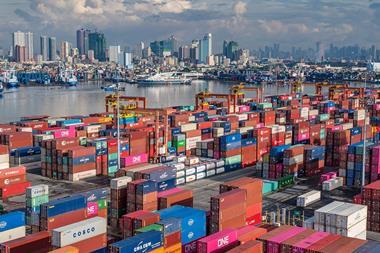
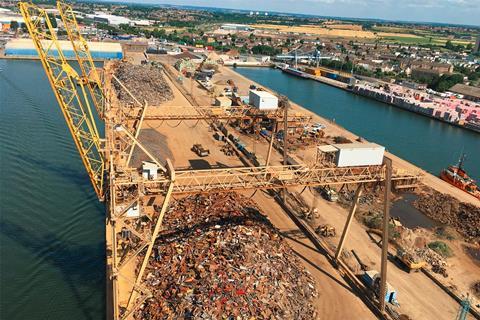
The Port of Tilbury is the UK’s largest waste export and recyclables handling port, with the portfolio including glass, wood, metal and general waste.
Two years ago URM Glass opened a multi-million pound high-tech glass sorting plant in the port. Glass is collected at materials recycling centres across London and the South East – sources include bottle banks, windscreen and industrial glasses, and pre/post process glass – and delivered to the Tilbury facility for sorting into colours and crushing.
Some of the crushed glass is shipped to Portugal, but most is loaded on to trains heading for one of the largest glass manufacturing facilities in Europe, in Cheshire. Forth Ports built a bulk rail terminal specifically for this project and others, and it is now expanding the facility after securing new volumes.
Recent investment has included a mobile crane, supporting equipment, a bespoke storage area and system upgrades. The terminal has a direct connection to the national rail network, enables sideloading rates of 300 tonnes per hour and also handles aggregates for FM Conway and green glass for OI Glass.
Biffa is the port’s third recyclable glass customer; glass is sorted and cleaned before being delivered to Tilbury for export.
Tilbury Green Power, opened in 2017, uses about 270,000 tonnes a year of waste wood sourced from the region to produce up to 319,000 megawatts of renewable electricity a year – enough to meet the demand of about 97,000 homes.
Plans have been submitted for phase two of TGP, a 20-megawatt power plant which will burn baled waste brought to the port.
Hadfields ships waste wood through the port, for use in power stations and cement kilns across Europe, and the port is traditionally also strong in RDF (refuse derived fuel) shipments to Europe.
Outside influence
However, “the circular economy works very well but it is dependent on government decisions”, points out Tilbury’s commercial and marketing manager, Alison Hall. “We have seen peaks and troughs, particularly when things like landfill taxes change. Also, the inconsistency from one borough to another regarding recycling and waste is massive. People don’t always appreciate that the success of the circular economy is down to government policy and driving it through to the councils and waste companies.”
Tilbury also plays an important part in Cory’s waste-to-energy plant upriver at Belvedere, in central London. The incinerator bottom ash (IBA) generated at the plant is loaded into containers and moved by barge to Cory’s processing facility at the Port of Tilbury.
As well as ash and slag, the IBA contains glass, brick, rubble, sand, grit, metal, stone, concrete, ceramics and fused clinker. It is all moved by conveyors through a series of screens, magnets and eddy current separators to remove the metal and grade the remaining materials. Metals are sent on for further recycling; the aggregate products are used in road building and construction projects.
VALENCIA LOOPS INTO CIRCULAR ECONOMY
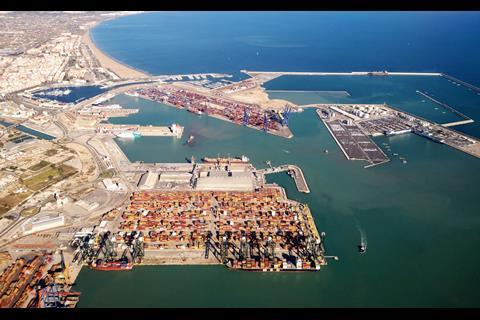
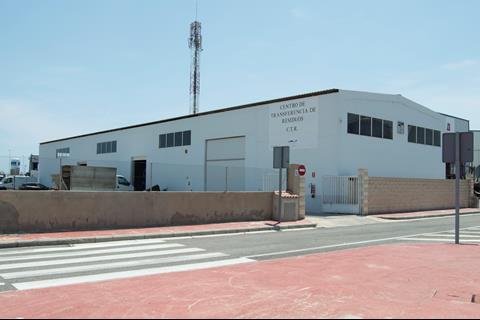
Valenciaport is the only port member of the LOOP project – other members include the European knowledge and innovation community Climate-KIC and a number of universities, among others. The port authority has implemented a policy of waste reduction within the ports of Valencia, Sagunto and Gandia by building a waste transfer centre to which all port-based companies can send their waste to be segregated for better management. By using this facility, the share of valued waste has increased nearly ten per cent in the past three years, says Valenciaport.
“Only authorised companies can operate in the port, picking up the waste from the terminals and the port authority facilities,” says Jorge Miguel Lara Lopez from Fundación Valenciaport. “There is a specific Customs procedure to take this waste out of the port area. With this solution, the port authority has more control over the movement of this type of waste and facilitates recycling of these materials. Moreover, there are annual statistics about the type of materials collected, the companies operating in these areas and the quantities in tonnes. This provides a real picture of the needs regarding waste management in the future.”
Among other projects at the port of Valencia is a plant for the valorisation of MARPOL Annex I waste into fuel for further use. “Considering that the collected MARPOL I waste has risen nearly 30% in the past six years, there is room for valorisation of this waste category,” says Mr Lara. “MARPOL has a different waste management circuit to the waste produced within the port. Other initiatives are in process within the port authority offices, such as the substitution of plastic with recyclable items – this initiative is still in process.”