A port in New Zealand is pressing on with development plans despite an ongoing debate over its future.
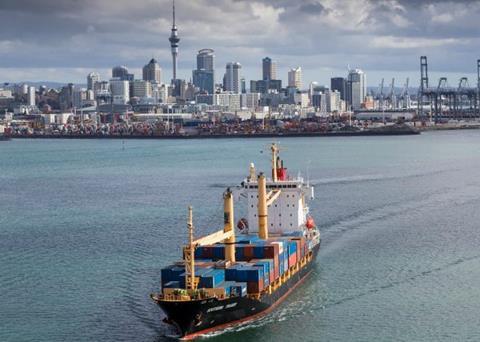
Ports of Auckland (POAL) has applied to Auckland Council for consent to deepen the city’s shipping channel to enable the Port of Auckland to handle bigger ships and more containerised imports. A resource consent hearing on the matter will be held this week. If consent is granted, work on deepening the channel could start in 2021.
The application comes as the New Zealand government considers the fate of the port following a report, published last year, by the Upper North Island Supply Chain Strategy working group that recommended the closure of the Port of Auckland, development of Northport to capacity equivalent to POAL and continued operation of the Port of Tauranga.
However, the report was accompanied by a heavily criticised economic analysis of supply chain scenarios by a consortium of advisors led by EY. The feasibility, costs and benefits of the proposed effective relocation of the Port of Auckland have been questioned by economic consultancies, the New Zealand Institute of Economic Research (NZIER) and Castalia.
Why a deeper channel's needed?
"The largest container ships calling in Auckland now carry up to 5,000 twenty-foot containers (TEU). Shipping lines want to bring 6-7,000 TEU ships here in the next 2-3 years and in future we will need to host 'New Panamax' ships that can carry around 12,000 TEU," explained POAL.
The channel is currently 12.5m deep at low tide, but New Panamax ships are 366m long with a maximum draft of 15.2m. POAL is only applying to deepen the channel to 14m, but it plans to make use of 'tidal windows' to minimise dredging, reduce cost and accommodate larger container ships efficiently.
"To create a tidal window suitable for New Panamax ships to access port safely we will need a channel which is 14 metres deep on the straights and 14.2 metres deep on the bends. Our berth will be dredged to 15.5 metres so ships can stay through a full tide cycle," stated POAL.