![PortStrategy[GreenPort]](https://www.portstrategy.com/wp-content/uploads/2026/09/PortStrategyGreenPort.svg)


Case Study
Kicking off the first in a series of PS Case Studies on combating congestion, Phillip Marsham, Executive Director, Manila International Container Terminal (MICT) and Manila Harbor Centre, ICTSI Group companies, confirms a long list of daily congestion-generated challenges, identifies key tools/actions deployed to minimise their negative impact and highlights the positive results achieved.
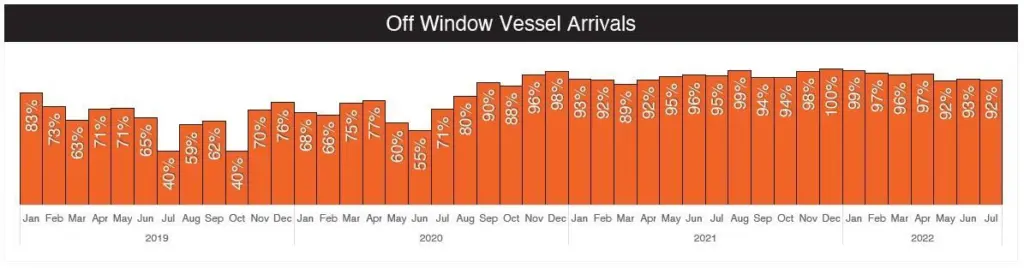
Major areas of challenge he identifies include the following:
- More than 90 per cent of vessels since November 2020 to end July 2022 arriving outside of their allocated berthing windows – Figure 1.
- Occasions when 2.5 x more vessels than anticipated have arrived on a daily basis creating severe incidences of vessel bunching.
- Carrier rationalisation measures that have seen a 18 per cent uplift in per call over-the-quay box movements in the period Jan-Aug’ 2022 compared to the same period in 2019 – Table 1.
- Over-staying reefer containers accounting for as much as 21 per cent of available reefer storage capacity and over-staying containers overall occupying up to 2500TEU of yard capacity. (Interestingly, MICT cites two influential factors in this area: higher utilisation of reefer storage capacity is to a significant extent being driven by the lower power costs and similarly increases in land transportation costs pushing up import and empty dwell times).
- “The combined impact of these and other factors is potentially very severe,” elaborates Marsham, “but we believe that we have responded well and as judged by our peers have delivered an exceptional performance.” The clearly visible wins identified include:
- MICT’s average vessel serving time only increasing by three per cent compared to 2019, in sharp contrast to the 29 per cent increase in vessel terminal time recorded at a global level.
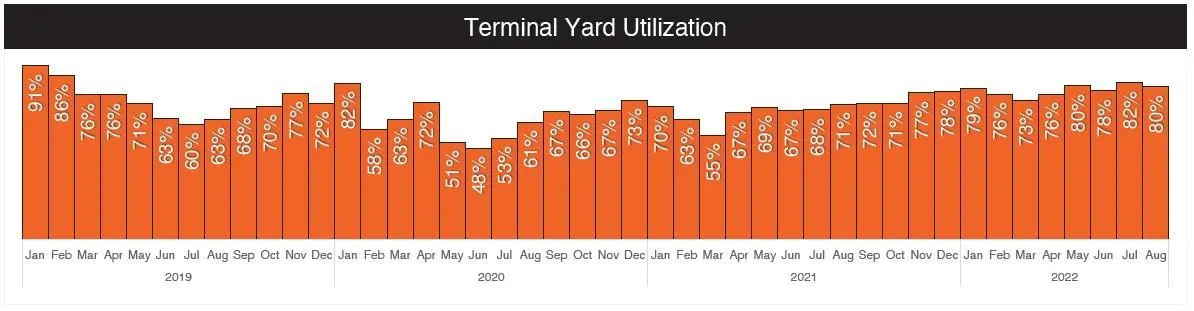
- Despite half year volume in 2022 increasing by 15 per cent compared to the same period in 2019 and significant over- staying container problems, MICT has rarely gone past the 80 per cent mark in yard utilisation from 2019 right through to the first half of 2022 – Figure 2.
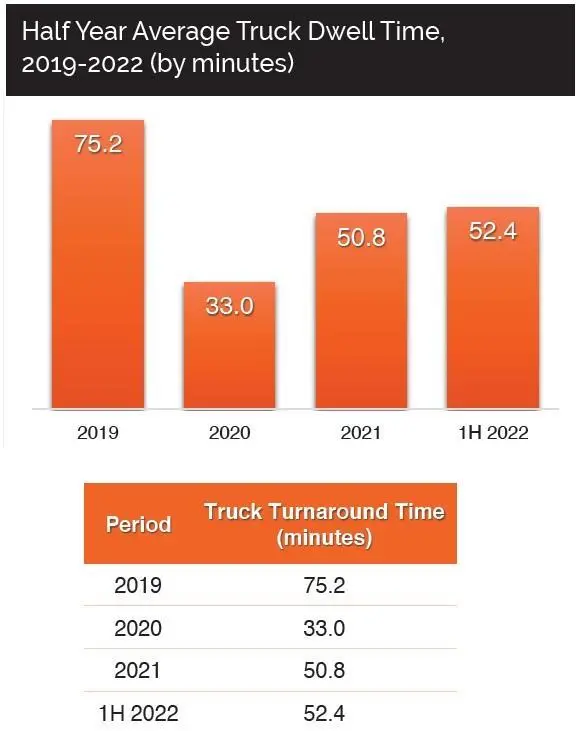
- Truck service time inside the terminal decreased by 30 per cent compared to 2019 – Figure 3.
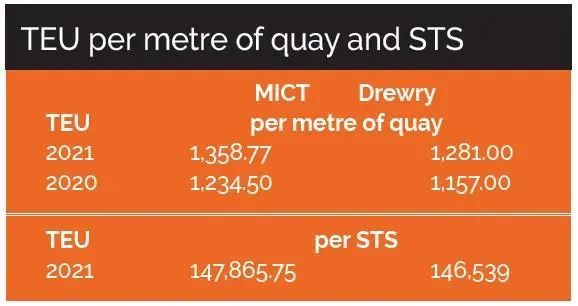
In addition, there are independent benchmarks, as set by Drewry, that confirm MICT’s resilience in the face of difficult operating conditions. These benchmarks and the standards achieved in relation to them are particularly important for all terminals as they basically highlight a terminal’s fundamentally important ability to keep cargo moving – Table 3.
THE CORRECT SOLUTION
Congestion has been a feature of the container supply chain, but this has been driven primarily by factors outside the direct control of the container terminal. As is illustrated at the Manila International Container Terminal, ICTSI’s flagship terminal, effective terminal management and innovations can minimise these difficulties. It would be fundamentally wrong to suggest that terminals have under-invested, and that this is the route of the problem. Simple moves like Customs approval of cleared containers for off-dock storage – together with effective terminal management – present the correct solution to (often other people’s) problems.
Key Congestion Beating Actions
- Vaccination of entire workforce against Covid-19
- Implementation of strict health and safety protocols
- 24/7 working/weekend working
- Ongoing communication with stakeholders
- Market responsive rules and actions
- Accelerated implementation of operational and administrative processes
- Strict berthing rules, prioritization and appointments
- Enhanced over-the-quay output
- Vehicle Booking System for Smooth Gate Flow and Enhanced Terminal Cycle Times

Related Articles
 EQUIPMENT
 OPERATIONS
 OPERATIONS