INNOVATION TO THE FORE

The following review highlights products, services and systems in the shoreside power supply sector that have recently come to the fore as well as identifies interesting orders placed.

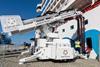
Kiel, Ostseekai: The largest shore power system to date in a German Baltic Sea port can supply two passenger ships at the same time

The following review highlights products, services and systems in the shoreside power supply sector that have recently come to the fore as well as identifi es interesting orders placed. It aims to identify developments that are of interest to ports, terminals and other parties now approaching the task of tapping into the environmental benefi ts of shore side power provision. The latest activities of a cross-section of the sector’s key suppliers are identifi ed on a company-by-company basis.

ABB: Surewave IntroducedNew to the market is ABB’s SureWave Static Frequency Converter (SSFC), a device designed to provide a smooth, automated power transfer from a ship’s onboard generator to an onshore power source.

The SSFC includes some new innovations designed for convenience and ease of use. One is its 50 per cent reduction in size from previous models, allowing for easy installation on either a vessel or port side. A higher level of flexibility is offered in terms of frequencies and voltage differences around the world. This means that it is possible to link 60 HZ powered equipment to a 50 HZ supply network, and vice versa. On top of this, the SureWave is accredited with the PEP eco-passport as verification of the product’s environmental performance.

Sebastien Surply, Global Product Group Manager, ABB Power Protection, explains that the shipping industry is under increasing pressure to reduce global carbon emissions and its environmental impact, with many ports introducing penalties for ships using diesel generators when they are docked. “By switching to next generation static conversion technology like SureWave, operators can avoid charges and significantly lower CO2 emissions and noise pollution during their stay.

“During SureWave’s estimated 15-year lifetime,” he elaborates, “operators can expect to reduce their CO2 emissions by approximately 350 tons and deliver operational cost savings to port stakeholders in the region of US$1.4 million compared to using traditional rotary systems.”


Cavotec: Ampreel and Powermove

Shoreside power projects have been coming in thick and fast for Cavotec. October 2021 saw three orders from South Korean shipbuilder Samsung Heavy Industries for its shore power connection systems, in use for container ships ordered by Evergreen, Seaspan and Capital.

In March 2022, it was announced that Cavotec’s Power AmpReel shore power connection systems are to be used in conjunction with 13,000TEU and 7000TEU newbuild container ships owned by Chartworld and Eastern Pacific Shipping. The Power AmpReel systems connect the vessels to a shoreside electrical power supply when berthed in port. This eliminates the need for keeping ships’ engines running and thus reduces emissions.

Cavotec PowerMove shore power connection systems are in use at the port of Valetta, Malta. Chosen by turnkey electrical system supplier Nidec, Cavotec provided five PowerMove systems to the port to connect cruise liners to shoreside electrical power systems within minutes of a vessel’s arrival.

In this case, the systems were tailored to the port’s specific requirements including maximising the area along the berth where ships can connect to power. Four of the five systems are able to travel 45m along the berth from the shore socket box to the vessel connection point. Meanwhile, the fifth extends more than 55 metres to meet the specific requirements of the Deep Water Quay at Valetta.

“Shore power will enable visitors and residents alike to enjoy the historic surroundings of Valletta in a cleaner and quieter environment. Cavotec’s shore power connection systems are a vital part of making that happen,” says Christopher Farrugia, Senior Manager of Infrastructure, Malta.

The systems incorporate remote-controlled telescopic arms that adjust to match tidal variations and the location of power connection sockets on cruise ships. The systems were also chosen taking into account meeting the wide range of cruise ships designs, with a variety of configurations and power requirements, including 6.6KV or 11Kv and in 50Hz or 60Hz.


Igus: e-dispenser Options

Web capture_24-6-2022_112610

ABB’s SureWaveStatic Frequency Converter (SSFC) smoothly transfers power from a ship’s onboard generator to an onshore power source

The big news for recent igus shoreside power products is the arrival of the shore power supply e-dispenser.

Whereas the previous e-chain reel system needed to be at least partially redesigned for every new port application, the e-dispenser offers a complete system design to suit different customer requirements. Providing modular energy supply solutions for different shore applications for both medium and low voltage connections, the e-dispenser features a ready-to-install package. This includes a conveyor unit with a triflex R energy chain, chainflex cables, connectors, a junction box and harnessing.


Schneider Electric: ShoreBoxX

The Schneider Electric ShoreBoX is designed to deliver reliable, accessible, safe and emission-free connections. The system is said to be user-friendly, featuring an accessible touchscreen, embedded control and a monitoring system that allows the operator to easily manage settings and to keep fully up-to-date with performance levels and events.

One customer employing ShoreBox X is the Port of Montreal, Canada. Vessels calling the port use the Schneider system to keep power for lighting, communications and heating while leaving the main engine switched off. Schneider’s shore power solution is claimed to help the port reduce greenhouse gas emissions to 2800 tonnes per year.


Siemens: Continuous Development

Siemens is continuously developing its portfolio with ongoing testing and validation. Siemens’ key product SIHARBOR enables ships to get power from the onshore power grid when berthed, so that it is not necessary to operate the diesel generators commonly used onboard – providing numerous benefits not only for port operators, but also for shipowners, local residents, and port staff. These include (for ships): the reduction of maintenance and fuel consumption costs of the diesel generators in the port; (for ports): new business opportunities for operators through the provision of power to vessels and (for local residents and port staff): improved quality of life by reduction of emissions, noise and vibrations.

“SIHARBOR can be designed as a turnkey solution, from planning through system integration (with all LV and MV products and switchgear for connection to the grid) up to commissioning and service,” comments Siemens. “The system can optionally be installed in a container or in existing buildings.

“In international maritime traffic,” explains Siemens, “around 75 per cent of all ships are equipped with 60 Hz networks. However, only 25 per cent of the countries operate their power grids with this frequency. Therefore, the onshore frequency must be adjusted to the onboard frequency in 75 per cent of the countries.

“With the Siemens Power Link (SIPLINK) converter system, ships operating at 50 Hz and at 60 Hz can be supplied.”

“SIPLINK,” elaborates the company, “is a converter system adapted for network applications. It can connect two or more medium-voltage AC networks with different voltages, phase angles and frequencies. With SIPLINK, the voltage is adjusted by transformer tap changing and by modification of the converter output voltage. Thus, any required transfer voltage to the ship can be implemented.”

The benefits are identified as: higher overall efficiency and reduced space requirements compared to conventional two-point low-voltage solutions and possible cable lengths with up to 1000m due to the sinusoidal output voltage of the M2C technology.

As regards operation, in order to eliminate the residual risk of arcing in the plug-in connection, the cable connection to the ship is tested at rated voltage with low power before being connected. On a higher level, the SIMATIC S7 control unit with operator panel monitors the state of the whole SIHARBOR system centrally. “Thereby, all relevant messages and data can be indicated, and all operating and safety functions can be selected,” states Siemens. “The control unit ensures that only permissible switching operations according to IEC/ISO/IEEE 80005 are executed. The personnel who operate the plug-in connection on shore and onboard are generally protected by double electrical interlocks. Protection is ensured both by the software and by the hardware, independently of each other. The whole shore connection system can be remotely controlled from the ship without additional qualified personnel.

”In November 2021, Siemens announced a major project in the Port of Hamburg, Germany. The Hamburg Port Authority commissioned Siemens to build the first shore power systems for container ships. An initial test phase will start next year, providing green electricity to container ships at the port’s Burchardkai and Tollerort terminals.


Wabtec/Stemmann-Technik

Stemmann-Technik technology recently supplied shoreside power systems to accommodate two cruise ships simultaneously at the Port of Rostock, Germany

Stemmann-Technik technology recently supplied shoreside power systems to accommodate two cruise ships simultaneously at the Port of Rostock, Germany

Wabtec with Stemmann-Technik technology has delivered shore power solutions, incorporating cable management systems, for cruise vessels, along with ro-ro, ro-pax and container ships.

Recent customers include the Port of Rostock, where two cruise ships can simultaneously be supplied with electricity. Elsewhere, the Port of Kiel saw a self-propelled vehicle providing cables to a cruise ship with 16MVA power. The most recent development has just been successfully tested in Southampton, UK and overcame challenges from port operations regarding reliability, tough environmental conditions and difficulties with the shape of the quay.

The ShoreCONNECT vehicle covered a distance of approximately 7.5m away from the edge of the quay and onto the vessel, with a 50m cable length used. This is said to be the largest vehicle ever for shore power but while maintaining crane stability and limited cable handling effort from an operator, while ensuring a fully safe activity.


“Every port is different and even inside one port, every quay can be different,” says Georg Matzku, Head of Shore Power, Wabtec. “We see how a port authority can have many and different struggles with adapting cable management to their ‘reality’. Safety, easy handling, low cost of operations and most important – flexibility – are the values we bring to the terminal operators.

”Rene Kulik, Sales & Marketing Director, Wabtec, explains further: “Wabtec is the world’s leading manufacturer of shore power and charging solutions for maritime and commercial applications, with seven pieces of self-propelled IEC80005-1 shore power cruise vehicle solutions currently in operation for customers worldwide. We provide ports and vessels with our electrification solution that reduces emissions as well as noise and air pollution. In addition, our technology is durable and efficient, resulting in maximum uptime and therefore, very limited downtime for maintenance. Making the maritime industry more efficient and sustainable is at the heart of what we do at Wabtec and is the reason we are pushing ourselves to better serve our customers, our communities, and the world.”


Yara Marine Technologies/NG3

Oslo-based Yara has relaunched its shore power systems, partnering with NG3, the French Greentech company, to take on new orders. Aleksander Askeland, CSO, explains that previously the market had been slow to open up but with a recent increase in new regulations and shore power supporting grants, the NG3 partnership is responding to improved market prospects. The relaunch of Yara’s shoreside power plans meshes with NG3’s shore connection systems, which include the fully automated cable management system, PLUG, that enables vessels to link to a shoreside power source in a matter of minutes.

Camille Chevreau, Sales and Operations Manager, NG3, adds: “We are excited, confident, and proud to partner with a large yet agile company like Yara Marine Technologies and look forward to tapping into their expertise, engineering capacity, and market relations.”