


Mobile harbour cranes
Demand for mobile harbour cranes remains strong and it is clear that the major manufacturers are all pushing the green agenda in their ongoing focus…
SECTOR ANALYSIS: POWER PLAYS & LOGISTICS CHALLENGES
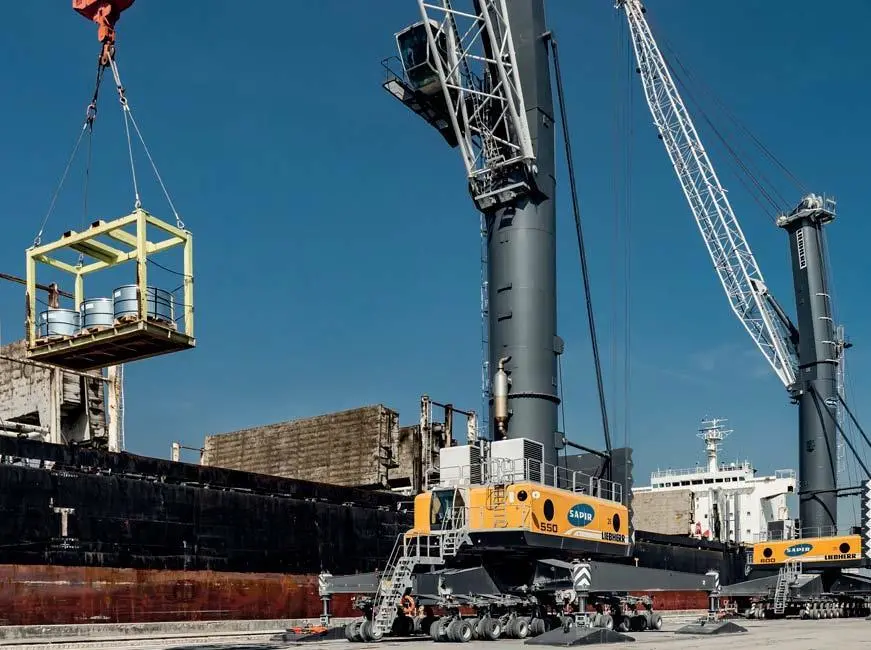
Demand for mobile harbour cranes remains strong and it is clear that the major manufacturers are all pushing the green agenda in their ongoing focus. This was confirmed with Liebherr recently announcing that over 30 per cent of sales being made now include an electric main drive, while the hybrid option of diesel and electric is in demand amongst its customers wanting the company’s most popular LHM500 model. ITALGRU is reporting similar trends, with more and more customers “opting for environmental machinery, while Konecranes has developed its electric design concept, which means efficiency increases when connected to the harbour mains. Instead of onboard diesel engines, the cranes are equipped with battery packs. However, it is not all plain sailing for the industry, with several challenges currently being faced. Price increases in steel and a lack of certain key pieces of equipment like microchips are hampering construction schedules, while retaining skilled workers is another common issue.
R&D, NEW PRODUCT LAUNCHES, DESIGN INNOVATION
Liebherr
For Liebherr, the LHM series has a clear focus – hybrid power supported by more digital and more automation. A new crane control system, state-of-the-art sensor technology and digital information transmission is at the forefront of the company’s current thinking. The Liebherr Pactronic 2.0 hybrid system is its second generation of a hydraulic drive system using hybrid technology, but now an accumulator serves as an energy store and provides support when needed by supplying additional, temporarily stored power. There is also now a choice of two operating modes. These are Boost Mode and Green Mode. In Boost Mode the Pactronic 2.0 acts as a power amplifier, generating increased lifting speeds but without the need for a larger or additional engine for more power, delivering reduced cargo-handling time. In Green Mode, the Pactronic 2.0 ensures up to 30 per cent lower fuel or power consumption and reduced CO2 emissions, thereby using less power to maintain the same lifting speeds, while also using less fuel and creating lower emissions. For the driver, greater precision and safety is top of Liebherr’s agenda. A new integrated touch panel means all crane functions can be selected clearly and intuitively, which greatly simplifies the operation of the crane. A revised air-conditioning concept significantly increases the well- being of the operator, whether air-conditioning or heating. It also ensures that fogged windows are quickly dehumidified, thus providing a clear view and more safety.
Recent Take-Up: Liebherr has seen a good take-up of its new crane series. ABP Immingham ordered new units, with three cranes on site by the end of 2022 in a £9.7 million (US$11.4 million) deal, while the Port of Hueneme (CA) also acquired a new electric-hybrid crane to replace old machinery as part of US$7 million investment by Ports America Group. Also in the US, Port Canaveral has recently ordered a new LHM 600 unit with the digital enhancements and improved cabin, which is due to arrive before the end of 2023. The Port of Esbjerg in Denmark ordered a second LHM 800 unit, plus a LHM 600 crane. The LHM 800 is the port’s seventh Liebherr mobile crane and both new additions will move next-generation offshore wind turbines, often via a twin/tandem lift operation.
Konecranes
Konecranes, who launched the world’s first mobile harbor crane in 1956 and helped pioneer the concept of Ecolifting™ retains a clear focus – products that can eco-efficiently service any type of vessel and any kind of cargo (containers, general cargo, project cargo and bulk) in any location. The company recently launched its sixth generation of mobile harbour cranes, with the continued aim of delivering sustainable lifting solutions to reduce climate impact, as per its customers requests. Generation 6 has marked the first comprehensive revamp of Konecranes Gottwald’s mobile harbour crane portfolio in 15 years. These units are all designed for electrical power use, which can be sourced from an onshore grid, meaning no direct carbon emissions during operation. Operators can also choose a new battery solution that reduces emissions and gives greater flexibility by permitting crane operation independent from the grid. For quays without a power supply, a common occurrence in developing markets, the cranes come with fuel-saving diesel generators and Konecranes’ latest hybrid drives. The design of the crane advances circularity through a more durable design: its robust construction doubles the cranes’ service life in container operation compared to earlier generations, and more powerful lifting capacity curves and high working speeds ensure greater efficiency and faster cargo turnaround times. The long-lasting design not only saves the resources needed to build new cranes, it supports resale values when customers choose to renew their fleets. There is also the TRUCONNECT remote monitoring system on all units, which collects condition, usage and operating data from control systems and sensors to help with maintenance planning and predicting possible component or equipment failure.
RecentTake-Up: Eco-efficiencies appeal to ports and orders to Konecranes continue. FHP Group received a new eco-efficient Generation 6 Konecranes Gottwald Mobile Harbour Crane for its Multi Service Terminal in the Marghera Port near Venice, in northern Italy in late 2022, while Spinelli Group received a similar unit in December 2022 at its terminal in Genoa, north-western Italy. This crane includes a Konecranes hybrid drive with a diesel engine that is in line with EU Stage V emission standards and features ultracapacitors to deliver additional power for heavy lifts, which can be refilled through the collection of braking and lowering energy. Finnish specialist rental and service company Adolf Lahti and stevedoring company Rauanheimo has also taken delivery of Finland’s first Generation 6 for Port of Röyttä in Tornio, next to the Swedish border.
SANY
Despite being a new entrant to the manufacturing of what it defines as “logistics equipment,” Chinese-based SANY Port Machinery has already established two manufacturing plants since its inception in 2010, in Changsha and Zhuhai. The company claims it already makes more than 150 models of mobile port machinery, large port machinery, and marine equipment. SANY’s focus is confirmed as “persistent innovation, focusing more on green energy, digitalisation and intelligence.” The SANY MHC is made using a modular design, so it can be easily equipped with different chassis and spreader types, according to client requirements, but it is the use of the optional lithium battery that is of interest. Here, the energy is released when the heavy cargo is put down and recycled to the lithium battery, and then when the lift occurs, the recycled energy is gained, thereby saving fuel and cost. The company has also released its SCL10000 unit, which runs on renewable diesel, or Hydrotreated Vegetable Oil (HVO) made from 100 per cent sustainably sourced raw materials such as used cooking oil and animal fat from food industry waste. SANY says it has the potential to generate 75-95 per cent less greenhouse gas emissions over the fuel’s lifecycle when compared with fossil diesel.
Recent Take-Up: Two new SANY mobile units arrived at Cebu South Harbour and Container Terminal Corporation, Philippines in the second half of 2022. In January 2023, a new SCL10000 unit arrived in Queensland, Australia. It is expected to support wind turbine erection activities and, as a result, could be deployed in port areas in the future.
ITALGRU
Italy-based ITALGRU has been manufacturing lifting equipment for over 60 years and places a clear emphasis on its strategic approach. The company explains that it is now very clear that environmental-friendly strategies drive the investments of port operators, so its answer to this trend is the new design of all IMHC models, which are available with electric drives. In addition, the units are equipped with energy saving systems based on hydraulic energy accumulators. They store energy from decelerations and lowering loads and the crane’s software automatically decides when to use the stored energy, thereby saving fuel.
Recent Take-Up: Although ITALGRU manufactures all of its mobile harbour cranes in Italy, around 90 per cent are exported, although the home country remains a market too. The Port of Augusta (Sicily), and Barletta both recently took delivery of a multi-purpose IMHC 2120 mobile harbour crane, with Augusta specifying an electric drive and equipped with a cable reel to draw electricity from berth. The Port of Durres in Albania also received an IHMC 2120 unit in 2022 and Croatia’s Port of Rijeka is now using the IMHC 1580 machine. Elsewhere both Dar es Salaam in Tanzania and Gangavaram Port in India have previously ordered units.
Related Articles
 OPERATIONS
 OPERATIONS
 OPERATIONS