![PortStrategy[GreenPort]](https://www.portstrategy.com/wp-content/uploads/2026/09/PortStrategyGreenPort.svg)



Phase Four of Porto Itapoá expansion begins
Porto Itapoá in Brazil is set to begin Phase Four of its expansion, a project expected to cost R$500 million (US$88.44 million) over the next year.
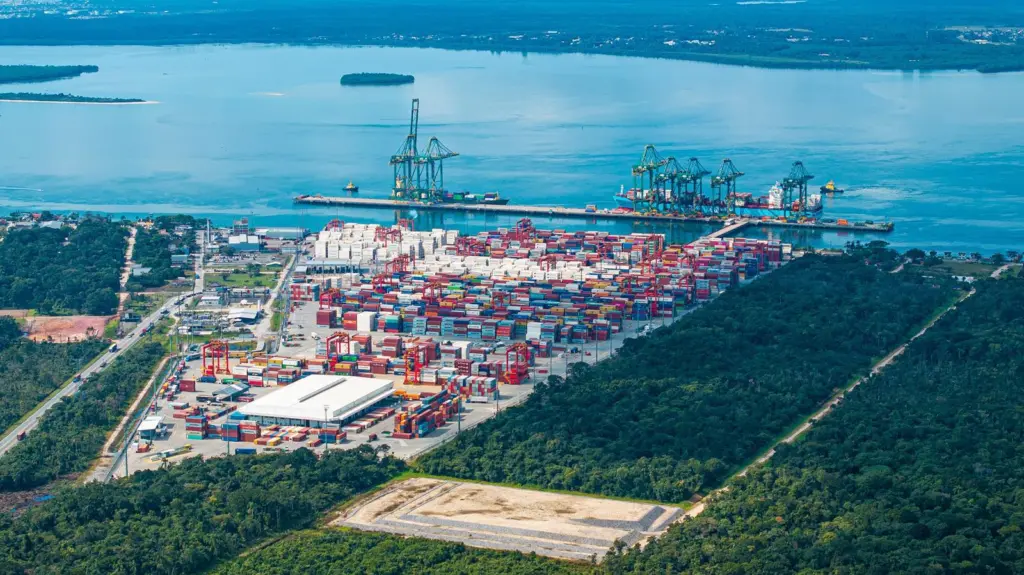
Located in Babitonga Bay, Santa Catarina, the terminal aims to solidify its position among Brazil’s top four ports and evolve into the largest and most efficient terminal in South America by 2033.
“This expansion will add another 120,000 m² to the yard,” said Felipe Fioravanti Kaufmann, director of business development and customer experience at Porto Itapoá.
“We are also planning to purchase additional high-tech equipment which we expect to improve the terminal’s efficiency and sustainability,” he said, adding that the Brazilian Institute of Environment and Renewable Natural Resources has approved the plans, which will follow a strategic schedule.
The expansion includes the acquisition of an eighth container crane and plans to extend the wharf by 400 metres to accommodate three large ships simultaneously. “In August of this year, our seventh container crane became fully operational and we have already seen a 15% increase in productivity as a result,” said Kaufmann.
Additional investments include twelve remote-controlled hybrid rubber-tyred gantry cranes, enhancing Porto Itapoá’s status as the first terminal in South America to implement this technology.
The terminal will also acquire nine new terminal tractors, expanding its fleet to 49, with a focus on sustainability through electric models powered by renewable energy.
Furthermore, the terminal plans to add 1,080 reefer outlets, increasing its total to 4,038, making it the largest in Santa Catarina and the second largest in Brazil. A new state-of-the-art scanner will bolster cargo safety, complementing the two existing scanners.
Recently, Porto Itapoá celebrated the completion of Phase Three, which added 200,000 square metres to the yard, solidifying its position as one of Brazil’s largest container facilities. The expansion also includes an upcoming dredging project, allowing larger vessels to access the bay and positioning Porto Itapoá as a critical cargo hub.
Related Articles
 EQUIPMENT
 OPERATIONS
 OPERATIONS