

SMARTER ON CLIMATE CHANGE
How the digital transition can advance a zero-emission agenda is considered in-depth in a new Digital Playbook released by chainPORT. Felicity Landon reports
Are some ports ‘smarter’ than others? As with many things, it depends where they started. Every port has a diff erent story and being ‘smart’ can mean diff erent things to diff erent people. Overall, this is surely not about being smarter than someone else – it’s about a port operation becoming smarter and more knowledgeable tomorrow than it is today.
That goal can involve robotics or driverless equipment. But it can also be the simple step of automating processes to do away with the need to fill in paperwork with a pen.
At the Container Terminal Automation Conference in London in March, Rodrigo Garro Umbert, Sales Manager at Orbita Ingenieria, said: “If you want to improve overall you really need to form a vision of the future.” Other speakers emphasised that digitalisation should not be just for its own sake but should underpin projects that make real and positive change.
This is entirely reflected in the second edition of chainPORT’s Digital Playbook, entitled ‘Digital & Sustainability’. It focuses on how the digital transition can advance a port’s zero-emission agenda, and how ports can harness the power of digital for the benefit of the environment.
“Our first Digital Playbook, in 2020, covered digital solutions in crisis management when we had come into the pandemic,” says Phanthian Zuesongdham, who leads the port process solution division at Hamburg Port Authority (HPA). “We were excited to see how digital solutions could really help during the pandemic – and we wanted to share this best practice with a wider audience in the ports industry. For the second Playbook, we chose another crisis which is much more challenging – climate change.
“Decarbonisation of the maritime industry should be one of the top priorities of organisations now and most of the chainPORT members are talking about ‘zero emission’ ports as a vision for 2030 or 2040. If we can share best practice on what we have already done and what it brings, that should benefit members and other ports.”
chainPORT, the global network of smart ports, was initiated by HPA and the Port of Los Angeles. Both partners share best practice examples in the new publication.
Green4TransPORT
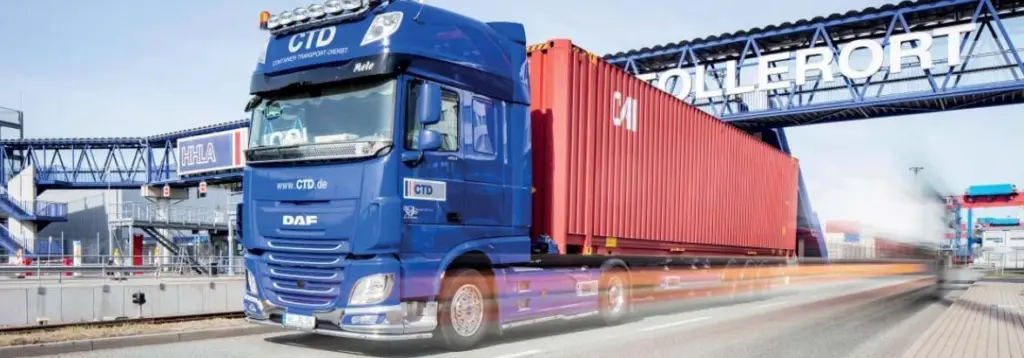
Hamburg’s Green4TransPORT aims to make the best possible use of the existing road infrastructure, networking and digitising it in to enable sustainable traffic management.
V2X technology enables real-time communication between trucks and the traffic light system – the system detects approaching trucks and the green phase of the lights can be extended to optimise traffic flow. The reduction of stop-and-go traffic at the traffic lights means fuel consumption, GHG emissions and material wear and tear are reduced.
MOZART (Mobility OptimiZation and Analysis in Real Time) uses quantum-inspired technology to achieve an overall network analysis and network-wide coordinated traffic signal control – essentially searching through an extremely high number of possible traffic light circuits in seconds to find the optimal one.
“We have completed the prototyping of MOZART, concentrating on a small number of junctions; now we are going to the next steps where we will cover the whole port,” says Zuesongdham.
The port has also deployed ‘Smart Area Parking’ which detects inflows and outflows, current parking space occupancies and remaining spaces, displaying the information on the road network and to B2B service providers via Mobility Data Marketplace – fewer vehicles searching for a parking space means less pollution.
Zuesongdham emphasises the need to share knowledge and inspire each other in the search to be smarter and more sustainable.“We are now in the era of collaboration rather than isolating each other – that is the way we avoid making the same mistakes, to really care about the resources we use,” she says.
She says three ‘smart port’ philosophies drive digital transformation in the Port of Hamburg: exploring for excellence – don’t do things that you are not good at, let people who are experts take them on board; focus on co-creation to get new ideas; and think in eco-systems – nobody is going to do everything on their own and you need partners, including start-ups and others from non-port sectors which are good at the technologies that can help,” she says.
Related Articles
 OPERATIONS
 OPERATIONS
 OPERATIONS