


Tapping transshipment
The recent expansion of West African dry bulk exports has focused attention on transshipment to reduce transport costs. The issues here are complex. Andrew Penfold takes a look at the pros and cons…
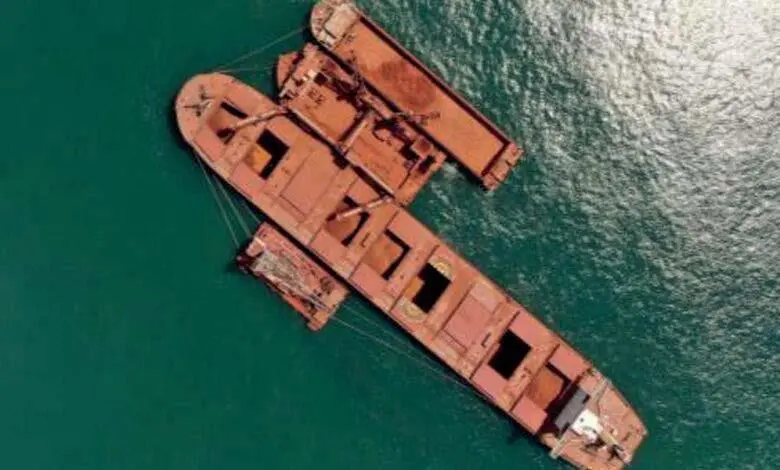
Diversification of dry bulk supplies has been the focus of much recent attention. A partial shift in focus to, for example, West Africa as a source of iron ore and bauxite for Chinese consumers has focused the spotlight on the economic delivery of these commodities as alternatives to established suppliers such as Australia and Brazil.
The snag in this strategy is the lack of true deepwater export terminals in many of these nascent suppliers. Although dry bulk freight rates have fallen back sharply since their peak in 2021, rates remain slightly above their long-term average. The relatively low value of dry bulk commodities results in market share being dependent upon CIF prices, with a focus on freight costs within this total. On this basis, the differential between Cape Size and smaller tonnage costs is central to the calculation. Last year, Handysize bulk carrier rates averaged around US$21,500, with Capesizes earning US$16,100 per day (source: Clarksons). This rate inversion was the result of a weakening of the supply/demand balance for iron ore and coal trades, and a relatively healthy balance in smaller size ranges.
The overall effect of these differences in scale economies has been that exporters relying on restricted port infrastructure have seen CIF prices stick at much higher levels – with this adversely impacting on volumes shipped.
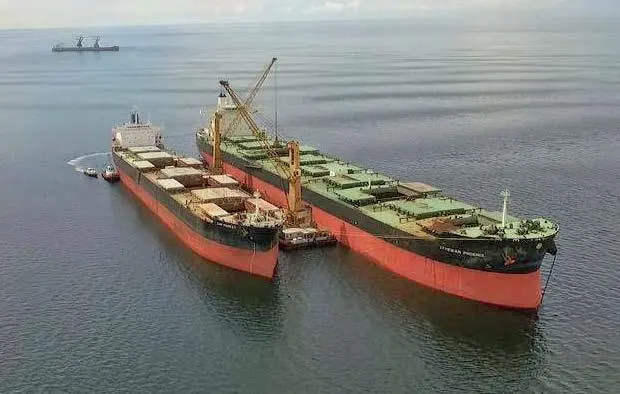
Transshipping bulk commodities has a long track record in the trades, with the offshore transfer of goods from a smaller vessel (or barges) to a large Capesize vessel now well established. It seems certain that the forces driving this will intensify as port investment lags demand. It’s certainly worth a look at the options here.
THE RATIONALE
The freight savings per tonne for, say, iron ore shipped from West Africa to China in a Capesize as opposed to a Handysize vessel are currently estimated at between US$15-20. At the 2021 peak of the market this was much higher and reached over US$45 per tonne. This represents a long-term differential that clearly justifies innovative solutions. This is not new technology, with offshore transshipment – ‘topping-off’ – established in the dry bulk market where load (or discharge) facilities are limited. Against this saving must be set the costs of establishing a transfer facility in often remote locations and the degree of financial security a service provider will require while providing the technical reliability the cargo owner must have. Also, the cost of chartering either a smaller bulk carrier or a fleet of barges must also be factored in.
Despite these complexities, transshipment provides a realistic means of entering high volume bulk trades where landed commodity prices would otherwise be uncompetitive.
There are several specialist shipping companies that offer these services, with the translation of these cost savings into an actual long-term proposition requiring highly skilled capabilities.
DIFFERENT APPROACHES
The development of a floating crane pontoon, sometimes with storage and often using a series of barges, has been an established way of meeting transshipment requirements for many years – for example, Indian iron ore exports have long used this method. Although overall system costs are low the speed of handling is slow and there is always considerable cargo loss. These issues can be minimised with custom designed units and specialist operations but, of course, the costs soon escalate.
Another method is the use of self-unloading bulk carriers to top-off the deepsea unit. High-capacity gravity belt-fed systems are highly competitive. If a large Capesize vessel can be partially loaded at the quay or loading jetty and then transferred to deeper water to be completed by a self-unloader, then a highly efficient system is possible. Self-unloaders such as Canada Steamship Lines’ (CSL) Panamax CSL Acadian can achieve discharge rates of between 5000-6000 tonnes per hour, depending on the commodity. CSL also has designs for various vessel sizes offering a gravity-fed discharge rate of up to 10,000 tonnes per hour.
The choice between a long-term commitment with a higher investment in such systems in contrast to a lower tech (and slower) grab-based system will always be case-specific, but the systems are available for varying throughputs and situations – it will always require a bespoke solution. Can this be a long-term solution or a means of moving commodities ahead of large-scale port development?
OPPORTUNITIES: W AFRICA DOMINATES
West Africa is the current focus of attention for the reasons listed. Essentially, the main opportunities are for bauxite, iron ore and manganese – with China providing the primary impetus for development.
Conakry in Guinea has some the largest undeveloped reserves of high-grade bauxite in the world. Recent interest on the part of Chinese aluminium companies has directly led to a rapid increase in bauxite export tonnages, with total national export volumes exceeding 80m tonnes in 2022. This rapidly increasing demand has survived political instability and several new export projects are anticipated in other West African nations. Given lack of infrastructure and available power it seems certain that the focus will remain on shipping bauxite rather than alumina. The Kamsar bauxite project in Guinea is typical of the type of project development.
Rapid development of iron ore in the region has seen Sierra Leone become a major shipper to China with most shipments using Capesize vessels but with transshipment. Without such systems the CIF cost of delivery into China would be largely uneconomic versus higher volume suppliers from Brazil and Australia. These underlying issues have been obscured by the very high market price of iron ore that has been noted in the peak market but as prices weaken the freight issue is once again to the fore.
African manganese exports are dominated by Gabon. Long-established as a secondary supplier, these exports have increased rapidly of late by means of introducing transshipment systems to allow competitive deepsea freight rates to be offered.
The demand is there – and growing – as these nations cannot provide the required infrastructure in the port sector. They currently rely on transshipment, and it seems certain that this will continue.
PROS AND CONS
The actual realisation of these operations is a complex undertaking. The advantages of introducing such systems are clear:
- There is the potential to reduce CIF prices of commodities – often by as much as US$20 per tonne.
- With lower commodity prices, this can be sufficient to allow market penetration by a new supplier.
- Transshipment systems allow the lack of capital for port development in some markets to be overcome.
- Transshipment potentially offers a far shorter lead time for export development.
- When established, these can become stable systems offering lower transport costs.
On the other hand:
- The start-up costs can be high – especially if a bespoke terminal (or loading vessel) is specified. This will require a degree of financial security on the part of the shipper. Perceived risks can be high.
- Initial positioning costs can be very high.
- The marine conditions can be problematic – offshore transfer is dependent upon wave and wind conditions and downtime can be significant.
- The maintenance of the system in a remote location requires extensive local back-up.
- Manning costs are invariably higher than initially identified.
All of this points to the need to use an established and experienced operator. Such an operator will charge premium rates, but there is really no short cut to delivering the required service levels.
EXPERIENCE ESSENTIAL
The actual establishment of a floating crane system is superficially simple but, in reality, there are only a few companies that offer the required degree of experience. Aside from CSL, some of the major players are as identified below.
Oldendorff is perhaps the most established player and offers both floating crane and vessel-based systems, with a very strong presence noted since 2002. As well as Kamsar, Oldendorff operate such systems on a global basis with coal handled for discharge in this manner in Vietnam and Bangladesh. The company has also developed a strong presence in iron ore discharge in the Persian Gulf markets.
More recently, a newly established Italian company – Shi.E.L.D. – has focused on developing a presence in West Africa ahead of anticipated increases in demand for these services. The company has experience in Guinea as the manager of a transfer vessel, the Bulk Borneo that handles up to 35,000 tonnes per day of bauxite. The Shi.E.L.D. team is closely linked to long established activities of Coe & Clerice in these operations.
Another new player is the Singapore headquartered (but Chinese owned) Winning Logistics – part of the Winning International Group – who offer offshore transshipment platforms with loading rates of 3000-4000 tonnes per hour. The company currently has four Floating Commodity Terminals operational for bauxite in Guinea. The plan is to extend this expertise at the global level wherever commodity demand runs ahead of port capacity.
The Danish group Norden has recently expanded into the market and has signed a 10-year contract with Comilog to establish and operate a manganese transfer station in Gabon. Total investment in the project is placed at upwards of US$40m, with the company keen to establish a position in this sector and to expand further. The project involves establishing a floating transfer station 40km from the existing port, to allow for the use of Capesize vessels. Manganese ore is transported on barges from the port to the floating transfer station, where it is loaded onto the vessels and shipped to Asia.
TRANSSHIPMENT OUTLOOK
The pressure to diversify dry bulk supplies and the management of uncertain, but often much higher, freight costs, together with a lack of required port investment, will continue to see the use of such transshipment operations.
The degree to which this approach represents a long-term solution will be crucially dependent upon the expertise of the chosen provider. The risks in this sector are high, but the potential cost savings are always attractive. The key to successful development is the realisation of easily identified potential advantages into long-standing and tested realities. This means using experienced operators (and paying the resulting price).
Related Articles
 OPERATIONS
 OPERATIONS
 OPERATIONS