



Penha’s Lock boosts navigation and São Paulo Water-Ring
Last October, the construction of Penha’s Lock started. This will give new impetus to the São Paulo Metropolitan region and the dream of deploying the Water-Ring is starting to become reality, says Frederico Bussinger, IDELT Consultant and Former Director of São Paulo Waterway Department.
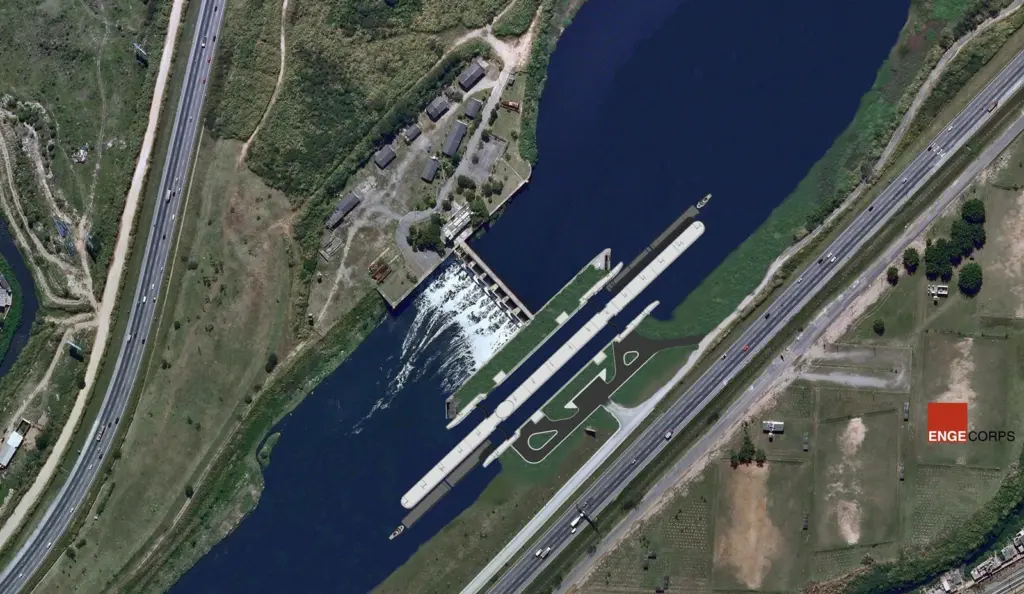
Penha’s Lock is the second lock on the Tiete River; the river that runs through the most densely populated part of the São Paulo Metropolitan Region (SPMR). SPMR is the 4th world’s largest metropolis; located on a plateau 700 meters above sea level, and about 90 km away from the Atlantic Coast and the Port of Santos (the largest in Latin America). Around $ 50 million is planned to be invested in the works. Its finalisation, scheduled for September 2015, will add another 14 km to 41 km inland navigated today (between Santana do Parnaíba, western municipality in the SPMR, and Penha/São Miguel Paulista, in the east zone).
The lock’s site is strategically located between Dutra and Ayrton Senna highways, which link São Paulo to Rio de Janeiro through the rich Vale do Paraíba; and next to the railroad that makes the same connection. It is also located near the metropolitan airport (Guarulhos), near the arena, which is being constructed for the Soccer World Cup opening game next year, and near extensive unoccupied and/or requalifiable areas, including some areas which will be intended for the deployment of multimodal logistics platforms.
The logistics and environmental benefits of the Water-Ring can be leveraged as it overlaps the road-ring and the rail-ring, which are to be completed this decade. There are three strategic points located at the gates of the metropolitan area, where it is feasible to have a trimodal integration: west, south (this almost halfway to the Port of Santos) and east (in this region of the lock).
Giant natural flood reservoir
The benefits of Penha’s Lock are major, ranging from immediate cost reduction of up to 2/3 of the shipping materials necessary for dredging the own lake, to the transportation of garbage and sludge from sewage treatment plants, and the construction of materials produced in Vale do Paraíba which can be used in the metropolitan area.
During the ceremony, which was organised in November for the start of the works on the lock, São Paulo’s Governor, Geraldo Alckmin, stated that with the dredging of 5 million m3, the navigation channel will be regularised, and a large lake will be created, with a double function: it will be the centre of the metropolis – a giant natural flood reservoir, which will be five times bigger than the biggest already existing reservoir in the SPMR – and it will integrate a flood defence system. The large lake is also going to be the border with the ecological Tiete Park, in order to beautify the area and to increase its leisure potential.
The new lock is also another step towards the implementation of the Water-Ring, which will entail a multiple use of the water, which is an important urban and environmental dimension. This can redirect the development of the great metropolis. The Penha’s anti-flood reservoir and the enhancement of the Water-Ring will lower costs and improve operations, as it will be shared between different functions:
– Clean water from the Tiete’s headwaters will go straight to Billings Dam, one of the metropolis’ water supply structures;
– Pinheiros River remediation, which had intensified by the current poor circulation;
– Use for irrigation of big east areas, traditional green producers;
– Energy generation by the efficient hydroelectric Henry Borden Power Plant, now limited to 1/3 of its capacity due to water shortage.
Furthermore, the upgrading of passenger transport through Billings Lake will be made possible, leisure and tourism, which flourished until the mid – twentieth century in that region will get a boost, and border regions will enjoy extensive redevelopment projects for housing, which have been designed by the São Paulo Municipality and/or the State government.
Hence, the establishment of Penha’s Lock construction has a twofold implication and will entail urban en environmental benefits that may be enjoyed soon. This medium to long term huge structural project will be able to leverage a new cycle of occupation and development of the region. It will even entail a new way to plan and manage, fluently, involving several units of the State Government, the 39 SPMR municipalities, and the society.
For more information, please contact Frederico Bussinger at fbussinger@idelt.org.br.
Related Articles
 ALTERNATIVE FUELS GREENPORT
 OPERATIONS
 ALTERNATIVE FUELS GREENPORT