



Private sector $ pour in
Port infrastructure development in Egypt continues to be focussed on the private sector playing a big part in the country helping meet national economic goals. But is there a danger of over-capacity occurring as a result of this strategy? AJ Keyes investigates
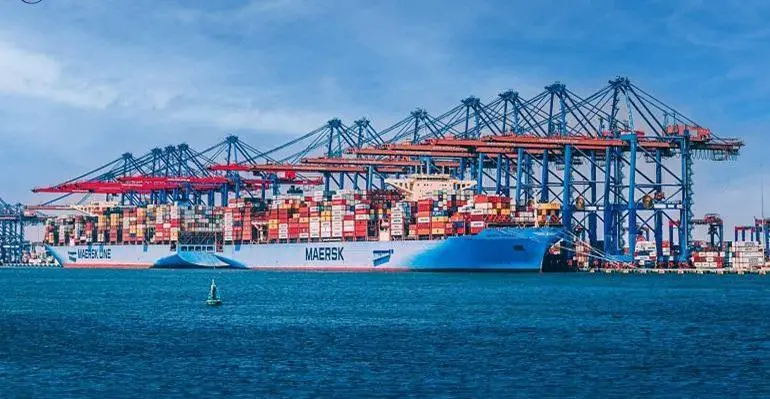
Ports in Egypt are being developed to boost economic growth. There are a wide range of plans and capacity is set to be increased substantially in the short term. However, what is driving this activity, and will it ultimately meet the desired objectives?
The country has ports on two coastlines, Alexandria, Damietta, and Port Said in the Mediterranean Sea and Ain al-Sokhna in the Red Sea. Collectively, these facilities handle around 90 per cent of Egypt’s total trade activity, according to the Egyptian Centre for Strategic Studies (ECSS) in June 2023.
There are currently both short-term and medium-term plans in place by the Ministry of Transport in Egypt to enhance and develop container port capacity by investing in new berths, dredged navigational channels and larger storage yards. These initiatives comprise key components of the government’s “Transforming Egypt into Global Trade Hub” report which outlines future plans across the port sector.
This aim is part of a strategic national plan, as Dean Richardson, Head of Maritime Advisory, Infrata, explains: “Egypt has a clear initiative . It wants to develop its port industry as a global maritime hub and this will be achieved by leveraging its facilities to connect two coasts and in doing so link both East and West.”
Egypt has a longstanding, existing network of port facilities handling both domestic and transshipment containers, collectively seeing around 7.5 million TEU per annum.
For the domestic market – that is, cargo that is destined for or originated in Egypt – it is handled at a range of locations, including at Alexandria (Alexandria International Container Terminals (AICT), Alexandria Old Port and El Dekheila, Alexandria Container & Cargo Handling Company (ACCHCO)), Damietta and West Port Said, with transshipment also undertaken at East Port Said (Suez Canal Container Terminal – SCCT) and Ain Sokhna. Damietta also handles this traffic.
PRIVATE PLAYERS PROMINENT
International terminal operators and shipping lines are prominent in the port sector in Egypt. For example, Hutchison Ports has been operating the one million TEU per annum AICT facility at the Mediterranean Port of Alexandria since it opened in 2007.
Likewise, DP World has a 100 per cent ownership stake in El Sokhna Container Terminal, with a capacity of around 950,000 TEU per annum, while APM Terminals retains a 55 per cent share in a joint-venture that includes China Cosco Shipping (20 per cent) and the Suez Canal Authority (10.3 per cent) at Suez Canal Container Terminal (SCCT) at Port Said by the Mediterranean entrance to the Suez Canal.
As part of the Egyptian government’s plans and strategic aims, an increase in foreign, private investment is targeting further development of container cargo-handling activities in the country.
Table 1 provides a summary of known, new, and planned developments at a range of different ports in Egypt. There are clearly a wide-range of different large-scale projects, all of which are supported by a range of private companies, with global terminal operating companies clearly leading the way.
| Port | Terminal | Shareholders (where disclosed) | Quay Length | Full Capacity of Project – TEU | Operations Starting |
|---|---|---|---|---|---|
| Alexandria | B100 Terminal | Hutchison Ports | 1800m | Up to 2.0 million | TBC |
| B55 | CMA CGM | 2000m | 1.5 million | Phased capacity ongoing | |
| Abu Qir | New Terminal at Naval Base | Hutchison Ports joint-venture with Egyptian Government | 1200m | 2.0 million | Q1 2024 |
| Damietta | Damietta Alliance Container Terminal | Hapag Lloyd (39%) / Eurogate (29%) / Contship Italia (29%) | 1670m | 3.3 million | 2025 |
| East Port Said | Suez Canal Container Terminal | AP Moller (55%) / China Cosco Shipping (20%) | +955m added to 2400m | 2.1 million | H2 2025 |
| Ain Sokhna | Sokhna New Container Terminal | Hutchison Ports* / CMA CGM* / Cosco (25%) | 2600m | 1.7 million | Q4 2024 / |
| Q1 2025 | |||||
| Safaga Port | Safaga Terminal | AD Ports | 1000m | 450,000** | Q2 2025 |
Notes: * = share has not been disclosed ** = container capacity is part of wider capability to also handle five million tonnes of dry/general cargo, one million tonnes of liquid bulks and 50,000 CEU of ro-ro
In August 2019, Hutchison Ports signed an MOU with the Egyptian government to develop a new US$730 million terminal in the port of Abu Qir, with an estimated two million TEU capacity when fully built-out and an 18m water depth. The terminal features a 60ha yard, with a further 100ha of land exclusively reserved for yard expansion. The new facility has recently handled its first vessel, with eight ship-to-shore cranes and 35 RTGs on hand.
Also, CMA CGM is the operator of a new largescale container facility in the Port of Alexandria, at Pier 55, which will eventually see total capacity of 1.5 million TEU per annum. Construction work commenced in 2022.
HUTCHISON SPENDING TO REACH US$1.5BN
In addition, CK Hutchison Holdings Ltd, owner of Hutchison Ports, has confirmed it is spending a further US$700 million in two other major port projects, which will bring its total investment in the country to more than US$1.5bn.
The new B100 container terminal in Alexandria is being complemented by a new 30-year operation at the Red Sea port of Ain Sokhna, which also includes Cosco Shipping Ports taking a 25 per cent stake. CMA CGM is reported to be the third shareholder with 25 per cent stake.
Kamel el-Wazir, Egypt’s Transport Minister, put the project into perspective: “When developed, the terminal in Ain Sokhna Port will be the largest container terminal in Egypt, with a length of 2600m, a total area of 1.6 million m2 and a capacity of 3.5 million TEU.”
Damietta is another port seeing further investment and capacity increases, with the private sector playing a key role in the process. The Damietta Alliance Container Terminal (DACT) is a joint-venture between Hapag-Lloyd Damietta GmbH (39 per cent), Eurogate Damietta GmbH (29.5 per cent) and Contship Damietta Srl (29.5 per cent) and is expected to be operational in 2025. The 3.3 million TEU annual capacity will eventually be served by 16 STS cranes.
Financing for the project is via a US$455 million agreement reached with a consortium of multilateral development banks comprising he European Bank for Reconstruction and Development (EBRD), International Finance Corporation (IFC), Asian Infrastructure Investment Bank (AIIB), Deutsche Investitions und Entwicklungsgesellschaft (DEG) and Proparco.
A similar largescale development is being undertaken just along the Mediterranean coast, at SCCT, located at East Port Said. Financial supporter of the project, the IFC, confirms: “The existing terminal is currently operating with a berth length of 2400m. The expansion aims to increase the terminal’s capacity by an additional capacity of 2.1 million TEU resulting in a total installed capacity of 6.6 million TEU. For the purpose of this expansion, the General Authority of Suez Canal Economic Zone (SCZone) granted the Company a concession agreement entailing the design, building, management and operation of a container terminal with an additional quay wall length of 955 meters and a yard adjacent to the current terminal. The Project costs are estimated at approximately US$489 million. The construction is expected to start at the end of 2023, with initial operations anticipated in the second half of 2025.”
Terminal operator, APM Terminals, has been present at this facility since 2004 and says it currently handles around four million TEU per annum, but needs the additional capacity, as it explains in support of the expansion: “This project reinforces SCZONE’s consistent support of Egypt’s economic strategy, which aims to develop Egyptian ports to maximize their role in global maritime trade and to exploit various investments to create job opportunities. This is exactly what the project offers, as it aims to expand the existing container terminal in Port Said East Port, with cumulative investments estimated at US$500 million, providing 1000 direct and indirect job opportunities, especially for the residents of Port Said and North Sinai cities.”
Another largescale port deal in Egypt deal involves the AD Ports Group, which has signed a 30-year concession agreement with the Red Sea Ports Authority to develop and operate a multi-purpose terminal at Safaga Port. It is investing US$200 million CAPEX in superstructure and equipment. The company has also agreed terms for expanded access to multipurpose terminals, cruise routes, and logistics capabilities in Safaga, Ain Sokhna, Port Said, Hurghada, Sharm El Sheikh and Al Arish.
OVER-DEVELOPMENT FEARS?
There are clearly a wide-range of port-related projects in Egypt, across both its Mediterranean and Red Sea coasts. If the aim of the government in the country is to develop a port network across its two coasts, then it is well on its way to being successful.
There have been a number of fiscal incentives and a robust governance framework that appeals to foreign investors. Thus far the process seems to be working with Abu Dhabi Ports now joining other port operators and investors and with the model in place is enhancing the quality of port infrastructure.
Yet the big question is will there be enough demand for all of this modern terminal capacity supply? Egypt is a populous country and with 104.2 million people it is currently the 14th largest globally, albeit that over 70 per cent of its population is based in the northern part of the country, within 20 km of the capital city, Cairo. According to the United Nations, the population of Egypt is expected to be 111.7 million by 2025 and 120.8 million by 2030, with longer-term growth continuing until it reaches as 160 million people by 2050.
This helps to support future port demand requirements, but is this growing population and ability to target the East Mediterranean transshipment market sufficient to support all of the port expansion in the country?
At a simplistic level, total port container capacity is expected to increase from around 10 million TEU in 2023 to around 19 million TEU by 2025. This compares to a total throughput for Egypt at the start of 2024 of around 7.5 million TEU – or in other terms, an estimated utilisation of around 80 per cent. That is a lot of container space being generated to fill.
There is a need for more container space and due to inviting private investment into the country, there are a range of different port capacity projects underway. However, it will be challenging for demand to keep pace with port supply, even allowing for a growing population and excellent geographic positioning at both ends of the Suez Canal targeting transshipment activity.
Related Articles
 PORT & TERMINAL NEWS
 PORT & TERMINAL NEWS
 PORT & TERMINAL NEWS