![PortStrategy[GreenPort]](https://www.portstrategy.com/wp-content/uploads/2026/09/PortStrategyGreenPort.svg)






Maintenance revolution underway
The port and terminal maintenance landscape is changing markedly driven by growing client demand for uptime, increased automation and a digital revolution in the deployment of maintenance services. Felicity Landon reports
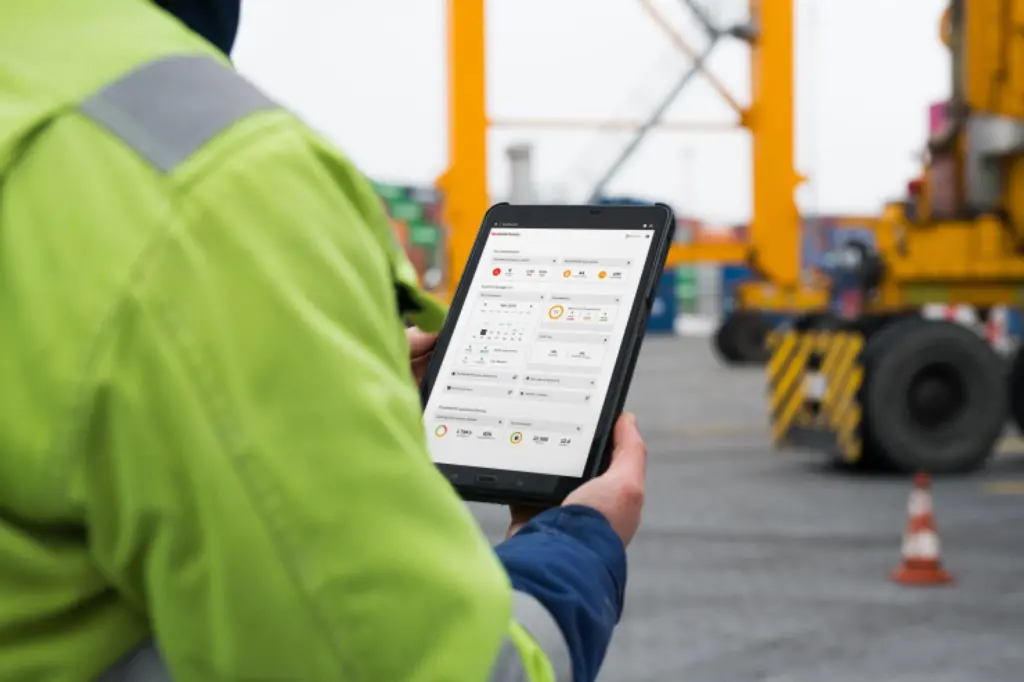
As terminal equipment becomes ever more technologically sophisticated and digitally connected, manufacturers and consultants agree that the maintenance aspect of this equipment has become just as important as the hardware itself, specifically when looking at the total cost of ownership.
“Maintenance, particularly preventive maintenance procedures, is becoming more and more essential to save costs and improve reliability,” says Alexander Koschinsky, Consultant and Project Engineer at Hamburg Port Consulting (HPC).
However, he emphasises, this is not a case of ‘one size fits all’ – as well as type and range of equipment, factors such as operational times, automation levels and even the weather conditions can mean that the right maintenance strategy differs from the standard manufacturers’ recommendations.
“When we talk to our customers, we always stress the need to have an applicable maintenance procedure. You can’t copy and paste from one terminal to another.”
The first and overall responsibility for customer support remains with the crane/equipment manufacturer, says Koschinsky: “The manufacturer must provide maintenance procedures for the specific equipment and of course these will vary; every manufacturer has different subcontractors, system components suppliers, and so on. Generally, if the manufacturer says they should do a particular inspection after three months, one year or a certain amount of operational time, the terminals will follow these instructions. However, when terminals come to us and ask ‘How can we improve performance and save costs, what can we do even better?’, then we suggest moving to condition-based maintenance or predictive maintenance – applying sensors, monitoring your data, so that you don’t follow specific dates of operational hours only but can even exceed them before service or maintenance work is needed. That way you can avoid wasting money on an early inspection that isn’t necessary.”
Christoph Schoppmann, HPC’s Manager Operations Excellence, says advancements in technology have made new maintenance strategies more viable. Sensors can, for example, monitor any vibration in the gearbox; cameras can check for rope wear.
Different clients adopt different policies, says HPC. One terminal might insist on changing all ropes or wheels at the same time regardless of condition; others take a more analytical approach.
Who is taking the more conservative approach on equipment maintenance? Next to the organisation’s philosophy, it is related to the background and experience of those in charge, Schoppmann concedes. “Younger people generally prefer a more analytic and datacentric approach, not purely relying on some sort of gut feeling. In my mind it requires both – the hands-on knowledge and experience of an equipment operator or mechanic who can see or feel what might happen, and the more data-based approach. Bring it all together.”
However, the days are long gone when a crane was a relatively simple affair that did not necessarily require a specialist to repair. “The technology is getting more and more complex, integrating the (safety) PLCs (programmable logic controllers) with many other technology and system components. If one small part is not working, then the whole thing doesn’t work. Therefore, there is a lot of emphasis on 24/7 support, not only on the mechanical part, but specifically also for the IT maintenance.”
STANDARDISATION AND ACCESSIBILITY
HPC encourages clients to seek standardisation – in a terminal equipped with different batches of cranes, the mechanics of one crane could be entirely different to those of another, throwing up obvious maintenance challenges.
Accessibility is also a priority – the maintenance team must be able to do their work easily. “The maintenance considerations start in the specification phase,” says Koschinksy. “Also, later in the design phase, when we review a set of crane drawings, we will identify if access to all maintenance areas of the crane is ensured for M&R personnel.”
Alongside other services around operations, IT and equipment, HPC provides workshop organisation, planning and design services which ensure that maintenance teams have the tools and the space, height and layout of workshop required.
Finally, terminals will have varying expectations on service levels. “Some are fine if they can achieve 85% availability of equipment; others need 99% to meet the needs of their customer base and frequency of use. Obviously, this means a very different approach to maintenance.”
KONECRANES: CLOSE INTERACTION
The close interaction between equipment sales and maintenance services reflects the increasing complexity of port equipment and the critical role of uptime in terminal operations, says Konecranes.
“While not all equipment buyers opt for comprehensive maintenance packages initially, there’s growing recognition that professional maintenance services are essential for maximising equipment lifespan and performance,” says Neil Griffiths, Service Agreement Director, Konecranes. “The maintenance aspect has become equally important as the hardware itself, particularly as equipment becomes more technologically sophisticated. Modern port equipment requires specialised expertise for maintenance, especially when dealing with automation systems and digital components.”
This is particularly evident in automated terminals, where Konecranes’ SLAs (Service Level Agreements) dedicated to automation software performance have become critical. The company says 65% of the world’s automated terminals are running with Konecranes equipment and these customers recognise that proper maintenance and support are essential for business continuity.
“Given that automated terminals are more dependent on technological systems, and that most system failures cannot be resolved without access to software, development tools and crane control systems, customers in this space are much more likely to invest in comprehensive maintenance partnerships,” says Griffiths.
The interdependence of automation and maintenance has made sophisticated service agreements an operational necessity rather than just an option for automated terminal operators, he notes.
The main terminal equipment maintenance services offered by Konecranes are structured through tiered ‘Lifecycle’ programmes that progress from basic maintenance to advanced fleet management solutions.
At the foundation level, Lifecycle programmes 1 and 2 provide scheduled maintenance with fixed hourly rates, focusing on ensuring equipment reliability through regular service intervals. These include basic digital tools like CheckApp for pre-shift inspections and access to the yourKONECRANES equipment management portal for performance monitoring.
The more advanced Lifecycle 3 and Lifecycle X programmes integrate predictive maintenance capabilities using IIoT (Industrial Internet of Things) sensor networks that monitor critical component conditions in real time. This enables early detection of potential issues before they cause costly breakdowns, says Konecranes. These programmes also use its newly launched remote support services, which connect onsite teams with technicians who can diagnose and guide repairs remotely.
“A significant development is the introduction of performance-based agreements under Lifecycle X, where we share uptime reliability with the customer and billing is tied to actual equipment uptime rather than fixed hours. This uptime guarantee model aligns provider and customer interests around maximising operational availability.”
Digital solutions have become fundamental to effective terminal equipment maintenance, and managing more complex service agreements, says Griffiths. Integrating services such as real-time condition monitoring; data-enabled “Predict & Plan” spare parts services; remote diagnostics and support capabilities; and fleet-wide performance optimisation through aggregated data analysis are a few ways Konecranes has found to enhance equipment performance and terminal efficiency.
The company says AI and machine learning are the next level of technological innovation, that will deliver increasingly better maintenance management insights from the vast datasets equipment fleets are generating. “While digital twin technology shows promise, the focus remains on practical applications of digital tools that deliver immediate value in maintenance operations.”
KALMAR: PREDICTABILITY AND RELIABILITY
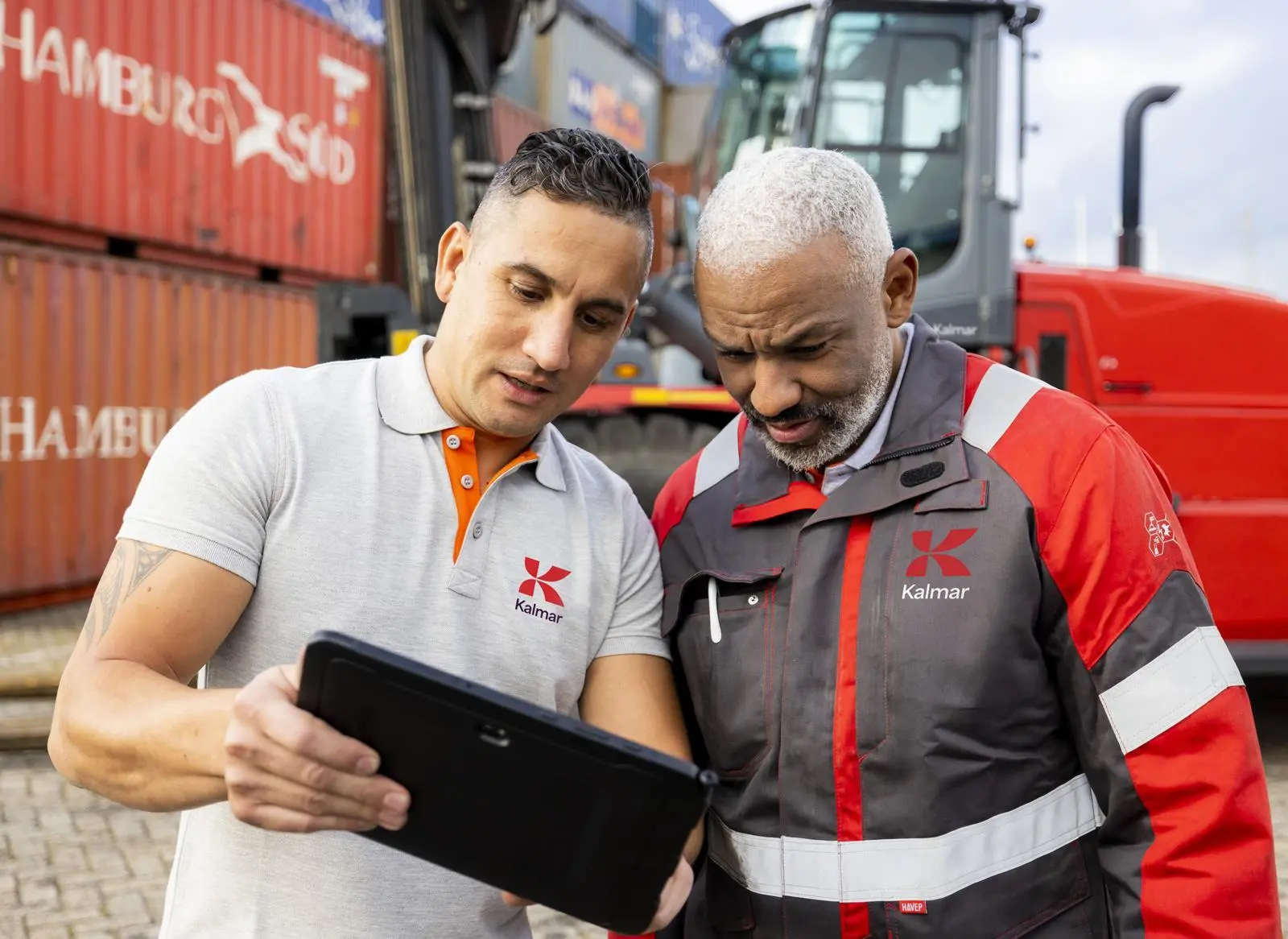
IT, AI and digital solutions are playing an increasingly critical role in terminal equipment maintenance, says Anna Jern-Houttu, VP, Service Solutions at Kalmar. “The industry is shifting from reactive and preventive maintenance to predictive and reliability centred maintenance, using data and AI to optimise performance, reduce downtime and extend equipment lifespan,” she says.
Live diagnostics with MyKalmar INSIGHT is among examples of Kalmar leveraging IT and AI in terminal equipment maintenance, she says. “EMS (Equipment Monitoring System) or Live Diagnostic is an optional feature for MyKalmar INSIGHT, currently available for Kalmar straddle carriers. Customers and technicians are now able to see live diagnostic data, i.e. the real-time comprehensive status of all the devices in a straddle carrier in INSIGHT.”
Meanwhile, MyKalmar STORE, Kalmar’s parts eCommerce solution, is using a digital functionality called iRecommed to inform customers about required maintenance based on machine running hours and parts lifecycle estimation, enhanced by AI. The recommendations are published free of charge for MyKalmar STORE customers, says Jern-Houttu.
Kalmar offers a comprehensive range of terminal equipment maintenance services designed to keep operations running smoothly, minimise downtime and optimise performance. “Our services cover everything from preventive maintenance to on-demand repairs, modernisation and performance management solutions. With a focus on sustainability and operational excellence, we continuously enhance our service offerings to meet the evolving needs of terminal operators. Utilising AI, we are also developing our capability to perform predictive maintenance on the customers’ fleets – to optimise maintenance cost and uptime.”
Kalmar Care offers customers a choice of three customisable service models – Essential Care, Complete Care and On Demand Care, to suit their maintenance needs. Modernisation and upgrade services include software updates, automation enhancements and retrofits. “Kalmar’s extensive range of upgrades is designed to make equipment more productive, safer to operate, more fuel efficient and meet regulatory requirements.”
The company offers performance management services such as real-time monitoring and analytics through MyKalmar INSIGHT, to improve efficiency and decision-making.
“Ports and terminal operators recognise the value of ensuring their equipment runs reliably and efficiently,” says Jern-Houttu. In fact, the availability of relevant services to guarantee uptime is becoming one of the key differentiating factors in our markets.”
Customers invest in Kalmar’s maintenance services to maximise uptime, she notes. “Ports operate in high-demand environments where unexpected downtime can be costly. Kalmar’s preventive maintenance helps in minimizing disruptions.”
Terminal operators are also seeking total cost of ownership savings: “A well-maintained machine lasts longer, runs more efficiently and reduces unplanned repair costs,” says Jern-Houttu, who adds that expert support and genuine parts are critical: “Customers benefit from Kalmar’s global service network, skilled technicians and high-quality OEM parts.”
Is servicing now as important as hardware? “Absolutely! The industry has shifted from simply buying machines to buying solutions that include hardware, software and services. As automation, electrification and digitalisation advance, service agreements and lifecycle support are becoming a critical part of the negotiation.”
Related Articles
 TERMINAL OPERATIONS
 DIGITAL
 DIGITAL