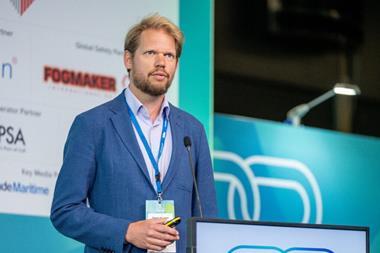
Ralf Garrn explores how PortView’s real-time emissions intelligence allows ports to confidently justify green infrastructure investments, accurately track emission reductions, and shape vessel behavior strategically.


Ralf Garrn,
Managing director
How can PortView help ports demonstrate that investments in shore power, alternative fuels and other green infrastructure are achieving measurable emissions reductions?
Green infrastructure decisions are expensive, and ports increasingly need to justify them to boards, public authorities, local communities and financing partners. The challenge is proving both where the investment is needed and what impact it delivers.
For shore power, ports need more than a headline emissions number. PortView shows how many OPS‑capable vessels are calling, how long they remain at berth, how many are alongside at the same time and how much energy they would draw. This gives ports a realistic view of required capacity by berth, terminal and time of day, and how demand is likely to grow as more vessels become OPS‑ready and regulations tighten towards 2030 for segments such as cruise and container.
The same intelligence is critical for preparing for new fuel and power profiles. As fleets adopt alternative fuels and face stricter zero‑emission‑at‑berth expectations, onboard power demand and emissions patterns will change. Actual reductions depend on how vessels are operated and which fuels they actually burn. PortView helps ports understand which vessel segments will drive future demand for shore power and alternative fuels, what energy volumes will be needed and what the trajectory looks like if infrastructure is not in place in time. The focus is readiness: ensuring the port can meet the new demands of shipping rather than assuming reductions will happen automatically.
The value goes beyond demonstrating the impact of infrastructure once it has been built. PortView also helps ports plan investments with greater confidence by showing where capacity will be needed and where it will have the greatest environmental impact. Once infrastructure is in place, the same continuous data allows ports to demonstrate that it is delivering measurable emissions reductions.
The EU Ports Strategy places greater emphasis on measurable environmental outcomes. How does PortView help ports move beyond emissions reporting to delivering real environmental improvements?
The starting point is continuous, up-to-date emissions intelligence. PortView continuously captures vessel activity and emissions as ships call at the port, giving ports an almost real-time view of how much is being emitted, by which vessel segments, at which berths and during which phases of a call.
That allows ports to see where emissions are concentrated, measure the impact of a new incentive, operational change or infrastructure project as it develops, and understand how emissions evolve over time. Instead of relying on emissions inventories that are updated only periodically, ports have a continuously refreshed picture of environmental performance that supports day-to-day decision-making.
The historical data then provides the context. It establishes a robust baseline against which ports can measure progress, identify long-term trends and demonstrate whether policies and investments are actually delivering measurable environmental improvements.
In practice, this means moving from static reporting to continuous environmental management. A one-off report provides a snapshot. Continuous data shows what is happening today, while historical data demonstrates how performance is changing over time. That is what turns emissions reporting into practical decarbonisation management and supports better decisions on where to focus future effort and investment.
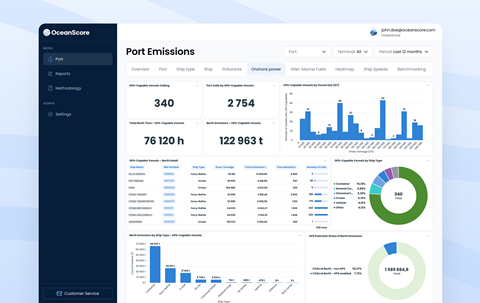
PortView - Track your impact on your environmental port initiatives
How can better emissions intelligence help ports influence vessel behaviour while supporting both sustainability and commercial competitiveness?
Ports cannot directly control which vessels call, which fuels they use or how their fleets are operated. But they can influence behaviour through pricing, incentives, infrastructure and the way they engage with shipping lines.
Better emissions intelligence allows those interventions to be much more targeted. A port can identify which vessel groups contribute most to local air pollution, which ships are ready to use shore power and where environmental incentives are likely to have the greatest effect.
That makes it possible to reward the behaviours the port actually wants to encourage, rather than applying broad and costly incentives without knowing whether they are changing anything. Targeted measures also reduce the risk of unintended commercial side effects, such as penalising lower-impact segments or driving traffic to competing ports.
There is also a clear commercial dimension. Credible environmental programmes can strengthen a port’s position with shipping lines, cargo owners, public authorities and local communities. The objective is not to choose between sustainability and competitiveness. Well-designed incentives and better infrastructure can support both.
How do PortView and the Environmental Shipping Index (ESI) work together to help ports meet compliance requirements and achieve their wider decarbonisation goals?
PortView and the Environmental Ship Index (ESI) address different, complementary aspects of a port’s environmental strategy.
PortView is OceanScore’s emissions‑intelligence solution. It gives the port a continuous view of vessel activity and associated emissions in and around its own port area. This creates a clear, data‑backed picture of how the port performs today, how that is changing over time and where emissions occur. Ports can use these insights to support local air‑quality management, infrastructure planning, regulatory reporting and environmental investment decisions.
ESI, developed by IAPH & administered by OceanScore, is a globally recognised framework that allows ports to reward vessels performing better than the industry standards through voluntary incentive schemes. Its updated methodology is designed to reflect fuel choices, shore‑power use, NOx performance and environmental technologies more closely, giving ports and shipping companies a common reference when they design and apply environmental incentives.
In their decarbonisation strategies, ports that choose to use both keep the two roles clearly separated. PortView is used to understand what is happening locally, where emissions are concentrated and which vessel segments or terminals should be prioritised. ESI provides an established incentive framework that ports can apply if they decide to reward cleaner vessels. In combination, this supports emissions reporting, incentive design, infrastructure planning and transparent communication with stakeholders.
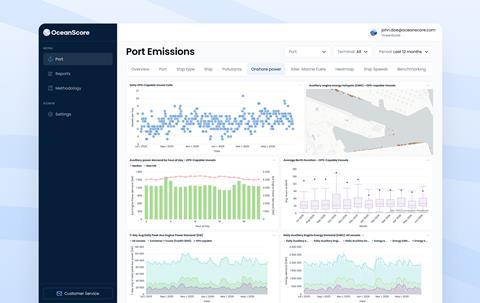
PortView - Vessel emissions data with the click of a button
As environmental expectations continue to grow, what role will continuous emissions data play in helping ports prioritise investment, demonstrate compliance and achieve their long-term sustainability objectives?
Continuous emissions data will increasingly become part of how ports make investment and strategy decisions.
Without it, infrastructure planning is based on assumptions, limited samples or reports that may already be outdated by the time a decision is made. With a continuous data foundation, ports can see how vessel traffic, fuel choices, berth activity and emissions develop over time.
That helps answer practical questions: Where would shore power have the greatest impact? Which vessel segments are likely to adopt alternative fuels? Which terminals or port areas should be prioritised? Are existing initiatives delivering the expected reductions?
It also gives ports a more defensible way to communicate progress and demonstrate compliance with evolving requirements. Environmental claims can be linked to measurable changes rather than ambitions alone.
Over time, the ports with the strongest data foundation will be better placed to allocate capital, respond to regulation, show that funding has been well spent and adapt their strategy as vessel technologies and fuel choices evolve. Continuous data does not make the decision for the port, but it makes that decision much easier to justify and much less likely to be wrong.